Saturday, July 25, 2026

A Secret Plan to End Trump in November?

Below is an important message from one of our highly valued sponsors. Please read it carefully as they have some special information to share with you.


Dear reader,

A high-level White House insider who’s been a lifelong friend of the Trump family just dropped this bombshell about the midterm elections.

In short, he’s exposing the biggest political political betrayal in America’s history.

Just listen to what a Republican party insider said recently on social media….

“I'm excited to share some credible inside information on the Democrats and some Republicans secret plan to end Trump's reign.”

Click here to see the details because this could have a major impact on your wealth in the coming months and years.

Regards,

Aaron Gentzler
VP of Research, Paradigm Press


Additional Reading from MarketBeat Media

The AI Data Center Boom Is Bigger Than One Stock—These ETFs Spread the Bet

Submitted by Nathan Reiff. First Published: 7/17/2026.

Data center building at dusk with illuminated network light trails and solar panels in the foreground.

Key Points

  • Investors can access the data center theme through ETFs that hold REITs, infrastructure companies, semiconductor names and power-related suppliers.
  • The Global X Data Center & Digital Infrastructure ETF offers concentrated exposure to data center REITs and related digital infrastructure companies.
  • The VanEck Data Center Supply Chain ETF is a newer fund that broadens the theme beyond real estate into chips, cooling, power and electrical equipment.
  • Special Report: SpaceX is offering you shares. Don't take them.

Though a handful of companies have emerged as frequent topics of conversation in AI, investors would do well to remember that the industry is still very much in a developmental phase. It's possible, and even likely, that the list of leading AI companies in the coming years will differ from today's. This is just as true of data center companies as any others within the industry, particularly given potential changes to regulations, shifting public opinion on data centers, and the possible impact of new technology.

Investors can approach the data center industry in multiple ways, including individual stocks,real estate investment trusts (REITs), and exchange-traded funds (ETFs). The last of these options may be best for those seeking diversified exposure to the space without making too specific a bet on any one company. This approach may also suit investors who want to lean into the data center trend without the burden of closely tracking every new update and advance.

A Combination of REITs and Individual Tech Stocks With DTCR

The quietest monopoly in energy (Ad)

One company has spent 60 years developing an energy source the International Energy Agency estimates at 140 times global electricity demand - with zero competition.

Last year, their crew drilled in 16 days what the government projected would take 64. Now Google has a 15-year deal locked in, Bill Gates has committed $100 million, and the Pentagon has made it a top priority. On August 18th, a new Washington policy adds another advantage rivals cannot match.

See the full story behind the 60-year energy monopolytc pixel

One of the most prominent ETFs in the data center space is the Global X Data Center & Digital Infrastructure ETF (NASDAQ: DTCR). DTCR tracks an index of companies operating data centers and other digital infrastructure, including firms in both the real estate and information technology sectors. More than half of DTCR's assets are dedicated to REITs, with other notable portions of the portfolio allocated to semiconductor stocks and software names.

DTCR is primarily a U.S.-focused fund, with about three-quarters of its assets invested in domestic equities. It also holds stocks based in China, Australia, South Korea, and elsewhere, making it a good option for investors seeking a domestic core with some international exposure as well. Although DTCR holds 28 stocks, a small handful of oversized positions dominate the portfolio.

DTCR's performance has excelled this year, with the fund returning over 30% in 2026. That may entice investors otherwise wary of the fund's annual fee of 0.50%, which is quite high compared with most passively managed ETFs.

Leaning Toward Real Estate Brings Higher Dividend Yield

The Pacer Benchmark Data & Infrastructure Real Estate SCTR ETF (NYSEARCA: SRVR) adopts a similar approach to DTCR, following an index composed of companies in the global data and tech infrastructure space, including data center REITs. To be included in the portfolio, firms must generate at least half of their revenues from power generation, digital infrastructure, and connectivity systems. The firms are weighted using a modified market capitalization approach.

The result is a portfolio of 75 names, considerably broader than DTCR, but similarly concentrated at the top with a handful of prominent positions. SRVR leans even more heavily toward real estate investments, with this segment of the portfolio accounting for more than 62% of the fund. With a focus on REITs comes an added dividend benefit, and the fund offers a dividend yield of 2.79%.

Year to date (YTD), this fund has returned nearly 8%, which is less than the broader market but still fairly impressive considering the AI-related sell-off that has taken place in recent weeks. At an expense ratio of over 0.50%, the fee may be on the high side, but investors anticipating a resurgence in the space may find it worthwhile for the potential of stronger returns.

A New Means of Accessing Data Center Supply Chains

One of the most recent additions to the data center ETF space is the VanEck Data Center Supply Chain ETF (BATS: RACK). This fund launched in June 2026, meaning it is still in its earliest stages of growth and has relatively low assets and trading volume for now. Still, compared with the real estate-focused funds above, RACK offers a unique way to play the data center industry that may appeal to investors seeking a broader view of the supply chain.

RACK tracks an index of data center supply chain firms involved in building, operating, and powering modern data centers. That includes companies that build software and hardware, as well as those providing building and contracting services, electrical support, power management, and more. The 51 companies making up RACK's portfolio are relatively evenly weighted, with no single name recently accounting for more than 5% of the basket.

This fund's expense ratio of 0.50% is in line with the other two offerings on this list. Because it is so new, it's difficult to assess the ETF's performance so far, so it does present somewhat more risk for investors.


Additional Reading from MarketBeat Media

Which Storage Stock Is Best Positioned to Win the AI Memory War?

Submitted by Nathan Reiff. First Published: 7/16/2026.

Rows of server racks with blue network cables and storage drives in a data center aisle.

Key Points

  • Seagate, Western Digital, and Sandisk have each posted strong revenue growth and rising margins amid memory industry volatility and surging AI demand.
  • Shares of all three companies have rallied dramatically year to date, with analysts maintaining mostly Buy ratings and additional upside targets despite recent price swings.
  • Rising competition, including China's ChangXin Memory Technologies' pending IPO, could reshape the memory storage landscape even as demand for HDDs and SSDs remains robust.
  • Special Report: SpaceX is offering you shares. Don't take them.

Continued supply shortages, sharp price increases, surging AI demand, and persistent competition in international markets have all contributed to volatility in the computer memory industry. With the impending IPO of China's ChangXin Memory Technologies, the landscape is likely to become even more competitive and uncertain in the near term. Still, many tech firms are scrambling to secure supply despite the intensifying marketplace and new competition.

The result is an environment that could benefit many participants in the memory storage space, although for different reasons. Makers of hard disk drives (HDDs) face different challenges and opportunities than companies behind NAND flash tools or enterprise solid-state drives (SSDs), for instance. This means that companies including Seagate Technology (NASDAQ: STX), Western Digital Corp. (NASDAQ: WDC), and Sandisk Corp. (NASDAQ: SNDK) can all find a niche and, potentially, room for further share price appreciation.

Seagate's HDD Business Soars, But What Upside Remains?

The quietest monopoly in energy (Ad)

One company has spent 60 years developing an energy source the International Energy Agency estimates at 140 times global electricity demand - with zero competition.

Last year, their crew drilled in 16 days what the government projected would take 64. Now Google has a 15-year deal locked in, Bill Gates has committed $100 million, and the Pentagon has made it a top priority. On August 18th, a new Washington policy adds another advantage rivals cannot match.

See the full story behind the 60-year energy monopolytc pixel

Seagate is a major manufacturer of HDDs, which are increasingly popular among hyperscalers because they remain cheaper alternatives to some other types of memory products. The company is also an emerging leader in heat-assisted magnetic recording (HAMR), an advanced technology that may be poised for a surge in demand in the coming years.

This positioning has benefited Seagate's financial performance considerably: in the latest quarter, the company grew revenue by 44% year over year (YOY) to $3.1 billion while achieving a non-GAAP gross margin of 47%. Both top- and bottom-line performance came in well ahead of analyst expectations, as the firm beat predictions for earnings per share (EPS) by a solid 59 cents. HAMR momentum in particular helped drive some of these gains.

Strong guidance for the foreseeable future and a long-term revenue growth target of at least 20% per year suggest that Seagate may be able to continue riding this momentum, which has already contributed to shares coming close to tripling year to date (YTD). Even so, analysts expect additional upside, with a consensus price target close to $899, and 22 of 27 ratings for STX are Buys.

What investors might watch out for with this stock is its potential for future growth, given its dramatic rally in recent months, as well as its heavy reliance on HDDs and related technologies.

Western Digital's Cleaner Post-Spin-Off Business Finds Its Legs

Western Digital has had almost a year and a half since officially spinning off Sandisk as a separate company focused on flash memory and SSDs. The result is a company streamlined to focus on enterprise HDDs, with strong pricing and improving profitability metrics. While the firm is likely behind Seagate in its ability to commercialize HAMR products and has a smaller share of the enterprise HDD space, its long-term agreements provide strong support for years to come.

In the most recent quarter, Western Digital boosted revenue by 45% YOY to $3.3 billion while almost doubling EPS over the same period. Its gross margin of 50.5% is also notable, as the firm was able to cut more than $3 billion in debt and generated close to $1 billion in free cash flow. At the same time, Western Digital has been aggressive about shareholder returns, repurchasing $752 million in stock last quarter and boosting its dividend in the process.

Like STX, WDC shares have almost tripled YTD, and analysts suspect that this momentum may have stalled somewhat. Still, 20 out of 24 call WDC a Buy heading into the second half of the year.

Sandisk Stock Remains in Focus After Its Spin-Off

Investors considering Western Digital will also want to look at how Sandisk has fared after the spin-off. SNDK shares are up some 458% YTD, a massive rally to be sure, but they have fallen by more than 27% in the last month. This volatility makes SNDK stand out somewhat in the memory space, but it could also present opportunities for investors willing to accept the risk.

On the business side, Sandisk has performed exceptionally well: the latest quarter brought several multi-year new business agreements worth tens of billions of dollars, 251% YOY revenue improvement to nearly $6 billion, adjusted free cash flow of almost $3 billion, and gross margin of 78.4%. Management sees a strong quarter ahead as well, including revenue between $7.75 billion and $8.25 billion and gross margin as high as 81%. The company is also engaging in a massive share buyback program.

It says a lot about how well Sandisk has performed that even after its massive rally, Wall Street still sees 17% in possible upside. In terms of ratings, 21 Buys and five Holds suggest a very bullish perspective among analysts, making SNDK a standout even within a strong industry.

Thank you for subscribing to The Early Bird, MarketBeat's 7:00 AM newsletter that covers stories that will impact the stock market each day.
 
This email content is a sponsored email from Paradigm Press, a third-party advertiser of The Early Bird and MarketBeat.
 
If you need assistance with your subscription, please contact MarketBeat's U.S. based support team at contact@marketbeat.com.
 
If you no longer wish to receive email from The Early Bird, you can unsubscribe.
 
© 2006-2026 MarketBeat Media, LLC. All rights reserved.
345 N Reid Place, Sixth Floor, Sioux Falls, S.D. 57103-7078. U.S.A..
 
Read More: Final Weeks to Invest 

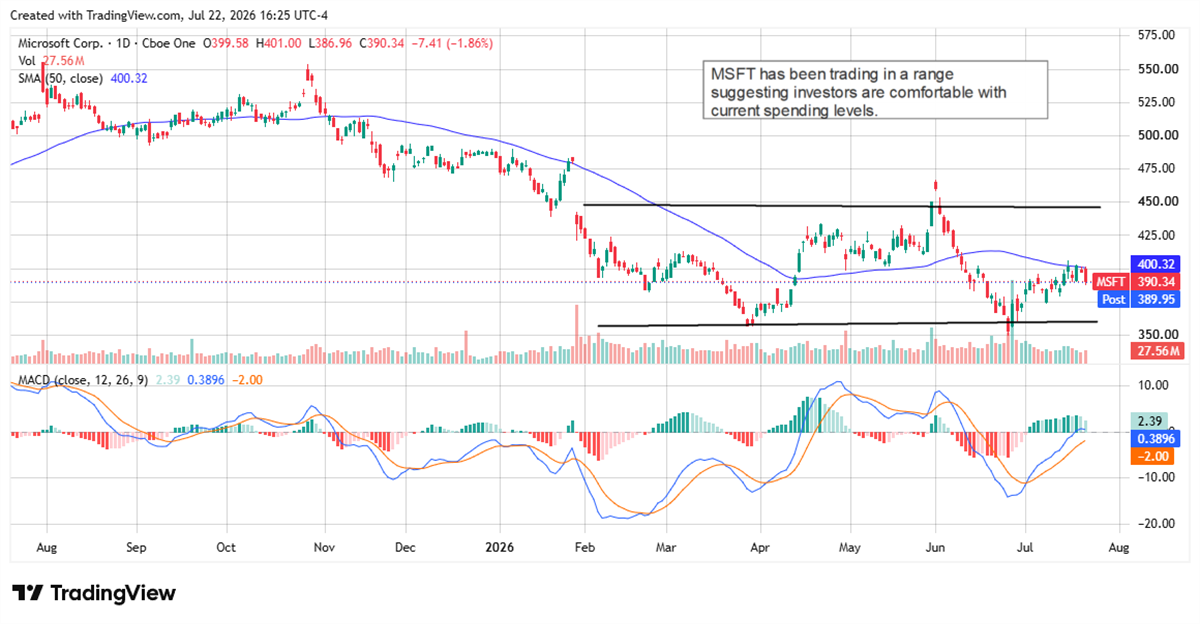
Key Numbers for Microsoft Earnings Are CapEx and Azure Growth

Here’s Why Trump Won’t End The Iran War

Dear Reader,

They declared a ceasefire!

Until they didn’t.

Then Trump said we were about to sign a deal.

Until we started shooting at each other again.

According to one source, Trump has said an Iran deal is “close” 38 times since the war began.

In the time between writing this message and you reading it, who knows whether we’ll be hearing about an imminent deal… or more bombing.

And it doesn’t matter.

This is all a distraction.

Here’s the REAL reason why Trump may NEVER end this war.

To your future,

Addison Wiggin

Founder, Grey Swan Investment Fraternity


Bonus News from MarketBeat.com

Delta Air Lines Lives Up to Its Claims: Shares Can Keep Climbing

Reported by Thomas Hughes. Article Posted: 7/12/2026.

Delta Air Lines logo displayed over a close-up of the airline's aircraft fuselage, tail, and engine against a blue sky.

Key Points

  • Delta Air Lines reported strong Q2 2026 results with revenue up 30.3% and raised guidance, prompting 27 analysts to maintain a consensus Moderate Buy rating with an 89% Buy-side bias.
  • Analysts have set price targets between $110 and $116, representing a fresh all-time high, while institutional investors own 70% of shares and continue accumulating.
  • Despite a price pullback and risks from rising costs and a C-suite transition, Delta's cash flow, debt reduction, and dividend growth support an intact uptrend.
  • Special Report: Forget SpaceX. Buy the company Musk can't replace.

Delta Air Lines (NYSE: DAL) lived up to its motto, with Q2 2026 earnings results showing strength and suggesting the stock can keep climbing. Drivers include outperformance from international demand, broad-based demand, premiumization, and structural cost advantages, all of which support strong cash flow.

The critical detail in the release was guidance, which suggests these trends will continue. More importantly, guidance was raised, prompting a strong response from analysts.

The quietest monopoly in energy (Ad)

One company has spent 60 years developing an energy source the International Energy Agency estimates at 140 times global electricity demand - with zero competition.

Last year, their crew drilled in 16 days what the government projected would take 64. Now Google has a 15-year deal locked in, Bill Gates has committed $100 million, and the Pentagon has made it a top priority. On August 18th, a new Washington policy adds another advantage rivals cannot match.

See the full story behind the 60-year energy monopolytc pixel

While no upgrades or price target revisions were tracked in the first hours after the release, several commentaries did hit the wires. Analyst commentary reaffirms the strong trends, including numerous initiations, upgrades, and price target increases ahead of Delta’s earnings release on July 10.

As it stands, MarketBeat tracks 27 analysts rating DAL as a consensus Moderate Buy. Coverage is up versus the prior month, quarter, and year, with sentiment firming and an 89% buy-side bias in the data. The consensus price target assumes fair value near the early-July highs, but the trend matters more. Recent revisions place this market in the high-end range, between $100 and $116, which would mark a fresh all-time high if reached.

Delta’s July Pullback: A Touch-and-Go Event, Buy the Dip

Delta’s price pullback reflects a market that was expecting strength, as the Q2 results and guidance delivered exactly that. Revenue growth accelerated sequentially and year over year, posting a robust 18.7% gain and topping expectations.

Delta’s strength was evident across metrics, supported by just a 1% increase in capacity. Total revenue per average seat mile (TRASM) grew 12.4%, with strength in the main cabin and premium segments, which rose 17%. Domestic revenue increased 12% and international revenue 8%, while cargo rose 39% and maintenance services climbed 32%. Loyalty, a forward-looking indicator, grew 19%, and corporate traffic grew by double digits.

While margin contracted in the quarter, and slightly more than expected, the decline was minimal. More importantly, top-line strength carried through to the bottom line, leaving adjusted earnings per share of $1.56 ahead of forecasts by 400 basis points. Looking ahead, the company expects strength to continue and reaffirmed its guidance. The key takeaways are that free cash flow and capital returns should continue, and that guidance may still be conservative. Travel trends remain robust across leisure and business segments, potentially helped by falling energy prices.

Delta’s Cash Flow Recovery Story Takes Flight

Delta’s stock recovery is underpinned by growth but, more importantly, by the cash flow it produces. Drivers of the share price include persistent debt reduction, improving investment-grade balance sheet quality, and capital returns to shareholders.

Q3 capital returns included dividends but no share buybacks, with the dividend annualizing to about 1%. The payout ratios show no red flags for investors, as the company is positioned to continue executing its strategy while increasing its dividend annually. Balance sheet highlights include higher cash, lower debt, and improving equity, with equity up 4.6% year to date.

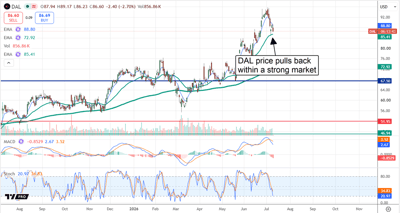
Institutional activity reflects the potential in a DAL investment. The group owns a substantial 70% of the stock and has been accumulating at nearly a 2-to-1 pace over the trailing 12 months. That provides a solid support base and market tailwind that is likely to remain in place given the guidance. In this scenario, DAL’s share price may continue pulling back in Q3, but downside appears limited, and higher prices are likely by year-end. Critical support levels are near $85 and $80; lower lows are unexpected.

Delta’s risks center on cost controls and execution. Costs, including labor, continue to rise while a major C-suite transition is underway. Two retirements and one executive’s departure for new opportunities resulted in several promotions and consolidated roles. The risk lies in disruptive hiccups tied to the role changes, especially during the upcoming seasonal shift. If Delta fails to match capacity to demand, it risks losing pricing power, which would be detrimental to both top- and bottom-line results. Over the longer term, Delta is expected to sustain modest growth over the next five years.

DAL chart showing a price pullback within an otherwise strong market.

The stock price action remains favorable despite the early Q3 pullback. Delta is rising on a wave of strength, cash flow, and dividends that has yet to fully play out, leaving the underlying uptrend intact. The likely outcome is that support kicks in at or near the early July lows, leading to a trend-following signal and a price rebound later this year. Signals of strength include MACD convergence on the weekly chart, suggesting the latest highs will at least be retested, along with support at the 30-day exponential moving average.


Bonus News from MarketBeat.com

The AI Data Center Boom Is Bigger Than One Stock—These ETFs Spread the Bet

Reported by Nathan Reiff. Article Posted: 7/17/2026.

Data center building at dusk with illuminated network light trails and solar panels in the foreground.

Key Points

  • Investors can access the data center theme through ETFs that hold REITs, infrastructure companies, semiconductor names and power-related suppliers.
  • The Global X Data Center & Digital Infrastructure ETF offers concentrated exposure to data center REITs and related digital infrastructure companies.
  • The VanEck Data Center Supply Chain ETF is a newer fund that broadens the theme beyond real estate into chips, cooling, power and electrical equipment.
  • Special Report: Forget SpaceX. Buy the company Musk can't replace.

Though a handful of companies have emerged as frequent topics of conversation in AI, investors would do well to remember that the industry is still very much in a developmental phase. It's possible, and even likely, that the list of leading AI companies in the coming years will differ from today's. This is just as true of data center companies as any others within the industry, particularly given potential changes to regulations, shifting public opinion on data centers, and the possible impact of new technology.

Investors can approach the data center industry in multiple ways, including individual stocks,real estate investment trusts (REITs), and exchange-traded funds (ETFs). The last of these options may be best for those seeking diversified exposure to the space without making too specific a bet on any one company. This approach may also suit investors who want to lean into the data center trend without the burden of closely tracking every new update and advance.

A Combination of REITs and Individual Tech Stocks With DTCR

The quietest monopoly in energy (Ad)

One company has spent 60 years developing an energy source the International Energy Agency estimates at 140 times global electricity demand - with zero competition.

Last year, their crew drilled in 16 days what the government projected would take 64. Now Google has a 15-year deal locked in, Bill Gates has committed $100 million, and the Pentagon has made it a top priority. On August 18th, a new Washington policy adds another advantage rivals cannot match.

See the full story behind the 60-year energy monopolytc pixel

One of the most prominent ETFs in the data center space is the Global X Data Center & Digital Infrastructure ETF (NASDAQ: DTCR). DTCR tracks an index of companies operating data centers and other digital infrastructure, including firms in both the real estate and information technology sectors. More than half of DTCR's assets are dedicated to REITs, with other notable portions of the portfolio allocated to semiconductor stocks and software names.

DTCR is primarily a U.S.-focused fund, with about three-quarters of its assets invested in domestic equities. It also holds stocks based in China, Australia, South Korea, and elsewhere, making it a good option for investors seeking a domestic core with some international exposure as well. Although DTCR holds 28 stocks, a small handful of oversized positions dominate the portfolio.

DTCR's performance has excelled this year, with the fund returning over 30% in 2026. That may entice investors otherwise wary of the fund's annual fee of 0.50%, which is quite high compared with most passively managed ETFs.

Leaning Toward Real Estate Brings Higher Dividend Yield

The Pacer Benchmark Data & Infrastructure Real Estate SCTR ETF (NYSEARCA: SRVR) adopts a similar approach to DTCR, following an index composed of companies in the global data and tech infrastructure space, including data center REITs. To be included in the portfolio, firms must generate at least half of their revenues from power generation, digital infrastructure, and connectivity systems. The firms are weighted using a modified market capitalization approach.

The result is a portfolio of 75 names, considerably broader than DTCR, but similarly concentrated at the top with a handful of prominent positions. SRVR leans even more heavily toward real estate investments, with this segment of the portfolio accounting for more than 62% of the fund. With a focus on REITs comes an added dividend benefit, and the fund offers a dividend yield of 2.79%.

Year to date (YTD), this fund has returned nearly 8%, which is less than the broader market but still fairly impressive considering the AI-related sell-off that has taken place in recent weeks. At an expense ratio of over 0.50%, the fee may be on the high side, but investors anticipating a resurgence in the space may find it worthwhile for the potential of stronger returns.

A New Means of Accessing Data Center Supply Chains

One of the most recent additions to the data center ETF space is the VanEck Data Center Supply Chain ETF (BATS: RACK). This fund launched in June 2026, meaning it is still in its earliest stages of growth and has relatively low assets and trading volume for now. Still, compared with the real estate-focused funds above, RACK offers a unique way to play the data center industry that may appeal to investors seeking a broader view of the supply chain.

RACK tracks an index of data center supply chain firms involved in building, operating, and powering modern data centers. That includes companies that build software and hardware, as well as those providing building and contracting services, electrical support, power management, and more. The 51 companies making up RACK's portfolio are relatively evenly weighted, with no single name recently accounting for more than 5% of the basket.

This fund's expense ratio of 0.50% is in line with the other two offerings on this list. Because it is so new, it's difficult to assess the ETF's performance so far, so it does present somewhat more risk for investors.

Thank you for subscribing to Insider Trades Daily, which covers the most recent insider buying and selling activity from Wall Street CEO's, CFO's, COO's and other insiders.
 
This email is a paid sponsorship sent on behalf of Banyan Hill Publishing, a third-party advertiser of InsiderTrades.com and MarketBeat.
 
 
If you would like to unsubscribe from receiving offers for Strategic Fortunes, please click here.
 
 
If you need assistance with your newsletter, please email MarketBeat's South Dakota based support team at contact@marketbeat.com.
 
If you no longer wish to receive email from InsiderTrades.com, you can unsubscribe.
 
© 2006-2026 MarketBeat Media, LLC. All rights protected.
345 N Reid Place #620, Sioux Falls, S.D. 57103. United States of America..
 
Read More: Final Weeks to Invest 

Page List

Blog Archive

Search This Blog

Summer-ready, wherever you roam

Shop essentials for travel, outdoors, and everything in between.  ͏  ͏  ͏  ͏  ͏  ͏  ͏  ͏  ͏  ͏  ͏  ͏  ͏  ͏  ͏  ͏  ͏  ͏  ͏  ͏  ͏  ͏  ͏  ͏ ...