Thursday, February 19, 2026

Start the season off strong and save

Book today, prices rise February 28
 ͏ ͏ ͏ ͏ ͏ ͏ ͏ ͏ ͏ ͏ ͏ ͏ ͏ ͏ ͏ ͏ ͏ ͏ ͏ ͏ ͏ ͏ ͏ ͏ ͏ ͏ ͏ ͏ ͏ ͏ ͏ ͏ ͏ ͏ ͏ ͏ ͏ ͏ ͏ ͏ ͏ ͏ ͏ ͏ ͏ ͏ ͏ ͏ ͏ ͏ ͏ ͏ ͏ ͏ ͏ ͏ ͏  ͏ ͏ ͏ ͏ ͏ ͏ ͏ ͏ ͏ ͏ ͏ ͏ ͏ ͏ ͏ ͏ ͏ ͏ ͏ ͏ ͏ ͏ ͏ ͏ ͏ ͏ ͏ ͏ ͏ ͏ ͏ ͏ ͏ ͏ ͏ ͏ ͏ ͏ ͏ ͏ ͏ ͏ ͏ ͏ ͏ ͏ ͏ ͏ ͏ ͏ ͏ ͏ ͏
No excuses. No waiting. Just action.

The 2026 season is here, and it's time to commit. The clock is ticking—lock in your next race before February 28 and secure the best price.

From brutal Ultra climbs to stadium sprints on your favorite team's home turf, we've packed the calendar with races designed to test your limits. Pick your battleground, show up, and prove to yourself that you're tougher than you think.

Sign up now. Become unbreakable.
Race a 5K in stadiums around the country.
Get a taste of the Spartan life with a 5K and 20 obstacles.
Level up to a 10K packed with 25 grueling obstacles.
Push yourself even further in a 21K with 30 obstacles.
 
Prove you have what it takes to conquer a 50K with 60 obstacles.
Join the toughest of the tough and tackle a 4-hour, 12-hour, or 24-hour Hurricane Heat.
 
Explore thrilling new destinations and take on a Spartan Trail.
TRAIN EAT APP TEAMS

Army Doctrine Writers Embrace AI to Speed Knowledge to Force

Left
U.S. War Department: News
Army Doctrine Writers Embrace AI to Speed Knowledge to Force
Feb. 19, 2026 |  By Randi Stenson, Mission Command Center of Excellence 

The process of writing Army doctrine, traditionally measured in years, is getting a 21st-century upgrade. Thanks to digital tools, some enabled by artificial intelligence, authors at the Combined Arms Doctrine Directorate are examining processes and gaining efficiencies without sacrificing their high standards for quality and precision.


"We have had people ask us about using AI and large language models to speed up the doctrine development process for years," said Richard Creed Jr., CADD director. "So, when some of these tools became available, the first thing we did was figure out their capabilities. That meant that we needed to identify people on our team with some AI experience from using civilian applications who could help us figure out what was possible."  
 
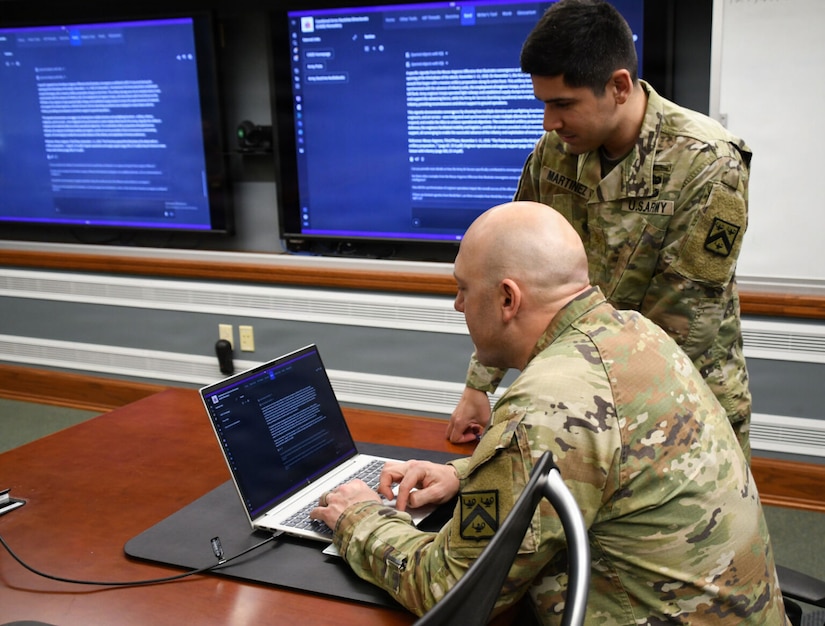
Two officers, Army Lt. Col. Scott McMahan, a doctrine writer assigned to the Operational Level Doctrine Division, and Army Maj. Matthew Martinez, CADD's information management officer, took guidance from leaders and developed a four-pronged strategy to equip every doctrine writer with the skills and tools to use AI effectively. The strategy began with foundational training for all CADD members, allowing them to apply approved AI tools to their work immediately.
 
To foster expertise, the plan also calls for training a "master gunner," someone highly qualified in using AI tools, within each doctrine division. These experts can then help their teams tackle more difficult challenges and find advanced applications for the technology. Furthering the integration, AI best practices are being formally incorporated into the Doctrine Developer's Course, ensuring future writers are introduced to these techniques from the start.  
 
Finally, CADD leaders are working with the Combined Arms Command and industry partners to build a purpose-made AI tool. This new software will be designed for all Army doctrine writers, but it will be especially helpful to authors at the Centers of Excellence, where personnel and time are often scarce.
 
According to McMahan, the answer is not in "letting AI write the books" that guide the force. Instead, it is about providing human experts with powerful new assistants.  

"You treat it like a resourceful and motivated young officer who might not know all the information, but they can certainly assist you in cutting some corners and being a little more efficient," he said. "The bottom line is that eventually it should, even if you're just shaving at the margins, it's going to speed up the time when doctrine will reach soldiers in the field."
 
Creed said his guidance was always to treat technology as a tool, not a panacea.


"Because we have such good people, I expected that we would stay abreast of developments and be ready when the tools were ready," he said. "They came up with an approach that would make one person in each doctrine division an AI subject matter expert while training everyone else in the basic use of AI for tasks related to their job. It was no different than ensuring all soldiers are combat lifesavers while assigning an actual medic to each platoon."  
 
So far, changes have been small, but they add up when looking at multiple individual and project tasks. One example is an internally developed tool that enables writers to quickly search across hundreds of texts for historical vignettes that illustrate a complex doctrinal point. This task could once have taken days of research, especially for a new doctrine author.
 
"The large language model tools under development now have access to the databases we needed access to in the past. Access to the data is the foundational measure of whether the tools are useful to us. We tip our hats to those who figured out how to do that," Creed said.  
 
Another use of AI is something McMahan calls "breaking the blank page." The tool can help writers get through creative blocks and generate ideas.  

" we were looking for some more meat for an idea, we were able to feed this tool some initial thoughts, and of the three paragraphs it spit out, one sentence was used, but that was a really powerful and useful sentence," he said.  
 
Blending technology and in-house experience is reducing administrative burdens for doctrine authors and staff in several ways. For instance, digital tools that assist with grammar and readability free authors to focus on the complex aspects of their work, which in turn saves valuable time for CADD's high-demand editors. This efficiency extends beyond writing, as leaders have improved the publications tracking process with automated forms and the use of power business intelligence tools, and individuals are creating their own self-study tools to prepare for internal certification.  
 
McMahan recognizes that the technology is not perfect, but notes that it is improving over time. He said that AI models can "hallucinate" by inventing facts or confusing source materials when asked a question. These are critical flaws in a field where accuracy is paramount. In one case, an AI-generated question for a doctrine test was based on an outdated manual, an error that was only caught because the user creating the test was an expert on the topic.  
 
Situations like this drive home the importance of subject matter expertise.  

"We made it perfectly clear that AI tools were not intended to be a crutch for not doing the work we expect from our people," Creed said. "Humans will review every line of what a produces for accuracy. To make sure that happens, one must make sure your people know their business."  

Right


ABOUT   NEWS   HELP CENTER   PRESS PRODUCTS
Facebook   X   Instagram   Youtube

Unsubscribe | Contact Us


This email was sent to stevenmagallanes520.nims@blogger.com using GovDelivery Communications Cloud on behalf of: U.S. Department of War
1400 Defense Pentagon Washington, DC 20301-1400

Le secrétaire d’État Marco Rubio à la réunion du Conseil de la paix

Department of State United States of America

Traduction fournie par le département d'État des États-Unis à titre gracieux


Département d'État des États-Unis
Marco Rubio, secrétaire d'État des États-Unis
Institut Donald J. Trump pour la paix
Washington
Le 19 février 2026
Allocution

Je serai concis et direct. Nous souhaitons parler brièvement de la vision stratégique de cette organisation et commencer par reconnaître que nous sommes ici, aujourd'hui, parce que le président – le président des États-Unis, Donald J. Trump, a à la fois la capacité et la volonté d'user du pouvoir de sa fonction pour sortir des sentiers battus. C'est la raison pour laquelle nous sommes ici, aujourd'hui. La crise à Gaza était unique en son genre, une crise que les institutions internationales existantes n'étaient parvenues ni résoudre ni à comprendre. Elle nécessitait une solution très spécifique, qui exigeait le partenariat de tous les pays présents ici, y compris ceux ayant le statut d'observateur, et nous vous remercions d'être venus aujourd'hui et de participer à cet événement.

C'est le message que je souhaite faire passer aujourd'hui, et vous entendrez bientôt Steve et Jared, qui, soit dit en passant, méritent une reconnaissance exceptionnelle pour leur accomplissement, leurs innombrables heures de travail et déplacements à travers le monde. Ils méritent vraiment notre reconnaissance et nos remerciements pour les efforts qu'ils ont déployés, sous le leadership du président Trump, afin de rendre cela possible.

La situation à Gaza était impossible à résoudre de manière orthodoxe, avec les structures existantes. Nous avons donc demandé à l'ONU et obtenu son accord en vue de constituer ce groupe et réunir ces pays pour trouver une solution très spécifique, des solutions, à un problème très particulier et spécifique. Nous avons encore un long chemin à parcourir. Il reste beaucoup de travail à accomplir. Cela nécessitera la contribution de tous les États-nations représentés ici, aujourd'hui, et nous vous remercions de votre participation. J'espère que cela… Nous espérons que cela pourra servir de modèle pour d'autres situations complexes et difficiles afin qu'elles puissent être résolues de la même manière, mais pour l'instant, nous nous concentrons sur celle-ci. Nous devons faire les choses bien. Il n'y a pas de plan B pour Gaza. Le plan B, c'est le retour à la guerre. Personne, ici, ne souhaite cela.

Le Plan A, la seule voie possible, consiste à reconstruire Gaza dans une perspective de paix pérenne et viable, où chacun pourra vivre côte à côte sans jamais craindre le retour du conflit, de la guerre, de la souffrance humaine et de la destruction.

Une fois encore, Monsieur le Président, merci d'avoir eu la vision et le courage de poursuivre quelque chose qui n'avait jamais été fait auparavant, et nous n'avons pas encore terminé. Je remercie également Steve Witkoff et Jared Kushner pour le temps et le travail qu'ils ont consacrés à ce projet. Au nom du département d'État des États-Unis et du gouvernement des États-Unis, je remercie tous les pays présents ici. Chacun d'entre vous est indispensable, y compris nos partenaires observateurs, qui, nous l'espérons, trouveront le moyen de se joindre à nous à un moment donné en tant que membres officiels, mais nous vous sommes reconnaissants d'être ici aujourd'hui et de la contribution que vous avez déjà apportée. Merci.

(Applaudissements)


Voir le contenu d'origine : https://www.state.gov/releases/office-of-the-spokesperson/2026/02/secretary-of-state-marco-rubio-at-the-board-of-peace-event/
Nous vous proposons cette traduction à titre gracieux. Seul le texte original en anglais fait foi.


This email was sent to stevenmagallanes520.nims@blogger.com using GovDelivery Communications Cloud on behalf of: Department of State Office of International Media Engagement · 2201 C Street, NW · Washington, DC · 20520 GovDelivery logo

Drug Trafficking News Update

U.S. Department of Justice

Offices of the United States Attorneys

You are subscribed to Drug Trafficking news updates. This information has recently been updated, and is now available.

02/19/2026 07:00 AM EST

Geno Cassell Smith, 64, of Chesapeake, was sentenced today to 10 years in prison for attempted possession with intent to distribute methamphetamine.
 

Human Trafficking News Update

U.S. Department of Justice

Offices of the United States Attorneys

You are subscribed to Human Trafficking news updates. This information has recently been updated, and is now available.

02/19/2026 07:00 AM EST

Demarco Raushi Coney-Jones II, 31, of Merced, California, was sentenced today to nine years in prison for coercion and enticement to travel in interstate for prostitution.
 

Violent Crimes News Update

U.S. Department of Justice

Offices of the United States Attorneys

You are subscribed to Violent Crimes news updates. This information has recently been updated, and is now available.

02/19/2026 07:00 AM EST

U.S. Attorney Michael DiGiacomo announced today that Steven L. Ploof, 48, of Greece, NY, pleaded guilty before U.S. District Judge Meredith A. Vacca to threatening to assault a member of the immediate family of a Federal law enforcement officer with intent to impede with such law enforcement officer while engaged in the performance of official duties, or with intent to retaliate against such law enforcement officer on account of the performance of official duties. The charge carries a maximum penalty of six years in prison and a fine of $250,000. 
 

USAO - New York, Western News Update

U.S. Department of Justice

Offices of the United States Attorneys

You are subscribed to USAO - New York, Western news updates. This information has recently been updated, and is now available.

02/19/2026 07:00 AM EST

U.S. Attorney Michael DiGiacomo announced today that Steven L. Ploof, 48, of Greece, NY, pleaded guilty before U.S. District Judge Meredith A. Vacca to threatening to assault a member of the immediate family of a Federal law enforcement officer with intent to impede with such law enforcement officer while engaged in the performance of official duties, or with intent to retaliate against such law enforcement officer on account of the performance of official duties. The charge carries a maximum penalty of six years in prison and a fine of $250,000. 
 

USAO - Massachusetts News Update

U.S. Department of Justice

Offices of the United States Attorneys

You are subscribed to USAO - Massachusetts news updates. This information has recently been updated, and is now available.


Page List

Blog Archive

Search This Blog

Your 4/4 Sale Starts Now

Don't wait—these limited-time deals are disappearing fast. Apple® 13" MacBook Air, Intel Core i5, 8GB RAM, 128GB SSD ...