Hello, Thanks for signing up for MarketBeat Daily Ratings—we’re excited to have you on board. Every weekday, you’ll get a curated summary of new “Buy” and “Sell” ratings from Wall Street’s top-rated analysts, the latest stock news, and bonus investing content—all delivered straight to your inbox. You’re just two quick steps away from completing your sign-up: 1. Make sure our emails go to your inboxGmail users:
Mobile: Tap the three dots (…) in the top right and select Move to Inbox or Move to Primary
Desktop: Click the folder icon at the top and select Move to Inbox or Primary Apple Mail users:
Tap our email address at the top (next to From: on mobile), then select Add to VIP Other providers:
Reply to this message and add newsletters@analystratings.net to your contacts 2. Confirm your subscriptionClick this link to confirm your subscription. This verifies your account and ensures you receive your newsletters without interruption instead of getting stuck in your spam filter. Confirm your subscription here. After you confirm, feel free to download our popular free report, "7 Stocks to Buy and Hold Forever" with this link. Thanks again for subscribing—we look forward to being part of your investing journey. 
Matthew Paulson
Founder and CEO, MarketBeat. P.S. If you didn’t mean to subscribe, no problem—you can unsubscribe here.
Today's Featured Content
MongoDB Could Be Setting Up for a Sharp Earnings ReboundAuthor: Thomas Hughes. Originally Published: 4/30/2026. 
Key Points
- The market is mispricing MDB, focusing on the slow start to AI application development, not the long-term outlook.
- AI apps are expected to experience a 25% compound annual growth rate in market cap over the next 5 to 7 years.
- MDB's market overreacted to SaaS disruption fears in 2026 and is set up to rebound robustly in the back half.
- Special Report: Elon Musk’s $1 Quadrillion AI IPO
The market is mispricing MongoDB (NASDAQ: MDB), by fixating on tepid near-term guidance and the gradual rollout of AI rather than the company’s long-term opportunity. MongoDB’s Atlas platform is well positioned in real-world AI deployments that require profitable scale. Its document-style architecture enables semantic and vector searches in ways many traditional databases cannot. In most use cases this often removes the need for additional infrastructure, reduces production costs for AI applications at scale and, most importantly, ranks highly with end users. The platform’s unified approach also reduces time spent on operational tasks, freeing engineers to focus on development.
Most investors are reacting to the Iran strikes without understanding the underlying motive driving the decision.
Addison Wiggin, Founder of Grey Swan Investment Fraternity, says there is a hidden reason behind the bombing - and knowing it could change how you position your money right now. Discover the real reason behind the Iran strikes before markets react
MongoDB is frequently recognized for ease of use and fast deployment. Hyperscalers such as Amazon and Alphabet have honored MongoDB with multiple Partner of the Year awards, and more recognition is likely to follow. The critical takeaway for investors is that mass adoption of AI is still in its earliest phases and will take time to gain momentum. While small today, AI applications are forecast to grow at roughly a 25% compound annual growth rate for the foreseeable future, effectively quadrupling in size by early in the next decade. Fears of AI disruption are weighing on the stock now but should fade over time. Whatever shape AI takes, it relies on data—and that is MongoDB’s strength. It is more likely that incumbent SaaS providers will incorporate AI into their products rather than be displaced outright by AI modelers, creating opportunities for vendors that manage and serve data well. 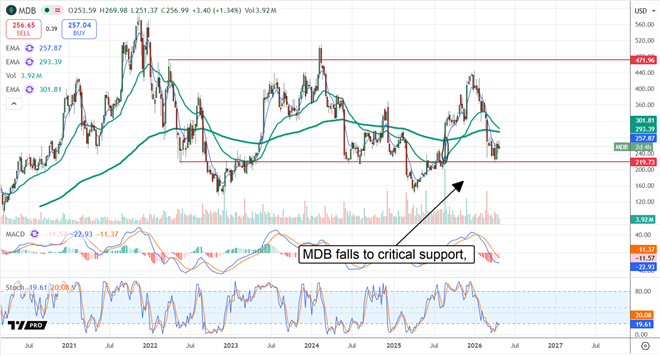
MongoDB Accelerated in 2025, Guides for the Same in 2026MongoDB’s bearish 2026 price action was driven by AI disruption fears and amplified by its Q4 2025 results, prompting the market to overreact. The Q4 report, released in early March, showed sequential and year-over-year acceleration supported by Atlas — but investors focused on the conservative guidance. The company forecast Q1 would be weaker than expected while offering a robust full-year outlook. Importantly, revenue and profitability growth are expected to decelerate through year-end, but by less than many analysts anticipated; the guidance appeared deliberately cautious. Meanwhile, signs from across the AI ecosystem indicate that activity and adoption are increasing. The most visible catalyst for MDB shares is the upcoming earnings release, scheduled for late May. Many analysts lowered targets after the Q4 guidance update, effectively setting a low bar for the company to beat. Current trends suggest results could land at the low end of the company’s range, or even miss guidance, which in turn would create scope for meaningful outperformance and a step-up in guidance on better-than-feared results. In that scenario, MDB’s share price could move quickly from the bottom to the top of its trading range, implying substantial upside from recent lows. Analysts and Institutions Show High Conviction in MDB’s FutureThe analysts' response to MongoDB’s outlook was mixed and contributed to the volatile price action, but it also suggests the market overreacted to SaaS disruption fears. While many price targets were trimmed, several analysts raised ratings or increased targets to balance those cuts. As of late April, 36 analysts express confidence with a Moderate Buy consensus—equating to a roughly 72% buy-side bias—and the consensus price target implies roughly 40% upside. Positive results in the next release would likely push those targets higher. Institutional ownership plays a large role in MDB’s volatility. Institutions own just over 90% of the shares and largely determine direction through their buying and selling. Selling in Q1 2026 helped cap the stock near the top of its trading range, but longer-term data show net purchases over the trailing 12 months and increased activity in early Q2 as the share price declined. That dynamic means institutions currently constrain upside amid SaaS disruption concerns, but their depressed-positioning and analyst support make them likely buyers at these levels. At the same time, institutional participation helps limit downside, offering support near the bottom of the range. The key question is whether institutions will lift the price ceiling in coming quarters as evidence of strength—particularly through Atlas adoption and the integration of active AI features—emerges. Risks remain: competition (despite MongoDB’s moat tied to its document-oriented data model), ongoing GAAP operating losses, and continued volatility. The stock is in a discovery phase where sentiment can swing faster than fundamentals, and those swings will probably persist until there is clear, repeatable evidence of MongoDB’s role in the AI ecosystem and a path to consistent profitability. |






No comments:
Post a Comment