Dear Reader,
THIS IS NOT A DRILL.
You have LESS THAN 24 HOURS to claim your 82% discount on ETF Income Maximizer.
After that?
It's gone. Forever.
What you're about to miss:
- Up to 140% yield ETFs
- Tesla as a potential 51% dividend stock
- Monthly income from Apple, Amazon, and more - without trading options
All for just $9 (Regular price: $49)
CLAIM YOUR $9 ACCESS NOW BEFORE IT'S TOO LATE
Every minute you wait is costing you potential income.
$10,000 could become $14,000 in annual income...
$100,000 could generate $140,000 yearly!
Can you afford to miss this?
The clock is ticking. Loudly.
GET INSTANT ACCESS NOW OR RISK MISSING OUT FOREVER
Land, fly, or die,
Tim Plaehn

Affirm's Google Deal Aims for Your Wallet
Submitted by Jeffrey Neal Johnson. Date Posted: 5/14/2026.

Key Points
- Affirm's groundbreaking partnership with Google creates a massive new customer-acquisition channel within the search and payments ecosystem.
- Affirm is demonstrating significant improvement in its underlying profitability, demonstrating its ability to manage loan unit economics effectively.
- This strategic integration positions Affirm at the forefront of AI-driven commerce, creating a substantial competitive advantage in the digital payments space.
- Special Report: Have $500? Invest in Elon’s AI Masterplan
A persistent 3.8% Consumer Price Index (CPI) reading and record-high credit card APRs are reshaping consumer credit behavior. With total U.S. credit card debt swelling to $1.28 trillion and serious delinquencies reaching 7.10%, a structural shift away from traditional revolving credit is accelerating. This macroeconomic backdrop creates a significant tailwind for Buy Now, Pay Later (BNPL) providers. A strategic partnership integrating Affirm Holdings (NASDAQ: AFRM) directly into the ecosystem of Alphabet Inc. (NASDAQ: GOOGL) fundamentally alters the customer acquisition landscape for the BNPL sector.
A Structural Reshaping of Customer Acquisition
Affirm Holdings' integration with Google Pay, Google Search and the Gemini AI assistant represents an evolution from a merchant-centric to a consumer-centric acquisition model. By embedding its real-time underwriting engine at the point of intent—within search results and the native payment wallet on billions of Android devices—Affirm Holdings effectively bypasses the traditional friction of merchant-by-merchant onboarding.
Goldman Sachs just told you what to buy (most people missed it) (Ad)
Goldman Sachs just revealed that 40% of AI data centers will be crippled by electricity shortages by 2027 - not chips, not funding, but power. Demand is growing 15% per year and the grid can't keep up.
One small company makes the exact equipment these data centers need. They're sitting on $1.5 billion in orders, their hardware is already inside Musk's Colossus, and the stock still trades like a name nobody's heard of. Analyst Dylan Jovine is releasing the ticker for free.
See the stock positioned to solve AI's biggest power crisisThis creates a powerful, low-friction pipeline to capture high-intent buyers before they even finalize a purchase decision, a strategic moat that competitors like Klarna (NYSE: KLAR) and Block's (NYSE: XYZ) Afterpay must now contend with.
The technical execution is key. When a user shops in Chrome or on an Android device, Google's autofill and wallet features can now directly surface Affirm Holdings as a payment option. This allows for a virtual card to be generated and an instant underwriting decision to be made, streamlining what was once a multi-step process.
For Affirm Holdings, this dramatically lowers customer acquisition costs (CAC) and provides a direct channel to drive Gross Merchandise Volume (GMV). For Alphabet Inc., it enriches its commerce ecosystem by adding a critical financing layer that can boost conversion rates for merchants using its platform. The partnership also sees Affirm Holdings piloting extensions to the Universal Commerce Protocol (UCP), an open standard for agentic commerce that enables artificial intelligence (AI) agents to execute purchases on a user's behalf, positioning Affirm Holdings at the forefront of this technological shift.
Affirm's One-Two Punch
This powerful new distribution channel arrives just as Affirm Holdings demonstrates improving underlying profitability and financial resilience. A key metric, Revenue Less Transaction Costs (RLTC), which serves as a proxy for gross profit on loan volume, expanded 41% year over year to $498 million in Affirm's third quarter of 2026. This growth, representing 4.31% of GMV, signals that Affirm Holdings' underwriting algorithms are successfully navigating the high-rate environment, balancing loan performance with funding costs to preserve unit economics.
This performance is supported by a solid balance sheet. Affirm Holdings has strengthened its liquidity, expanding total funding capacity to $28.2 billion. This financial firepower is critical, providing the necessary scale to support more than $65 billion in potential annual GMV. The combination of a strong funding base and proven margin expansion directly addresses a central point of the bearish thesis, which has historically questioned Affirm Holdings' ability to sustain profitability and liquidity through a full credit cycle.
Furthermore, the broader regulatory environment has become more favorable. The rollback of certain Consumer Financial Protection Bureau (CFPB) oversight initiatives for nonbank entities in late 2025 reduces a layer of compliance friction, potentially lowering operational overhead for the entire BNPL sector.
Valuation and Volatility Remain in Focus
Despite the powerful catalyst and improving fundamentals, investors must weigh the associated risks and the stock's premium valuation.
With a forward P/E ratio near 60, Affirm Holdings trades at a premium that reflects high expectations for future growth. The stock's high beta of 3.72 underscores its volatility and sensitivity to macroeconomic shifts.
Bearish sentiment, evidenced by healthy short interest, remains focused on the inherent credit risk. The same consumer escaping high credit card debt is the core demographic for Affirm Holdings, and a further deterioration in household savings or employment could pressure the underwriting models.
While Q3 results were strong, the market will be watching closely for any signs of margin compression or rising delinquencies within the loan portfolio as the Google integration scales. Recent insider trading data, which shows net selling, also warrants consideration, though the volumes have not been substantial enough to signal a major shift in executive confidence.
An Alliance That May Redefine Digital Payments
The integration with Alphabet Inc.'s ecosystem appears to be an inflection point for Affirm Holdings, positioning its financing tools at the nexus of search, mobile payments and AI-driven commerce. The ability of Affirm Holdings to maintain underwriting discipline and expand margins while absorbing a potentially massive influx of new volume will be the key determinant of its long-term success.
Investors evaluating the fintech and payments space might consider this development a significant change in the competitive landscape. For those with a higher risk tolerance, direct access to billions of consumers could justify the stock's premium valuation, as it represents a structural advantage over competitors. More cautious investors, however, may prefer to see further data confirming that Affirm Holdings can maintain its strong RLTC metrics as the Google-sourced volume fully ramps up before committing capital.
Palantir and Dell Build an AI OS for the Paranoid
Submitted by Chris Markoch. Date Posted: 5/24/2026.
Key Points
- Palantir and Dell launched a secure AI operating system designed for defense, healthcare, banking, and other industries that require on-premises control of sensitive data.
- The partnership combines Palantir Foundry and Ontology with Dell AI Factory powered by NVIDIA hardware to create enterprise-grade AI infrastructure.
- The deal strengthens the bullish case for Palantir stock by expanding its reach into regulated enterprise markets while supporting PLTR’s long-term growth narrative.
- Special Report: Have $500? Invest in Elon’s AI Masterplan
What’s really driving the AI buildout is starting to come into view. NVIDIA Corp.’s (NASDAQ: NVDA) earnings report made clear that the AI revolution is happening at the edges. That means chatbots on websites, copilots in spreadsheets, and summarization tools layered onto software that already works well enough.
For a growing group of organizations, however, including defense contractors, hospital systems, and global banks, that kind of peripheral AI is not only inefficient; it’s unacceptable.
Goldman Sachs just told you what to buy (most people missed it) (Ad)
Goldman Sachs just revealed that 40% of AI data centers will be crippled by electricity shortages by 2027 - not chips, not funding, but power. Demand is growing 15% per year and the grid can't keep up.
One small company makes the exact equipment these data centers need. They're sitting on $1.5 billion in orders, their hardware is already inside Musk's Colossus, and the stock still trades like a name nobody's heard of. Analyst Dylan Jovine is releasing the ticker for free.
See the stock positioned to solve AI's biggest power crisisThat’s the opening Dell Technologies Inc. (NYSE: DELL) and Palantir Technologies Inc. (NASDAQ: PLTR) are stepping into. At Dell Technologies World, the two companies announced a joint solution: Palantir’s Foundry and Ontology platform running on-premises inside Dell AI Factory with NVIDIA.
The result is what they’re calling an AI operating system—a full software and hardware stack that brings production-grade AI agents and workflows to organizations that can’t afford to let their data leave the building.
This isn’t a partnership of convenience. It’s a direct response to a problem that has quietly stalled AI adoption at the highest levels of enterprise and government: you can have powerful AI, or you can have control. Until now, you couldn’t easily have both.
The Real Problem Isn’t the Model—It’s the Operating Environment
The announcement reframes what enterprise AI actually requires. According to Dell’s blog post, most organizations aren’t held back because they lack access to capable AI models. They’re stuck because their data is fragmented across ERP systems, electronic health records, core banking platforms, logistics software, and document stores—spread across on-premises infrastructure and multiple clouds—and almost none of it is “AI-ready.”
Palantir’s contribution to the joint architecture directly addresses this. Its Foundry platform and Ontology layer take that fragmented data and build what the companies describe as a governed semantic layer—a unified, strongly typed representation of the business’s assets, processes, people, and relationships. Developers and AI agents don’t interact with dozens of brittle backend systems. They interact with Ontology objects that carry data lineage and clear semantics through every transaction.
Underneath that software layer sits Dell AI Factory with NVIDIA—PowerEdge servers with NVIDIA HGX B-series accelerators, Dell ObjectScale and PowerFlex storage replacing the default persistence layer in the Palantir stack, and Ethernet-based networking aligned with NVIDIA Spectrum-class fabrics. Palantir’s Apollo runtime manages each cluster with zero-trust governance, continuous audit logging, and centralized fleet management across sites—including air-gapped environments where no cloud connection is possible or permitted.
This is the architecture for organizations where a data breach is a national security event, a regulatory catastrophe, or a patient safety failure.
This Is Exactly the Valuation Argument Palantir Has Been Making
Critics of Palantir’s stock price have long pointed to the same objection: the valuation is too rich for a company selling expensive software to a limited set of government clients. The Dell partnership is a pointed rebuttal.
Palantir has always sold to CEOs who understand that AI transformation isn’t a pilot project—it’s a platform decision. The Dell integration expands the addressable market for that platform dramatically, offering a validated, on-premises reference architecture that any regulated enterprise can deploy without building the infrastructure stack from scratch. The argument against Palantir’s scale was always that its market was finite. This deal makes that argument harder to sustain.
Technical Analysis: PLTR Chart Shows a Stock Finding Its Floor
The daily chart for PLTR as of May 20, 2026, shows a stock that has been working through a significant correction from its November 2025 highs near $200. Price is currently near $137, trading below the 50-day simple moving average of $143.26—a level that now serves as near-term resistance.
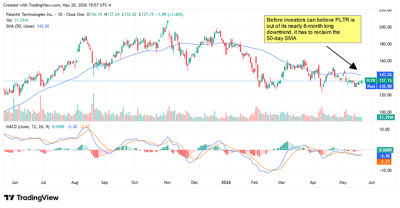
The MACD tells a more nuanced story. The MACD line has crossed back above zero at 0.0689, while the signal line sits at -2.30, suggesting early-stage bullish momentum. The histogram, while still showing some softness, has been narrowing—a pattern consistent with a base-building phase rather than continued breakdown.
Volume has been elevated in recent sessions, pointing to accumulation. For investors, the key technical question is whether the stock can reclaim and hold the 50-day SMA. A sustained close above $143 would shift the near-term bias in a constructive direction.
Locked-Down AI at Enterprise Scale
The Dell and Palantir partnership matters for reasons that go beyond the product announcement. It validates a model of AI deployment that has been underappreciated: secure, sovereign, on-premises AI that doesn’t force organizations to choose between capability and control.
The broader signal is this: the most consequential AI decisions being made right now aren’t happening in the cloud. They’re happening in secured data centers, in air-gapped facilities, and in hospital server rooms—places where the data is too sensitive and the stakes too high for anything less than complete control. Palantir and Dell just made a serious bid to own that space. Maybe this will move the Palantir conversation beyond valuation.
This email content is a paid advertisement sent on behalf of Investors Alley, a third-party advertiser of InsiderTrades.com and MarketBeat.
All information contained herein is copyright 2024, Magnifi Communities LLC.
Information contained in this email and websites maintained by Magnifi Communities LLC (dba Investors Alley) are provided for educational purposes only and are neither an offer nor a recommendation to buy or sell any security, options on equities, or cryptocurrency. Magnifi Communities and its affiliates may hold a position in any of the companies mentioned. Magnifi Communities is neither a registered investment adviser nor a broker-dealer and does not provide customized or personalized recommendations. Any one-on-one coaching or similar products or services offered by or through Magnifi Communities or Investors Alley does not provide or constitute personal advice, does not take into consideration and is not based on the unique or specific needs, objectives or financial circumstances of any person, and is intended for educational purposes only. Past performance is not necessarily indicative of future results. No trading strategy is risk free. Trading and investing involve substantial risk, and you may lose the entire amount of your principal investment or more. You should trade or invest only "risk capital" - money you can afford to lose. Trading and investing is not appropriate for everyone. We urge you to conduct your own research and due diligence and obtain professional advice from your personal financial adviser or investment broker before making any investment decision.
If you have questions about your subscription, don't hesitate to contact MarketBeat's U.S. based support team at contact@marketbeat.com.
If you no longer wish to receive email from InsiderTrades.com, you can unsubscribe.
© 2006-2026 MarketBeat Media, LLC.
345 North Reid Place #620, Sioux Falls, South Dakota 57103. United States of America..




No comments:
Post a Comment