Hello, Thanks for signing up for MarketBeat Daily Ratings—we’re excited to have you on board. Every weekday, you’ll get a curated summary of new “Buy” and “Sell” ratings from Wall Street’s top-rated analysts, the latest stock news, and bonus investing content—all delivered straight to your inbox. You’re just two quick steps away from completing your sign-up: 1. Make sure our emails go to your inboxGmail users:
Mobile: Tap the three dots (…) in the top right and select Move to Inbox or Move to Primary
Desktop: Click the folder icon at the top and select Move to Inbox or Primary Apple Mail users:
Tap our email address at the top (next to From: on mobile), then select Add to VIP Other providers:
Reply to this message and add newsletters@analystratings.net to your contacts 2. Confirm your subscriptionClick this link to confirm your subscription. This verifies your account and ensures you receive your newsletters without interruption instead of getting stuck in your spam filter. Confirm your subscription here. After you confirm, feel free to download our popular free report, "7 Stocks to Buy and Hold Forever" with this link. Thanks again for subscribing—we look forward to being part of your investing journey. 
Matthew Paulson
Founder and CEO, MarketBeat. P.S. If you didn’t mean to subscribe, no problem—you can unsubscribe here.
More Reading from MarketBeat
NVIDIA's Quantum Computing Play Just Sent IonQ and Rigetti FlyingAuthored by Jeffrey Neal Johnson. Posted: 4/15/2026. 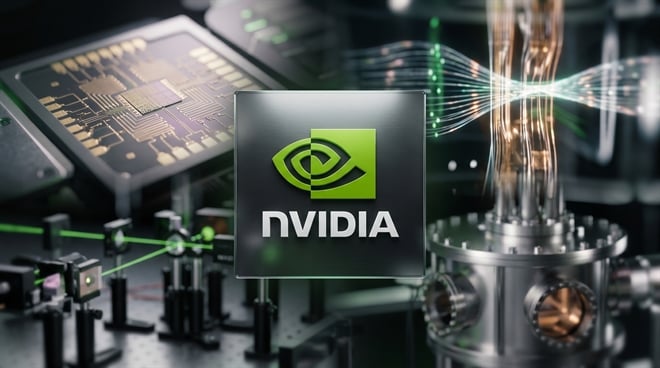
Key Points
- The launch of the Ising open-source AI family positions NVIDIA as a foundational software provider for the rapidly maturing quantum computing ecosystem.
- Hardware specialists like IonQ and Rigetti Computing are poised to benefit from standardized software that automates complex system calibration tasks.
- Integrating sophisticated AI models into quantum workflows represents a major transition from theoretical research to practical enterprise applications.
- Special Report: Elon Musk: This Could Turn $100 into $100,000
On April 14, 2026, what might have seemed like a niche software update from NVIDIA (NASDAQ: NVDA) created a tidal wave in the quantum computing sector. While the semiconductor sector titan’s stock rose 3.73% to close at $196.38, the impact on pure-play quantum companies was far more pronounced. IonQ (NYSE: IONQ), a leader in trapped-ion quantum systems, jumped 20.19% to close at $35.77. In lockstep, Rigetti Computing (NASDAQ: RGTI) climbed 11.50% to close at $16.87. This synchronized rally is a textbook example of the NVIDIA halo effect. Investors have seen the pattern before, most notably in the AI data center space, where NVIDIA’s CUDA platform became the industry standard and lifted the entire ecosystem.
The Stock Signal That Called 2008 Just Flashed Red
What does a 100-year-old algorithm know that Wall Street doesn't? This proprietary signal predicted the Dot-Com bust, the 2008 financial crisis, and the 2020 crash. Now, as Middle East tensions threaten to trigger America's $38T debt crisis, it just issued its biggest warning yet. Get the 10 popular stocks to avoid — and 3 overlooked stocks you need to buy now. Get the full details in our urgent briefing
When a $4.77 trillion company plants its flag in a new technological territory, it serves as powerful validation — signaling to the broader market that the sector is shifting from speculative science to commercially viable enterprise. The market's decisive reaction suggests NVIDIA's latest move is being viewed as a fundamental catalyst poised to reshape the industry's future. From Unruly to Reliable: A Look at the Ising AI ModelsAt the heart of this industry-wide re-rating is NVIDIA's Ising, the world's first open-source AI model family designed to manage quantum computers. To grasp its significance, investors should understand the monumental challenges that have historically constrained quantum hardware development. Quantum bits, or qubits, are the building blocks of quantum computers, but they are incredibly fragile and prone to errors from the slightest environmental disturbance. Calibrating these complex systems is also an arduous task. Imagine trying to perfectly tune an orchestra of thousands of highly sensitive, temperamental instruments simultaneously — that is analogous to preparing a quantum processor for a calculation. NVIDIA's Ising models address these two bottlenecks — error correction and calibration — by using AI as the master conductor.
Automating the orchestra: The Ising Calibration model acts as an AI-powered tuning fork, automating the complex calibration process. It reduces a task that previously took days of painstaking work by physicists to a matter of hours, a significant leap in operational efficiency. Building a noise-canceling shield: The Ising Decoding models provide real-time error correction. They are up to 2.5 times faster and three times more accurate than existing open-source methods, effectively creating a software layer that makes fragile qubits more robust and reliable. By releasing these tools as open source, NVIDIA has laid the groundwork for a standardized software layer across the quantum industry. That allows hardware specialists to accelerate development cycles and focus on innovation, confident that a powerful and reliable operating layer is already available. Riding NVIDIA’s Coattails: A Tale of Two Quantum CompaniesWith a new software standard emerging, hardware companies that best integrate these tools stand to gain a meaningful competitive advantage. IonQ, with a market capitalization of roughly $13 billion, is a clear frontrunner. The company received a major endorsement when NVIDIA named it an early adopter of the Ising Calibration model. This software integration complements IonQ’s strategic focus on hardware scalability, underscored by its acquisition of semiconductor fab SkyWater Technology. Greater control over manufacturing is a crucial advantage that NVIDIA's efficiency-boosting software can now amplify. That combination of hardware strategy and software adoption underpins the Moderate Buy analyst consensus and bullish price targets. Meanwhile, Rigetti Computing is another key beneficiary. The company has concentrated on hardware milestones, such as delivering its 108-qubit system. The value of that machine is now magnified by the availability of an off-the-shelf, world-class software suite to run it. This collaboration is critical for Rigetti as it seeks to leverage a stable base of government contracts to attract more commercial clients. For a company with a market cap above $5 billion, NVIDIA's catalyst provides a clearer roadmap for translating technical achievements into mainstream enterprise adoption and revenue growth. The Quantum Roadmap: From Theory to Tangible OpportunityThe launch of NVIDIA's Ising models marks a fundamental pivot in the quantum computing investment landscape. The narrative is no longer solely about a long-term race to build the biggest hardware; it is now also about near-term opportunities to deploy enterprise solutions on a standardized software platform. The convergence of NVIDIA's AI prowess with dedicated hardware from innovators like IonQ and Rigetti signals the start of a more commercially focused chapter for the industry. While the path to large-scale, fault-tolerant quantum computing remains a multi-year journey, this software catalyst has clarified the route forward. Investors tracking the sector should watch which hardware firms adopt and build on this new software layer. Their ability to do so will likely determine who leads in the emerging software-driven quantum era. |





No comments:
Post a Comment