How to Approach the Market During the "Fog of War" VIEW IN BROWSER In 1962, President John F. Kennedy was given something that profoundly influenced how he would view the world: Barbara Tuchman’s Pulitzer Prize-winning book, “The Guns of August.” The book, which chronicles the miscalculations and rigid military thinking that led to the outbreak of World War I, would come in quite handy just a few months later during the Cuban Missile Crisis. The existence of medium-range missiles in Cuba was a direct threat to the United States. But Kennedy was determined not to repeat the same missteps detailed in Tuchman’s book. He knew that a crisis could escalate if the Soviets were backed into a corner. They needed room to maneuver, a way to choose de-escalation while still saving face. But due to the growing thickness of the “fog of war,” it was difficult to determine the other side’s motives. Ultimately, the Kennedy administration got what it wanted, and the missiles in Cuba were removed. The Russians got something out of it, too – the removal of U.S. missiles placed in Turkey. The Fog of War Hanging Over the Market Fast forward to this week, and we find ourselves once again in the middle of the “fog of war.” Now, the geopolitical stakes may not be as high as they were in the Cold War, but the risks and uncertainty of the Iran war have driven many investors to the sidelines. As a result, all of the major indices declined sharply in March. The S&P 500 and Dow closed out the month down 5% and 5.4%, respectively, while the NASDAQ declined 4.8%. 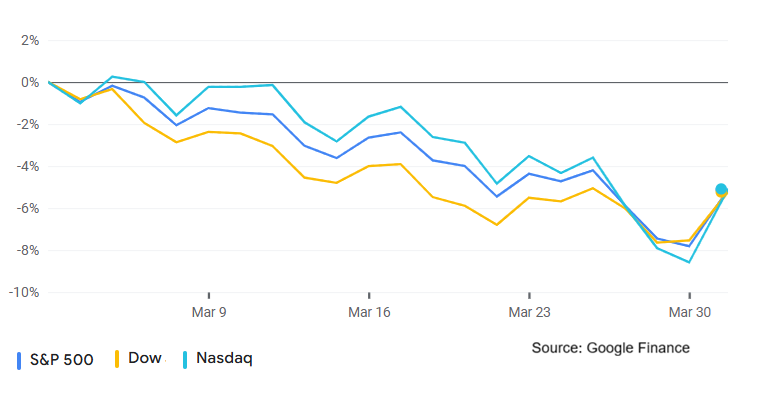
On Wednesday night, President Trump spoke to the nation about the conflict with Iran. He took a tough tone, and that caused the market to get up on the wrong side of the bed once again. But on Thursday, rumors emerged that a deal could be in the works to reopen the Strait of Hormuz, and that’s caused a reversal. At the time I’m writing this, that’s still a rumor. And, as investors, we can’t afford to overreact too much to rumors and innuendo. Who’s in charge of Iran is a little unclear at this point. But what we do know is that the “fog of war” is likely to persist in April, as a ceasefire remains elusive and tensions in the Middle East remain elevated. I suspect that stocks will continue to oscillate as investors react to the latest headlines regarding the Iran war, the Strait of Hormuz and rising energy costs. Mean reversion algorithms will also continue to play a role in the market’s oscillations, too. But the biggest glitch for the stock market going forward will be inflation. Inflation Strikes Again There is no doubt that the conflict in the Middle East has driven energy, fertilizer and food prices higher. Even prior to the conflict, wholesale prices were already rising: The Producer Price Index (PPI) for February showed that food prices rose 2.4% and energy prices jumped 2.3%. In the wake of the Iran war, both West Texas Intermediate (WTI) and Brent crude oil prices have surged above $100 per barrel. To put this into perspective… Brent crude oil rose about 55% in March, marking its biggest monthly surge on record. WTI crude oil also rose more than 50% in March. 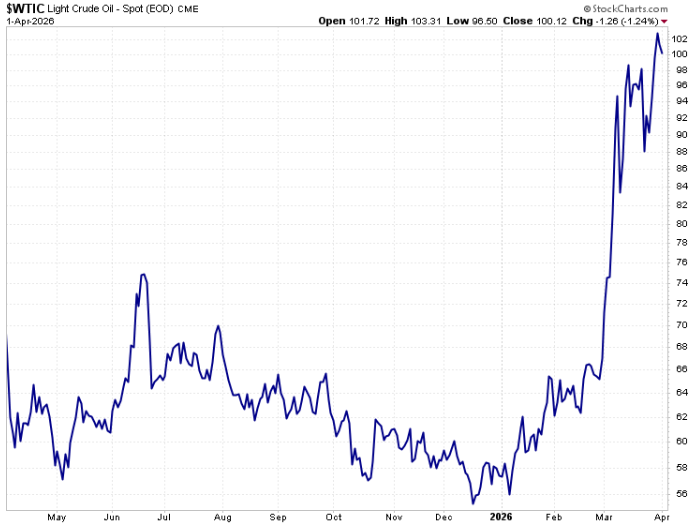
With crude oil prices surging, Americans are feeling the pinch at the pump. Gasoline prices rose above $4 per gallon for the first time since August 2022. That’s an increase of more than a dollar since the start of the Iran war. So, the March data for food and energy inflation is probably going to be hideous. Some economists now expect U.S. inflation to exceed 4%. In fact, the OECD updated its inflation forecasts this week, projecting that inflation for the Group of 20 will rise to 4% in 2026, up from the previous 2.8% estimate. Inflation in the U.S. is anticipated to rise to 4.2%. Due to the inflation “bubble” and higher Treasury yields, hopes for the Federal Reserve to cut key interest rates have been squashed for the time being. Why I Want You to Remain Positive Now, I know it’s hard to be excited after the gut-wrenching month of March. In this environment, it is very easy to be discouraged and to follow the crowds to the exits. But here’s what I want you to remember: The stock market is currently oversold. So, when war concerns diminish or a ceasefire is established, the stock market will resurge in a massive relief rally. I’m viewing the market’s pullback and the subsequent dip as a great buying opportunity for fundamentally superior stocks. The fact is, we remain in a stunning earnings environment, and these are the stocks that should rebound impressively in the upcoming weeks, especially as the first-quarter earnings announcement season gets underway. Remember, your best defense remains a strong offense of stocks with accelerating sales and earnings growth, positive analyst revisions and robust guidance. Good stocks always bounce – and I look for my Growth Investor stocks to rebound 20% or more in the upcoming weeks, especially as the fog of war dissipates and our companies post wave-after-wave of positive quarterly results. That’s because my Growth Investor stocks are showing 37.3% average annual sales growth and 144% average annual earnings growth. And ultimately, earnings are what drive stock prices – not the headlines. So, if you want to learn more about Growth Investor, I encourage you to check out my latest research presentation by clicking here . Sincerely, | .png)
.png)







No comments:
Post a Comment