McCormick & Company (NYSE: MKC) posted first-quarter 2026 results that beat expectations on both the top and bottom lines. Net sales came in at $1.87 billion, up 16.7% year-over-year, with adjusted EPS of $0.66 versus $0.60 a year ago. Despite the beat, MKC stock dropped 6.11%, closing at $50.44 on volume of 12.09 million shares. The headline numbers weren’t the problem. The market’s reaction was almost entirely driven by the announcement of a merger with Unilever’s Foods business. This is a deal that reshapes McCormick’s long-term story in ways both exciting and uncertain.
Table of Contents
The underlying business delivered what it was supposed to. Adjusted operating income rose 18.8% to $267.6 million, with margins expanding 30 basis points to 14.3%. The company reaffirmed its full-year 2026 adjusted EPS guidance of $3.05 to $3.13, representing 2% to 5% growth. For a steady dividend aristocrat navigating macro volatility, that kind of consistency matters.
Executive Order 14178 Could Make Early Investors a Fortune
Three days into his term, Trump signed a sweeping executive order to “reboot” the dollar. Now his plan is finally coming to fruition. And his old friend, Elon Musk, is leading the charge.
Within weeks, America could have a new currency, and life as we know it will never be the same.
The Unilever Foods Merger Could Triple McCormick’s Revenue Base
The deal that rattled investors would combine McCormick with Unilever’s Foods business, creating an entity with roughly $20 billion in annual revenue. That is approximately three times what McCormick generated on a standalone basis. The strategic logic is compelling: McCormick would transform from a mid-cap flavor company into a genuine global food powerhouse with broader distribution, a deeper brand portfolio, and meaningful scale advantages.
Investor concerns are understandable and shouldn’t be dismissed. Execution risk in a deal this size is real. Integrating two large global businesses across different supply chains and corporate cultures is a multi-year undertaking with no guarantee of a smooth landing. Timing risk matters too. If consumer spending softens during integration, the combined company faces headwinds with less flexibility than either business would have independently.
Dilution risk rounds out the near-term concerns, and the deal structure will need close scrutiny for its per-share impact. But none of these risks are surprises to institutional investors. They’re standard deal considerations. A 6% single-day pullback may ultimately say more about MKC’s pre-announcement valuation than the deal itself.
Volume Growth: The Underappreciated Story Inside the Numbers
Here’s what most analysts aren’t discussing. McCormick’s organic growth story has largely been a pricing story. In Q1 2026, total organic sales grew just 1.2% on a constant-currency basis, driven by 1.9% pricing while volume fell 0.7%. That’s the familiar consumer staples pattern: charge more, sell slightly fewer units.
A closer look at regional data is more encouraging. In the Consumer segment’s EMEA region, volume grew 2.4% alongside 1.3% pricing. In APAC, volume grew 2.1% while pricing was essentially flat at 0.1%. These are volume-led growth markets, and they matter in the current environment where most staples companies are watching units erode.
The Unilever foods business has a similar volume profile in international markets, particularly in the regions where McCormick is already seeing expansion. A combined entity wouldn’t just be bigger; it could be volume-positive in ways the standalone McCormick has struggled to demonstrate domestically. That’s a quiet but meaningful differentiator if the merger closes and integrates on plan.
The Chart Shows Buyers Stepped In Before the Close
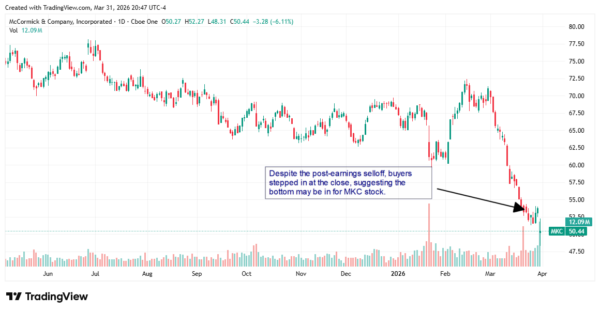
The technical picture on March 31 tells a nuanced story. MKC opened at $50.27, dropped to an intraday low of $48.31, but clawed back to close at $50.44, well off the lows. On volume of 12.09 million shares, that reversal suggests longer-duration buyers were actively absorbing the sell-off rather than running from it.
Zooming out, the chart tells a harder story. MKC has been in a sustained downtrend since trading near $77 last summer, shedding roughly a third of its value over nine months before this earnings day. The stock is now near multi-year lows. That context cuts both ways—the technical damage is real, but so is the potential value for investors with patience and a long-term view.
What Could Hold McCormick Back?
Tariffs are the clearest near-term risk. McCormick’s 2026 outlook already bakes in an incremental tariff impact of roughly 5-6% on adjusted operating income and EPS, partially offset by mitigation strategies. That’s a material headwind, and it could worsen if trade policy deteriorates further before the year is out.
The ERP system rollout is another watch item. The digital and ERP plan revision trimmed approximately 3-4% off the 2026 EPS outlook. Technology transformations of this scale routinely encounter cost overruns and delays, and McCormick is still in the midst of execution. Investors rarely reward consumer staples companies that miss earnings due to back-office IT issues.
Volume softness in the Americas Flavor Solutions segment, down 1.7% in Q1, reflects weakness among large CPG and QSR customers. If that pressure deepens, it offsets the pricing gains that have been carrying the organic growth narrative and complicates the case for near-term EPS momentum.
McCormick is not a growth stock. It is a dividend aristocrat with deep brand equity, consistent cash generation, and a long track record of annual dividend increases. None of that changes because the stock fell 6% on a merger announcement. The $129 million returned to shareholders through dividends in Q1 alone reflects a commitment that doesn’t waver for a single day of trading.
The Unilever deal, if executed well, could be genuinely transformational—tripling revenue, expanding geographic reach, and adding the volume contribution that standalone McCormick has struggled to deliver domestically. The risks are real but knowable.
For value investors with a two- to three-year horizon, the sell-off may be an opportunity. The story to watch is integration execution—and whether the combined McCormick can deliver on what its new scale implies.
StockEarnings, Inc (SE) is a research service not owned or managed by registered brokers and therefore this site does not make any investment recommendations. The information provided in this newsletter is not guaranteed as to the accuracy or completeness. Each user of SE chooses to do trades at their sole discretion and risk. SE is not responsible for gains/losses that may result in the trading of these securities.
This newsletter includes paid advertisements. The source of all third-party content in which SE receives some sort of compensation, is clearly and prominently identified herein as "ad" or "Sponsored". Although we have sent you these advertisements, SE does not specifically endorse any third-party product nor is it responsible for the content of the advertisement or the experience with the third-party advertiser. Furthermore, we make no guarantee or warranty about what is advertised.
All investments involve risk, losses may exceed the principal invested, and the past performance of a security, industry, sector, market, or financial product does not guarantee future results or returns. Please click here for SE Disclaimers.
StockEarnings Inc.33 SE 4th St, Suite 100,Boca Raton, FL 33432 USA ! W;887, 6 STOCKS








No comments:
Post a Comment