Tuesday, March 31, 2026

How to Stress-Test Your Knowledge

Shield

AN OXFORD CLUB PUBLICATION

Loyal reader since December 2024

Liberty Through Wealth

SPONSORED

Alaskan North Slope >> New Ticker Opportunity

Screenshot
 

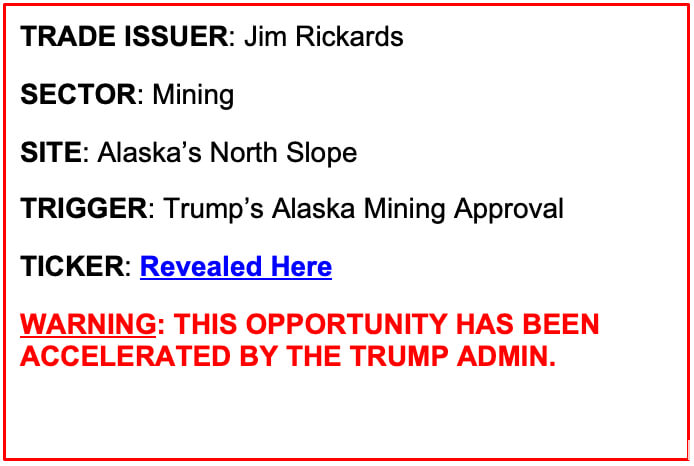
Jim Rickards has just revealed the name of one of his top tickers for what he calls ‘Phase II’ of the American Birthright.

You can find the details in the official trade mockup below:

Click here now for his urgent message.

EDITOR'S NOTE

The headlines scream risk. Recession calls. War fears. Election drama.

But Alexander Green says the real story is hiding in the data.

The Fed has started cutting rates. Trillions in cash sit on the sidelines.

And President Trump is pushing a record amount of investment back into U.S. markets.

Put together, Alex believes these three forces are about to trigger a brief "Frenzy Phase" in one corner of tech - the same pattern that helped mint waves of millionaires in the 1990s.

Click here for the details.

- Jonathan Rodriguez, Senior Managing Editor

THE SHORTEST WAY TO A RICH LIFE

How to Stress-Test Your Knowledge

Alexander Green, Chief Investment Strategist, The Oxford Club

Alexander Green

In my new book, "The American Dream: Why It's Still Alive... and How to Achieve It," I marshal an armada of facts - not opinions - to explain why the Dream today is bigger, better and more achievable than ever before.

Yet polls show that seven out of 10 Americans don't agree with me.

They think the Dream doesn't exist anymore. In fact, a substantial percentage of Americans insist it was never real.

How does this contradiction exist if my arguments are based on verifiable facts?

Because the truth is in short supply in some quarters.

As I mentioned in a recent column, some people would prefer to hang on to mistaken beliefs.

And they are not going to read an entire book - or even a lengthy article - that argues in favor of something they disagree with.

(Thankfully, people like John Stossel put out five-minute videos like this one that help set the record straight about the American Dream.)

However, AI platforms offer an effective way to verify your knowledge or the answers you pick up along the way.

Don't get me wrong. Anyone using these platforms daily - as I do - knows they make mistakes, misinterpret things, and show clear biases.

But far, far less than they used to. And there is now quick and easy to check their accuracy.

Here's a basic example...

SPONSORED

Get Marc's Top 5 Dividend Stocks (FREE PICKS)

World-renowned income expert Marc Lichtenfeld just released his Ultimate Dividend Package. Inside, you'll find his TOP FIVE dividend stocks right now.

And today, he's giving you this package... completely free of charge!

To get your FREE dividend recommendations, click here now.

The vast majority of Americans believe that violent crime is rising in this country.

This perception holds across parties - 92% of Republicans, 78% of Independents and 58% of Democrats - according to recent polls.

It's easy to see why most Americans believe this.

Turn on the news and you'll find it's filled with reports of violent crimes committed, along with suspects interviewed, arrested, arraigned, tried and sentenced.

A single violent crime can dominate the news headlines for weeks. (Just look at the amount of coverage devoted to the abduction of Savannah Guthrie's mother.)

However, a single incident - or string of incidents - doesn't necessarily make a trend.

So let's test this widespread belief using AI. The first step is to define the claim clearly.

For example, "Is the long-term trend in violent crime in the U.S. getting better or worse?"

Perplexity answered: "Violent crime in the U.S. has gotten better over the long term: rates are dramatically lower than in the early 1990s, despite a pandemic-era spike and recent media focus on crime."

It then cites several sources of declining crime rates and concludes, "Using the Bureau of Justice Statistics' victimization survey, violent crime rates are down about 70% from 1993, an even steeper long-term drop than shown in police-reported data."

Knowing that any AI platform can make mistakes, I then ask ChatGPT to fact-check this.

ChatGPT tells me "Short answer: Your summary is largely accurate. The main numbers and overall conclusion match widely cited U.S. crime data."

I fact-checked it again with Claude, Copilot, Grok, and Gemini.

The other platforms gave similar answers. None of them were contradictory.

AI is extremely good at quickly locating the institutions that collect or publish authoritative data—government agencies, academic researchers, and major statistical organizations.

In practice, the optimal process looks something like this: define a precise claim, challenge the conclusion with opposing evidence (if necessary), then use competing AI platforms to verify the answer.

Used this way, AI becomes a fast and powerful accelerator of critical thinking rather than just a substitute for it.

As I mentioned previously, if you really want to know the truth about something - to the extent it can be known - you must not be just willing but delighted to learn that a belief of yours is mistaken.

AI platforms offer all of us that opportunity. (The AI models I mentioned are all free to download and free to use.)

You can ask whatever you want - and follow up by asking for citations, further evidence, or more clarification.

However, when some AI users don't get the answer they want, they'll point to some respected authority or highly praised book or podcast that argues something different.

And maybe that authority is right and the world's superintelligent AI platforms are all in error. But that's not usually the case.

What is more likely is that users would prefer to hang on to mistaken beliefs that they find satisfying.

Particularly if they are ones that their friends - or members of their tribe - subscribe to.

If so, don't push. AI is a good way to stress test your own thinking. It's not always a great way to persuade others, despite its effectiveness.

Besides, if you make it your mission to correct the world's mistaken opinions, I can tell you one thing for certain.

You've got your work cut out for you.

Good investing,

Alex

P.S. If you're as weirdly obsessed with verification as I am, I highly recommend Michael Shermer's new book, Truth: What It Is, How to Find It, and Why It Still Matters.

Leave a Comment
This secret stock is set to bring 50,000 new jobs to America with a deal involving Apple and $10 billion

BUILD AND PROTECT YOUR WEALTH

He Called Apple, Amazon, Netflix, and Nvidia Over 20 Years Ago. Now He Says to Buy AI's "Next Magnificent Seven" Stocks.

Dividends vs. Buybacks: Which Are Better for Investors?

President Trump's Blueprint for America's Transformation

A Resource More Valuable Than Oil

Liberty Through Wealth

SPONSORED

"At Your Age, Can You Afford to Miss This?"

The biggest wealth-building opportunities don't wait for you to feel "ready." Amazon. Apple. Tesla. The pattern is always the same: life-changing gains go to those who position themselves EARLY.

Marc Lichtenfeld reveals why the $34 trillion robotaxi revolution could be your last chance at huge profits.

Don't let this opportunity pass you by

No comments:

Page List

Blog Archive

Search This Blog

What TurboQuant Actually Means for AI Memory Stocks

The bear case is wrong – and history proves it What TurboQua...