Monday, February 2, 2026

The Moral Case for Stock Investors

Shield

AN OXFORD CLUB PUBLICATION

Loyal reader since December 2024

Liberty Through Wealth

SPONSORED

Seven stocks set to go SUPERNOVA??

Two BIG catalysts could drive a set of stocks higher in the coming days.

Both involve a brewing conflict between China and the United States.

And the President has said we will do “whatever it takes” to win this battle.

Micro Mag 7 #1 - The Rare Earth Stock
 

And this could result in trillions of dollars flowing into specific industries and stocks.

Go here for details on seven tiny stocks that could rise as much as 1,500% in the coming year.

EDITOR'S NOTE

Since 2000, out of every investment available, only TWO have beaten what Chief Income Strategist Marc Lichtenfeld calls "The 29% Account."

This little-known opportunity has outperformed Apple, Amazon, Microsoft, and thousands of other stocks... turning $1,000 into $556,454 over 25 years.

The big banks have known about it for decades. Now you can too.

See the full details here.

- Nicole Labra, Senior Managing Editor

THE SHORTEST WAY TO A RICH LIFE

Why Shareholders Are Public Benefactors

Alexander Green, Chief Investment Strategist, The Oxford Club

Alexander Green

When you buy or sell shares of a public company, your actions are almost certainly based on self-interest.

You want to buy a company at a good price. And you want to sell it at an even better price.

Yet many shareholders - perhaps most - don't realize that they are actively promoting the public good when they act for personal financial gain.

Here's how...

In a free enterprise system like ours, every transaction is based on mutually beneficial exchange.

The only way a business attracts customers - and makes money - is by enticing them to buy its products and services.

If they sell those products and services for more than they cost, they earn a profit.

And if they can't, they don't.

Not making a profit is more common than non-entrepreneurs realize. Most businesses close within five years of opening.

A profitable firm is the exception, not the rule. (Especially in the world of start-ups.)

Business owners - shareholders - eat the losses. They are also entitled to the profits if there are any.

Capitalism is not a zero-sum game where businesses gain at everyone else's expense.

If you don't want to work for a company, buy from a company, sell to a company or own its shares, you won't.

SPONSORED

The ultimate trade for pickleball players

3 People on the Pickleball court
 

If you play pickleball, golf, or any other sport...

Then take a look at this one special trade.

Imagine entering a trade at 9:30 a.m. ET...

Collecting a HUGE profit a few minutes later...

Closing your computer...

And going about the rest of your day on the courts (or doing whatever else you want)!

That's what is possible thanks to this lucrative 9:30 a.m. ET trade setup.

Click here to learn it for yourself

At a successful business, the incentives are aligned for everyone to benefit, not just the shareholders.

As I've written before, businesses focused solely on short-term profits don't last long.

If they cut corners on quality, their customers will leave them.

If they bargain with your suppliers too hard, they won't trade with them.

If they undervalue their employees, they will take their talents elsewhere.

It is in the best interests of business owners to make sure that all stakeholders - employees, suppliers, customers, and communities - are satisfied.

Yet the business and its assets do not belong to the other stakeholders. They belong solely to the shareholders.

(Many people lost sight of this a few years ago, when some of the world's largest asset managers pressured firms to pursue not sales and earnings but various social responsibility objectives. Better known as ESG... or Environmental, Social and Governance. Fortunately, the pendulum is swinging back the other way.)

The best companies seek to maximize long term gains, not short term ones.

If this were not the case, they would not invest billions each year on equipment, factories, technology, research and development, marketing, employee benefits and so on.

Instead, they would distribute all that money to the shareholders, either in the form of dividends or share buybacks.

But they don't. Because they expect their investments to pay off in even bigger profits down the road.

These investments require quite a bit of money, of course.

Every growing business is faced with essentially three choices: using their existing cash flow, borrowing or raising money in the equity markets.

Most young companies - and many fast-growing ones - don't have enough excess cash flow to finance investments for future growth.

They can borrow, either from a bank or through a bond offering. But that means signing a contract to provide interest payments and a return of principal on specific dates.

If the business grows slower than expected, this can become a major problem, as more debt may need to be taken on or - in the worst case - the firm may have to be liquidated to satisfy creditors.

So many firms opt to raise money in the stock market instead.

The funds are raised in an initial public offering (IPO) or secondary offerings.

If you're buying shares in the market, your money does not go to the company itself. Rather it goes to someone who is selling their shares.

You are not providing capital to the firm. You are providing liquidity to other shareholders, as you are again when you sell your shares.

Think about this for a moment...

Businesses provide us with virtually everything we want or need. They provide jobs and training for employees. They are sources of sales and profits for suppliers. And they pay billions each year in corporate taxes.

Who makes this possible?

You, the shareholder, who is willing to accept the risks and potential rewards of a business owner - and who provides liquidity for other investors.

So don't buy into the mischaracterization that stock market investors are greedy and selfish. You're a public benefactor!

Now... get out there and make some serious money.

Good investing,

Alex

Leave a Comment
This secret stock is set to bring 50,000 new jobs to America with a deal involving Apple and $10 billion

BUILD AND PROTECT YOUR WEALTH

This Gold Play Has Beaten Gold 10-To-1 for 25 Years - Find Out More.

Tenable: Is This Software Stock a Value Play?

Costco Manager Reveals a 3-Minute Secret That Changed Alexander Green's Life

When AI Spots What Human Traders Miss: Three Unrelated Stocks Signal Something Big

SPONSORED

"If You Can Predict THIS, You Can Predict the Stock Price"

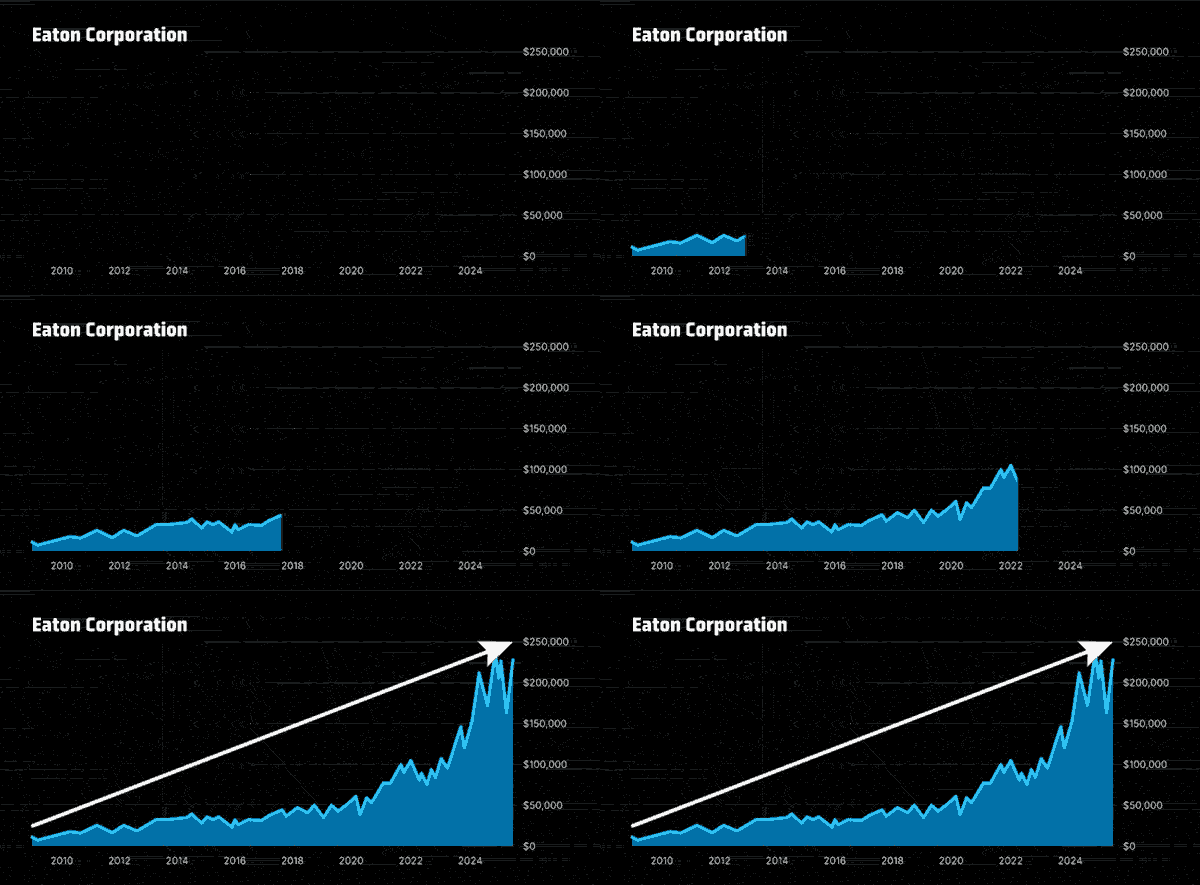
Eaton Total Value chart
 

Wall Street Journal study proves, THIS ONE METRIC is the most accurate predictor of stock market success. (No, it's not sales or earnings)

No comments:

Page List

Blog Archive

Search This Blog

Did you block me?

Are my messages getting through...  ‌ ‌ ‌ ‌ ‌ ‌ ‌ ‌ ‌ ‌ ‌ ‌ ‌ ‌ ‌ ‌ ‌ ‌ ‌ ‌ ‌ ‌ ‌ ‌ ‌ ‌ ‌ ‌ ‌ ‌ ‌ ‌ ‌ ‌ ‌ ‌ ‌ ‌ ‌ ‌ ‌ ‌ ‌ ‌ ‌ ‌ ‌ ‌ ‌ ‌ ‌ ‌ ...