The Bar Is Getting Raised. Alphabet and Amazon Are Showing Us Why... VIEW IN BROWSER Before the turn of the millennium, AOL was the undisputed king of the internet. Remember those little CDs you’d get in the mail? AOL dominated online access. And for a time, it seemed like the company could do no wrong. Then, in early 2000, it announced a $165 billion merger with Time Warner, the largest deal the market had ever seen. At the time, it was billed as a masterstroke. A way to marry old media and new technology into a single, unstoppable powerhouse. Instead, it became a cautionary tale. Why? Lean in closely for this one, folks... That deal marked the moment when the market stopped treating AOL as a pure growth story and started scrutinizing it as a capital-intensive business with execution risk. Fast-forward to today, and it’s fair to ask whether we’re approaching a similar inflection point in artificial intelligence. To be clear, AI isn’t going anywhere – just like the internet didn’t. And today’s Big Tech leaders? I’m not saying they’re going to fade into oblivion, either (although some might). It’s just that the market is growing increasingly focused on the cost of building AI – and on who ultimately earns an attractive return on that investment. That shows up loud and clear in the reaction to earnings reports. You may recall that last week I detailed how, even though Microsoft Corporation (MSFT) surpassed expectations on earnings and revenue, shares took a hard hit amid fears of slowing Cloud growth and its massive AI spending plans. We saw even more of that this week. When markets reach this point – where even strong earnings fail to satisfy – it marks the beginning of a more volatile and selective phase, what I’m calling the AI Dislocation. When that phase occurs, the reaction to earnings can become far more unpredictable. And this week, two more Magnificent Seven stocks – Alphabet Inc. (GOOGL) and Amazon.com, Inc. (AMZN) – came under the microscope with their earnings reports. So, in today’s Market 360, we’ll review their earnings and talk about why expectations are higher than ever – and how investors can prepare for what lies ahead. Alphabet Let’s start with Alphabet. For the fourth quarter, the company reported revenue of $113.8 billion in revenue, topping Wall Street’s expectations for $111.4 billion. Earnings were $2.82 per share, higher than the $2.65 expected by analysts, and up from $2.15 in the previous year. Growth was driven in large part by a 48% jump in Google Cloud revenue to $17.7 billion, which was driven in part by AI deals with Meta Platforms, Inc. (META), OpenAI (the company behind ChatGPT) and Anthropic (the company behind Claude). That was also well ahead of estimates for $16.2 billion. Google Services – including Search and YouTube advertising – climbed 14% year over year. Additionally, Alphabet surpassed $400 billion in annual revenue for the first time in its history. That was thanks to increasing search demand and the launch of its new Gemini 3 AI Model – which outperformed rivals like OpenAI and led to the company reportedly calling a “code red” as a result. Yet despite these strong results, Alphabet’s shares fell as much as 5% on Thursday. Why? Because the company is spending like a sailor in port – specifically on AI. The bill? In the range of $175 billion to $185 billion in 2026. That’s roughly double last year’s spending, and Wall Street thought it was going to target about $120 billion in spending this year. Judging by the market reaction, investors zeroed in on that rising spending figure, whether it’s sustainable and what it could mean for profitability in the years ahead. Amazon Now, let’s see what Amazon delivered. For the fourth quarter, the company reported $213.4 billion in revenue, up 13.6% year over year, and topping Wall Street’s revenue expectations of $211.5 billion. It also reported earnings of $1.95 per share, which was a penny short of Wall Street’s estimate. Amazon Web Services remained a key growth engine, generating $35.6 billion in revenue during the quarter. But despite those results, Amazon’s shares fell as much as 10% on Friday after the company outlined gargantuan spending plans and a softer-than-expected guidance. In short, management expects to spend $200 billion on capital expenditures in 2026, as it ramps up investment across AI, chips, robotics and other long-term initiatives. That was also well above market estimates of about $146 billion. At the same time, Amazon forecast operating income of between $16.5 billion and $21.5 billion for the coming quarter, below expectations of roughly $22.2 billion. That combination – heavier spending now and more modest near-term profitability – appeared to dampen the mood. Still, the market’s reaction made one thing clear: Investors are increasingly focused on the timing of those returns, not just their potential. Why Strong Earnings Are No Longer Enough At this point, the market is making something very clear. The first phase of the AI boom was about proving the technology worked. A small group of mega-cap companies pioneered the tools that brought AI to the masses, and investors rewarded them handsomely. But that phase is now giving way to something different. As the AI race intensifies, the market is becoming less forgiving and more selective about which companies it rewards. As I’ve explained recently, markets are transitioning out of the early, momentum-driven Stage 1 of the AI boom. In that phase, broad enthusiasm can lift nearly every company tied to a powerful trend. In Stage 2, the focus shifts from ambition to execution. The key question is no longer “can this be built?” but “who earns an attractive return once it is built?” That transition into Stage 2 is what I’ve been calling the AI Dislocation. What Stock Grader Is Showing Right Now To help navigate this more selective environment, I’m leaning on Stock Grader (subscription required) – the same system I’ve used for decades to identify leadership shifts across major market cycles. Right now, Stock Grader has assigned Alphabet a Total Grade of “B,” meaning it is “strong,” while Amazon earns a “D,” meaning it is “weak” and we should steer clear. And when you look at the Magnificent Seven stocks as a group, things get really interesting... 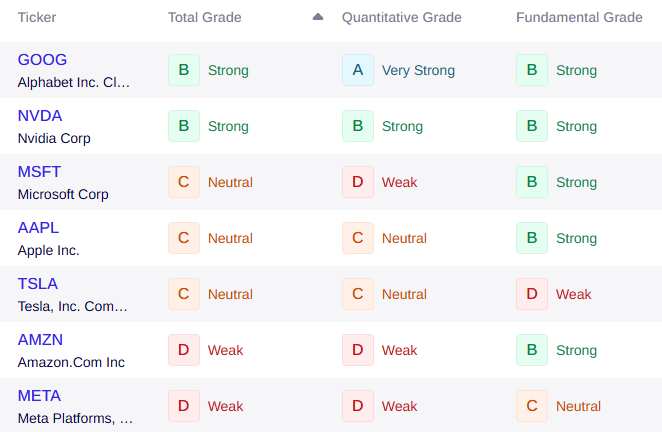
These stocks are supposed to represent the market’s leaders. Yet only two of the seven currently earn a “B” rating. The rest all hold neutral or weak ratings. Many of the most capital-intensive mega-cap names – the ones pouring enormous sums into AI buildouts – are no longer earning top grades. Strong businesses? Yes, that’s what’s subsidizing arguably the largest buildout since the railroads in the 1800s. But they’re increasingly weighed down by rising costs and longer payoff timelines. At the same time, Stock Grader has been flagging a very different group of stocks. Companies with accelerating earnings momentum, cleaner balance sheets and far less capital intensity. In other words, the kinds of businesses that tend to benefit when a technology moves from experimentation to profitable deployment. That doesn’t mean the AI leaders of the past disappear. It means the next phase favors different characteristics – and different stocks. What Comes Next In a market that’s becoming more selective by the day, preparation matters more than ever. To help investors better understand this shift, I recently put together a special presentation focused on the AI Dislocation, the move into Stage 2 and what to watch as this next phase of the AI boom takes shape. You can watch that presentation here. Understanding what’s happening right now could mean the difference between participating in the next wave of gains… or being left behind in 2026. So, I urge you to take a few minutes and watch now. Sincerely, | .png)
.png)








No comments:
Post a Comment