


Tuesday, February 24, 2026

Forecasting the Fight: How Meteorology, Oceanography Marines Support Operational Planning

Left
U.S. War Department: News
Forecasting the Fight: How Meteorology, Oceanography Marines Support Operational Planning
Feb. 24, 2026 |  By Marine Corps Lance Cpl. Kindsey Calvert, III Marine Expeditionary Force

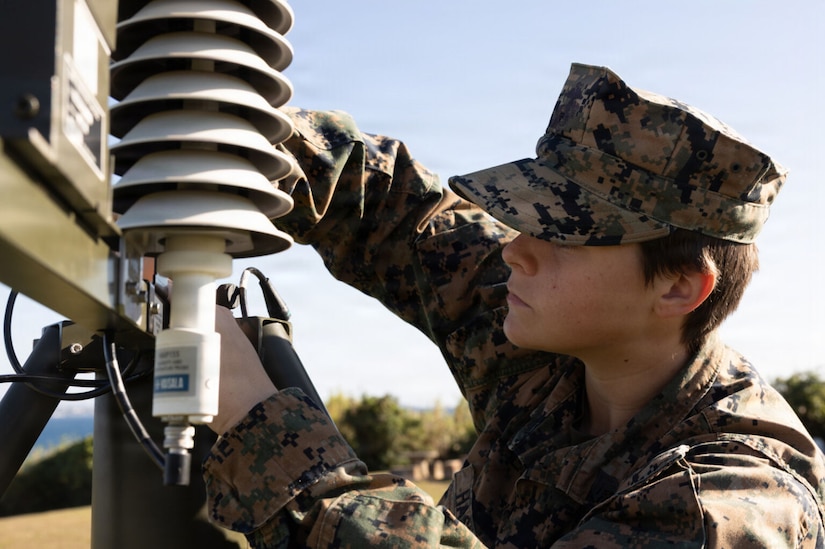
Weather, while it cannot be controlled, can be predicted, which helps commanders make informed decisions about planning exercises and troop movements. Meteorology and oceanography Marines support battlefield capabilities through forecasting and predicting how weather will impact operations.


These Marines are trained meteorologists and oceanographers who look at the current state of the environment and create weather forecasts that support operational planning and execution. They create routine forecasts, 96-120 hours out, using satellite data and weather patterns, in addition to future forecasts for exercise planning, using historical weather data over a 20-year period.


"Out here in the Pacific, weather can determine both friendly and adversarial pacing of operations," said Marine Corps Sgt. Priya Hasham, a meteorology and oceanography analyst forecaster with the III Marine Expeditionary Force. 

To learn this field, Marines attend a yearlong program where they are taught basic physics, develop an understanding of the atmosphere and how it affects the weather and gain the ability to interpret weather radar data to create forecasts. 

In creating a forecast, satellite imagery, radar and data from weather stations around the world can be used. Pattern recognition also plays a significant role in forecasting, making personal experience an important factor. Since weather is influenced by local terrain, the longer a Marine has been in an area, the more familiar they are with local weather patterns, improving their ability to create accurate predictions.


Most Marine Corps installations have these specialized Marines, whose responsibilities vary between units. At the III Marine Expeditionary Force, their weather predictions support intelligence and battlespace awareness by looking at the big picture of air, land and sea operations to inform commanders as to how assets will operate in various weather conditions.

"Forecasting is an art and science," Hasham said. "There is a lot of technical skill involved."

Right


ABOUT   NEWS   HELP CENTER   PRESS PRODUCTS
Facebook   X   Instagram   Youtube

Unsubscribe | Contact Us


This email was sent to stevenmagallanes520.nims@blogger.com using GovDelivery Communications Cloud on behalf of: U.S. Department of War
1400 Defense Pentagon Washington, DC 20301-1400

No comments:

Page List

Blog Archive

Search This Blog

Justified Accord 2026 Begins in Kenya, Tanzania

View Online Justified Accord 2026 Begins in Ken...

