While gold had a flying start in 2026, bitcoin had a stumbling start, both due to geopolitical risks. Yet, both asset classes came out somewhat unscathed, with varying degrees of success. | Can the context of safe-haven investing shift from gold to bitcoin? While historical performance and volatility suggest otherwise, Rick Rieder, a rising favorite for Fed chair, thinks so. | "I think [bitcoin] will take the place of gold to a large extent? Yeah, I do, because it's so much more functional than passing a bar of gold around," he told CNBC in 2020. |
|
| If Rick Rieder becomes the next Fed chair, his views could be highly significant. Rieder's perspective is strongly at odds with current Fed Chair Jerome Powell, who has consistently dismissed bitcoin as a speculative asset. | "It's not really a competitor to the dollar," Powell told Congress in 2021. "It's really a substitute for gold, but with a caveat." He called bitcoin "highly volatile" and "not backed by anything." |
|
| Powell's Fed has spent the past four years warning about crypto risks, proposing stricter regulations, and explicitly rejecting any consideration of bitcoin as a reserve asset. If Rieder takes over, the tone from the Federal Reserve building could shift dramatically. | But here is what is happening in 2026: when investors got nervous about the Trump-Greenland issue, they bought gold and sold bitcoin. This isn't new—it's been the pattern for years. But something is shifting beneath the surface. |
|
| | | | | Stop Chasing NVIDIA | | If you're chasing Nvidia, Amazon, or Palantir right now, I've got one word for you: Stop. Because according to legendary investor Whitney Tilson, AI mania is about to leave millions of investors holding the bag. | Whitney just went public with one of his most controversial predictions in years: "The AI boom is real... but the next wave of gains won't come from where everyone expects." | Instead, he believes a stealthy, little-known stock is about to blow past Nvidia in a way few investors see coming. | Learn the craziest part here... |
| |
| | |
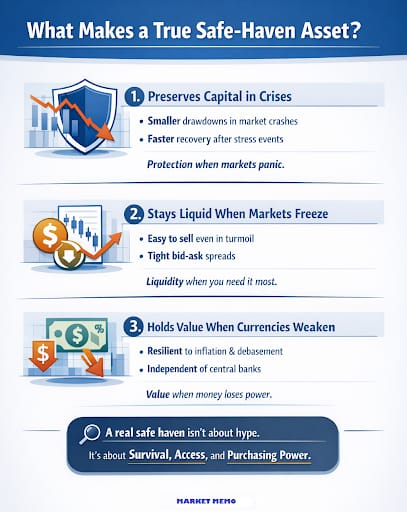
| The Safe-Haven Test | An asset is considered a safe-haven when it does the following: | | In 2022, when inflation spiked, gold rose 8%, while bitcoin fell 64%. Not exactly reassuring if you're looking for safety. | But 2024 told a different story: gold gained 27%, and bitcoin gained 120% amid fears of currency debasement and central bank policy mistakes. |
|
| | What is Driving Bitcoin's Safe-Haven Narrative | Institutional adoption: BlackRock's IBIT became one of the most successful ETF launches in history. Pension funds and endowments are allocating 1–3% of assets to bitcoin, something unheard of five years ago. Faster settlement: Moving $100 million in gold across borders can take days, require physical security, and cost thousands in fees. Moving $100 million in bitcoin takes 10 minutes and costs $50. Demographic factor: Investors under 40 trust bitcoin more than gold. A 2025 survey showed 43% of millennialswould choose bitcoin over gold as a safe-haven asset, compared with 12% of boomers. Time works in bitcoin's favor.
|
|
| | Why Gold Still Has the Edge | Bitcoin and gold are used to hedge against different risks. They have shown a very weak correlation of 0.14 over the past five years, with a 1-year rolling correlation of 0.02. But bitcoin shows a strong correlation with the Nasdaq 100, at 0.68. It basically trades like a large-cap tech stock and may be unsuitable during risk-off events. Until that changes, it's not a true safe haven. | Gold doesn't need electricity, an internet connection, or a private key. You can hold it physically. You can't accidentally lose it by forgetting a password. That simplicity has value during true chaos. When governments prepare for worst-case scenarios, they're still choosing gold. | The question isn't which one wins—it's the risks you're hedging against. | If you think we're headed for a 1970s-style inflationary spiral with functioning markets, bitcoin makes sense. If you believe we are headed for a 2008-style financial crisis with frozen credit markets, gold makes sense.
|
|
| | The Bottom Line | While gold has had over 5,000 years to prove itself, bitcoin has had only 16. The fact that we're even having this conversation shows how far bitcoin has come as an alternative investment. | But calling bitcoin a safe haven in 2026 is aspirational, not descriptive. Digital assets are a bet on the future and may not reflect the present. | Gold wins when things break. Bitcoin wins when they inflate. Sophisticated investors aren't choosing—they're holding both. |
|
| | | | | Important disclosures: This newsletter is provided for informational purposes only and does not constitute investment advice. All investments involve risk, including possible loss of principal. Please consult with your financial advisor before making investment decisions. |
| |
| | |
|
|







No comments:
Post a Comment