Everyone's asking if it's time to buy oil stocks
Here's my answer. And the setup I'm waiting for. U.S. forces captured Nicolás Maduro on January 3rd. By Saturday, Trump declared America would “run Venezuela” and rebuild its oil fields. Exxon and Conoco are still owed $10 billion from the 2007 nationalization. Chevron has billions more ready to deploy. Venezuela holds 303 billion barrels of proven reserves. That’s 17% of the world’s oil. And prices didn’t budge. The market already priced in the near-term picture. Venezuela’s infrastructure is rotted. The skilled workers fled years ago. Even optimistic timelines put 4 million barrels per day a decade away. Traders will bid up barrels that don’t exist anyway, and that caps any bullish thesis. Which creates the real play. The Goldilocks Zone: $58-65 Works for Everyone We called for oil under $60 in our last report. It happened. So, is it time to load up on oil stocks? Not yet. The $58-65 range works for almost everyone right now. The U.S. wants it - cheap oil keeps inflation in check and gives the Fed room to cut rates. That matters when you’re carrying $36 trillion in debt. Saudi Arabia wants it. This range keeps their barrels competitive while growing market share. They’d rather sell more at $60 than less at $80. Europe wants it. Low prices squeeze Russia’s war budget. China wants it. Slow growth leaves refiners hungry for cheap feedstock. WTI traded in this band through most of 2025, where Middle East flare-ups pushed prices toward $70-75. Those spikes faded fast and the market kept snapping back to the same range. - The world quietly agreed: oil that’s not too hot and not too cold.
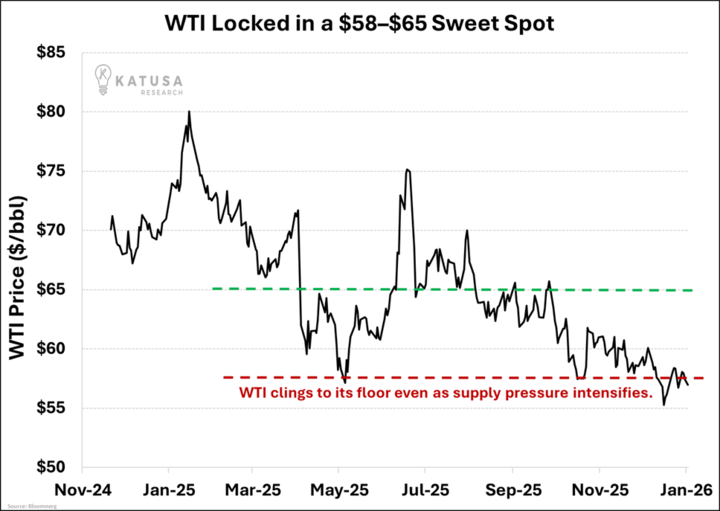
This won’t last forever. But right now, it dictates who wins. The Inventory Trap Most investors see the tight price band and assume crude is coiled for a rebound. Price sits near recent lows. Analysts call for upside. The physical market points the other way. | Sponsored
One company to replace Amazon… another to rival Tesla… and a third to upset Nvidia. These little-known stocks could challenge today’s reigning tech leaders. Eric Fry reveals names, tickers, and full analysis in a free broadcast. CLICK HERE to Watch Now. | | | | U.S. inventories went through a major reset after Covid. Stocks surged during lockdowns. They fell as demand recovered. Then Washington drained a huge chunk of its Strategic Petroleum Reserve during the Russia-Ukraine war. That history fools people into thinking inventories are still tight. They’re not. 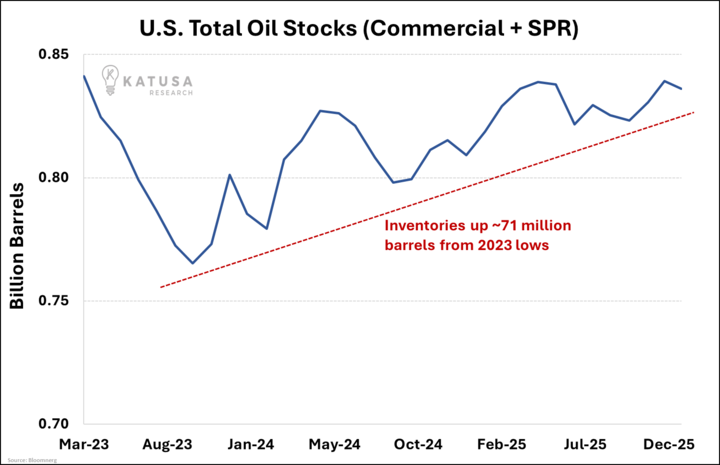
By December, commercial inventories were up 1.75% from the prior year. The SPR climbed nearly 5%. And that’s just onshore. - The IEA’s November report flagged 80 million barrels of oil-on-water added in September alone… the highest since mid-2021.
Most of it wasn’t sitting in tanks. It was parked on ships. Some trackers put the number closer to 100 million barrels. The largest buildup since the pandemic storage trade. The Oil Contango Playbook Contango happens when today’s oil price sits lower than the price for delivery later. The market’s way of saying: we have more barrels than we need right now. The six-month futures spread has been grinding higher. It just crossed above zero. 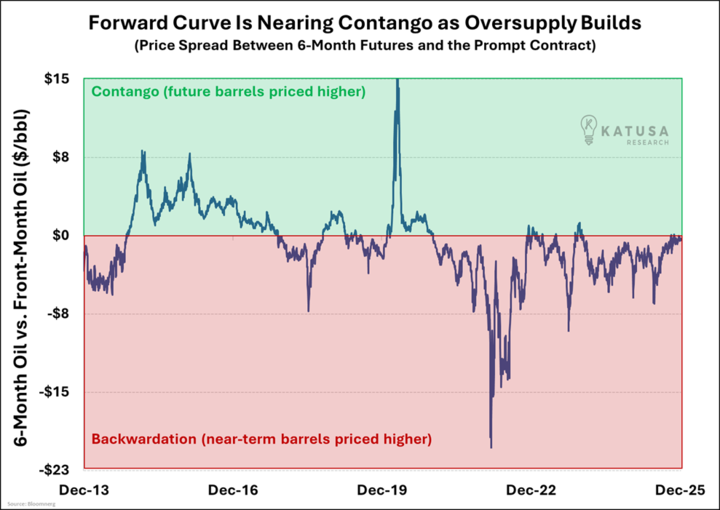 Once the spread sits comfortably positive, the market rewards storage over selling. Once the spread sits comfortably positive, the market rewards storage over selling.
When contango forms, traders buy cheap prompt barrels, park them in tankers, and sell forward at higher prices. Refiners lock in cheap feedstock. Margins expand. This is the setup. Very Large Crude Carriers hold two million barrels each. 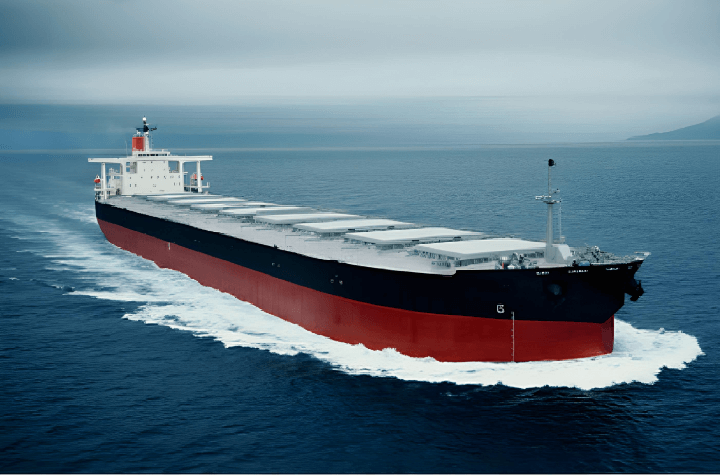
In a loose market, they become floating tanks. VLCC spot rates act as an early warning. When traders book tankers for storage instead of transport, the fleet tightens fast. Day-rates spike before inventory data catches up. Since July, spot rates on the Arab Gulf-to-China route surged more than 700%. The Trade Venezuela changes nothing for oil prices in 2026. And everything for oil prices in 2030. The near-term setup rewards companies that profit from weak crude and wide spreads. Tanker operators filling with floating storage. Refiners locking in cheap feedstock. Players who treat contango as an opportunity, not the problem. The contrarian oil trade most investors expect: Load up on producers and wait for a spike… isn’t the play. Not yet. Not when the whole world agrees on $60 oil. Not when inventories are building. Not when the futures curve says store, don’t sell. JUST RELEASED: The Full January 2026 Edition of Katusa’s Resource Opportunities Report Covers: - Which tanker stocks to watch—and the valuation levels where they become buys.
- Mid-cap vs. large-cap refiner analysis: crack spread sensitivity, balance sheets, and the one name still generating positive free cash flow.
- 2026 price targets for gold, silver, copper, uranium, aluminum, and natural gas.
You’ll also find out the exact name of the copper stock I expect to get acquired this year (at much higher prices). Plus, specific entry points on our high-conviction uranium plays. [SUBSCRIBE TO KATUSA’S RESOURCE OPPORTUNITIES] Regards,
Marin Katusa
Founder, Katusa Research | 






No comments:
Post a Comment