Monday, January 12, 2026

Medal of Honor Monday: Army Lt. Col. Harold Fritz

Left
U.S. Department of War: Feature
Medal of Honor Monday: Army Lt. Col. Harold Fritz
Jan. 12, 2026 | By Katie Lange

When his platoon was faced with impossible odds during an ambush in Vietnam, Army Lt. Col. Harold Arthur Fritz didn't hesitate to do everything he could to save his fellow soldiers and stave off the enemy. He miraculously survived the fight. His bravery and actions that day earned him the Medal of Honor.

Fritz was born Feb. 21, 1944, in Chicago; however, by 1949, his parents moved him and his younger brother, Terrence, to Lake Geneva, Wisconsin, where Fritz grew up fishing, hunting and participating in the Boy Scouts. He wrestled, played baseball and was active in the National FFA Organization at Badger High School before graduating in 1962. Fritz's high school principal once referred to him as a reliable teen who everyone expected to succeed.

By age 21, Fritz was working on an education degree at the University of Tampa while working in a factory to support his high school sweetheart-turned-wife, Mary Ellen, who was pregnant with their first child, Kimberly. In a Library of Congress Veterans History Project interview in the early 2000s, Fritz said he received a draft notice after dropping a few classes to pick up more hours at work. With his daughter's upcoming birth, he decided it would be better for the family if he enlisted instead, so he did so in April 1966.

Shortly after starting his military journey, Fritz was accepted into officer candidate school. After graduating, he was assigned to the 11th Armored Cavalry Regiment.

Fritz was deployed to Vietnam in January 1968. He had nearly finished his yearlong deployment when, as a platoon leader for Troop A of the 11th's 1st Squadron, he took charge during a firefight that would change his life.

On Jan. 11, 1969, then-1st Lt. Fritz was leading a seven-vehicle armored column south along a highway away from the Quan Loi Army base in South Vietnam to meet and escort a convoy of trucks. Out of nowhere, they were ambushed by about 270 North Vietnamese soldiers positioned along the route. The column didn't even have time to move off the road before Fritz's vehicle was hit, seriously wounding him.

Despite his injuries, Fritz quickly realized the platoon was surrounded, outnumbered and in danger of being overrun. So, he leapt onto his burning vehicle and began repositioning the two dozen men who could still fight and the remaining vehicles to give the platoon a chance at survival.

"You don't have time to think about yourself," Fritz told the Veterans History Project. "You've got to remember you have to survive long enough to get your people out of there."

Without regard for his own safety, Fritz then ran from vehicle to vehicle, completely exposed, to continue repositioning men and improve their defenses. He helped the wounded, passed out ammunition, directed fire at the enemy and encouraged the few men who were left to continue the fight.

At one point, Fritz grabbed a machine gun and went to work, which inspired his fellow soldiers to deliver deadly fire that broke the assault and caused the attackers to flee.

However, minutes later, a second enemy force moved to within 7 feet of their position, again threatening to overwhelm the platoon. Armed with only a pistol and bayonet, Fritz led a small group of soldiers in a charge that inflicted heavy casualties and again pushed the attackers back.

"When the odds are the greatest, then you've got to be the most daring in what you do to turn them around," Fritz said. "That's what happened."

A relief force eventually arrived, but Fritz noticed it wasn't effectively deployed, so he moved through heavy enemy fire to redirect their positioning, which ultimately forced the enemy to abandon the ambush altogether and withdraw.

"The North Vietnamese found we were a little tougher force than they thought," Fritz told the Veterans History Project.

Fritz waited to get medical attention until all his wounded comrades had been treated and evacuated. Only then did he allow himself to be helicoptered to a hospital, where he was treated for shrapnel in his neck and back and a few gunshot wounds. Fritz, who was a smoker at the time, said a Zippo lighter from his wife that was stored in his left breast pocket actually stopped one of the rifle rounds.

"If it had not been there, it probably would have hit me in the heart and killed me," Fritz recalled. "Not that I'm advocating smoking, but had I not been a smoker at that particular point in time, maybe I wouldn't be here to tell the story."

He said that lighter is one of the few items he brought back with him from Vietnam in March 1969.

By early 1971, Fritz was serving at Fort Lewis, Washington, preparing for a move to Fort Benning, Georgia, when he got a call notifying him that he would be receiving the Medal of Honor.

"At first, it was disbelief," Fritz said of the call. "It takes a while for it to really sink in."

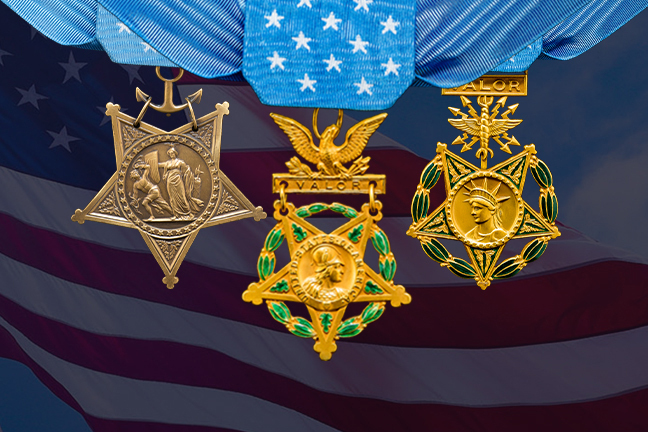
On March 2, 1971, then-Capt. Fritz received the nation's highest medal for valor from President Richard M. Nixon during a White House ceremony. Five other soldiers and one Marine also received the medal that day.

"It was really overwhelming," Fritz later said of the honor. "I feel very humble and proud to be a recipient."

By then, Fritz's family had expanded to include two sons, Christopher and Jeffrey. Fritz continued in the military and eventually returned to school to complete his degree in 1975, according to the University of Tampa.

Fritz retired as a lieutenant colonel in 1993 after nearly 28 years of service. Since then, he has taken part in several veteran-related events and attends speaking engagements with student groups to talk about the Medal of Honor and what it means to be a recipient.

"I try to tell people the important job that the military plays in keeping this country safe," he told the Veterans History Project.

Fritz's name is well-known among military circles. As recently as 2015, he was president of the Congressional Medal of Honor Society. In November 2024, the Peoria County, Illinois, Veterans Assistance Commission was officially named in his honor. Fritz Field at Fort Irwin, California, also bears his name.

This article is part of a weekly series called "Medal of Honor Monday," in which we highlight one of the more than 3,500 Medal of Honor recipients who have received the U.S. military's highest medal for valor. 

Right


ABOUT   NEWS   HELP CENTER   PRESS PRODUCTS
Facebook   X   Instagram   Youtube

Unsubscribe | Contact Us


This email was sent to stevenmagallanes520.nims@blogger.com using GovDelivery Communications Cloud on behalf of: U.S. Department of War
1400 Defense Pentagon Washington, DC 20301-1400

No comments:

Page List

Blog Archive

Search This Blog

UPDATED: Today in DOW: Jan. 12, 2026

Today in DOW: Jan. 12, 2026 Open Press Events Se...