| DAILY ISSUE Greenland Headlines Fade… but the Market Risk Doesn’t VIEW IN BROWSER Tom Yeung here with today’s Smart Money. The Northeast Greenland National Park is a stunning place. It is the world’s largest national park, covering 375,000 square miles of ancient rock formations, beautiful shorelines, and a mountain range with 126 named peaks. 
That said, few people actually get to see these natural wonders. The region has no roads, no permanent residents, and just 500 visitors a year – mostly on cruise ships passing through. The average annual temperature at Petermann Peak (in the eastern side of the park) is only 3 degrees Fahrenheit, making the mountain far more attractive in photos than in person. Miners face the same issue. One project on the northeast coast, a massive zinc deposit named Citronen Fjord, is only accessible by sea for around 12 weeks of the year when sea ice is at its thinnest. An optimistic feasibility study in 2021 pegged costs at around $0.76 per pound of zinc extracted – 50% higher than what it currently costs Teck Resources Ltd. (TECK) to dig up the metal in Alaska. Inland rare earth mining in Greenland will face even steeper challenges. So, are the president’s statements that Greenland “has to be acquired” an issue of securing resources? After all, perhaps the White House is thinking decades into the future, when easier-to-access mines and oil wells have run dry. Or is it a way to force other NATO countries to step up military spending? We’re not making any guesses, because only one person has that answer (and even he might not fully know). Earlier this week, the president announced a “framework” of a deal with NATO that offered few concrete details. However, there is one clear outcome from this global drama… The U.S. dollar will become less attractive to anyone abroad. And even as headline geopolitical tensions cool, the underlying pressures on the greenback remain. So, in today’s Smart Money, I’ll share how declining global confidence in the U.S. dollar – driven by geopolitical tensions and a slowing U.S. economy – could trigger further depreciation. We’ll look into what a dollar decline means for investors like us. Then, I’ll share how you can reduce dollar dependence in your portfolio in order to stay ahead of a potential continued slide. Let’s dive in… | Recommended Link | | | | What I’ve uncovered about the true impact of President Trump’s tariffs and DOGE initiative has left me deeply troubled. As someone who worked inside the Federal Reserve system and managed billions for America’s wealthiest families, I recognize the warning signs others miss. I urge you to see my urgent message immediately. The window for preparation isn’t just closing — it’s slamming shut. Watching this may be the most consequential few minutes you spend this year. |  | | Why the World Is Turning Away From the Dollar Tourists… exporters… traders… savers… If you’re living in Europe right now, there’s very little reason to buy U.S. dollars if you can avoid it. If a trade war between the U.S. and the European Union flares up again, no corporate treasury manager wants to have dollars that they no longer need. Central bankers feel the same pressures. The dollar’s share of central bank reserves around the world has fallen to just 40%, down from 60% a decade ago. On-again/off-again antagonism from the U.S. does not breed confidence in its assets. That’s creating a downward draft on American currency. If investors and central bankers expect the dollar to depreciate further, they will liquidate what dollars they can, creating a self-perpetuating cycle that sends values lower. Unlike stocks (where low prices make them more attractive), depreciating currencies are generally less attractive because falling exchange rates typically reflect weakening demand. One study found that investors can generate up to 10% annual returns through buying strengthening currencies and selling weakening ones. In addition, a falling dollar could force the U.S. Federal Reserve to cut rates by more than the one to two times (0.25% to 0.50%) that futures markets currently expect. Not only is the president expected to nominate a relatively dovish Federal Reserve chairman to replace Jerome Powell once his term ends in May, but Eric is also predicting that net employment growth turns negative as AI begins to cut demand for entry-level hiring, customer support staff, junior analysts, and back-office roles. 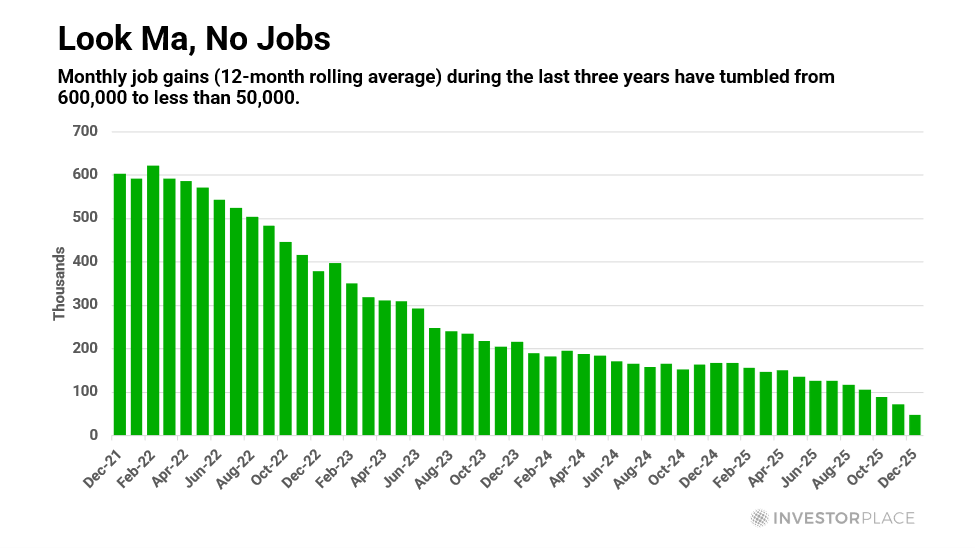
That would force the Fed to cut rates to cushion the fall, making the U.S. dollar even less attractive to foreign investors. The result is decidedly negative for the U.S. dollar, which already fell 10% last year. Here’s why it’s so important to prepare for a potential rout in the greenback… The Payoff of Dollar Weakness The effect of dollar depreciation quickly becomes clear when you compare U.S. stock performance against assets that do not depend on our domestic currency. Here’s how a selection of such assets performed in 2025 (when the dollar depreciated 10%) compared to the S&P 500… - S&P 500: +14.2%
- Japan – iShares MSCI Japan ETF (EWJ): +27.2%
- Copper: +33.5%
- International Stocks – iShares MSCI ACWI ex US ETF (ACWX): +34.5%
- Brazil – iShares MSCI Brazil ETF (EWZ): +42.9%
- Gold: +75.4%
We saw a similar effect in the 2000s, when the dollar index fell from 120 at the end of 2001 to just 74 at the end of 2007, a 38% decline. Over that period, the rise of dollar-protected assets was so startling that it created a “new normal” in ways to invest. This included the popularization of emerging market stocks, real estate, energy, and commodities. Few people then talked about the “depreciating dollar”… yet virtually everyone changed their investing behavior anyway. There’s a good chance that 2026 will see another year of dollar depreciation, driven by factors like Greenland and a slowing U.S. jobs market. So, even though tensions in the Arctic are cooling off, be sure to add to your dollar-independent positions as we head further into 2026. Eric recommends several of these positions in his Fry’s Investment Report service, including copper play Freeport-McMoRan Inc. ( FCX), which is currently up over 250% in the portfolio. He also recommends several foreign stocks that can deliver an extra layer of returns if/when the dollar depreciates. So, once again, be sure to diversify your holdings. You can learn the best way to do so by clicking here. Regards, Thomas Yeung, CFA Market Analyst, InvestorPlace P.S. One quick heads-up… My InvestorPlace colleague Luke Lango has a major free broadcast coming Tuesday, January 27. And it’s centered on what he believes could be the single biggest government-backed investing opportunity of 2026. So, be sure to watch your inbox that morning for a direct link. If you’ve ever wanted to get positioned before Wall Street catches on, you won’t want to miss this. | 







No comments:
Post a Comment