The transition to electric vehicle (EV) transportation has entered a critical phase, marked by a notable divergence between early-adopter enthusiasm and mass-market skepticism. While global EV sales reached an all-time high of 17.8 million units in 2024—representing 20% of the light-vehicle market—the outlook for 2025 and 2026 suggests a shift from explosive growth to a more moderate trajectory. | This period has been described as a significant "reality check" across several key Western markets, where the evaporation of consumer incentives, volatile residual values, and persistent infrastructure gaps have forced a realignment among manufacturers and policymakers alike. |
|
| | The Numbers | Global EV sales surpassed 17 million units in 2024, marking a 25% year-over-year increase. The 3.5 million additional vehicles sold in 2024 alone exceeded total global electric car sales in 2020, illustrating the scale the industry has now achieved. China has consolidated its position as the undisputed leader in the EV sector, accounting for more than 70% of global production and nearly two-thirds of global battery electric vehicle (BEV) sales. |  | Year-over-year global EV sales growth rate |
| Looking ahead, 2026 is expected to be different. Analysts anticipate global growth rates potentially falling to around 13%, bringing total EV sales to approximately 24 million units. |
|
| | | | | REVEALED FREE: Our Top 3 Stocks To Own In 2026 And Beyond | For 22 years, each and every stock Weiss Ratings rated a "Buy" has delivered an extraordinary average return of 303%—and that includes the losers. | Our sophisticated algorithms perform millions of real-time calculations daily, analyzing over 53,000 data points per stock. | The result? Unmatched accuracy, actionable insights, and unbiased ratings—insights previously accessible only to institutional investors. | Now this eerily accurate system is flashing green on a new set of stocks… | It's identified three under-the-radar picks that could thrive in 2026 and beyond… | And we're giving away their names and ticker symbols—FOR FREE. | Click here for the names of our three top stocks to own this year (no purchase necessary). |
| |
| | |
| The Subsidy Cliff | One of the primary catalysts behind the current market slowdown is the phasing out or reduction of purchase incentives in major economies. On September 30, 2025, the U.S. market experienced a sharp inflection point as federal EV tax credits expired. This led to two consecutive months of record EV sales in August and September 2025, as consumers rushed to take advantage of the $7,500 incentive. | What followed was a sharp contraction in the fourth quarter of 2025, with sales falling 49% compared to the third quarter. | EVs remain priced at a premium, with U.S. prices averaging 25–30% higher than comparable gasoline-powered vehicles. Analysts found that even with federal rebates, only 8 of the 41 EVs analyzed were priced lower than their gasoline equivalents. The expiration of incentives has forced manufacturers to rethink pricing strategies, with some offering private rebates of up to $30,000 to clear inventory—as seen with models such as the Acura ZDX. |
|
| | The Multi-Billion-Dollar Pivot | When consumers stopped rushing to buy electric vehicles, automakers that had aggressively bet on full electrification were hit hard. Ford is facing nearly $20 billion in losses tied to its EV strategy and has canceled multiple all-electric models. General Motors absorbed a $7.6 billion loss in 2025, although it continues to perform well in its traditional pickup truck segment. | These losses suggest that automakers misjudged consumer readiness. While manufacturers expected a rapid shift away from gasoline, many buyers were not prepared to make the transition. The consequences were significant: GM cut nearly 1,800 jobs and paused battery production at several facilities following the expiration of the $7,500 federal rebate. | Meanwhile, hybrid vehicles have emerged as the clear winners. Combining electric motors with internal combustion engines, hybrids allow automakers to meet emissions standards while maintaining consumer appeal. In 2025, the majority of buyers seeking lower-emission vehicles opted for hybrids rather than fully electric models. |
|
| | BYD vs. Tesla | The EV landscape has shifted dramatically as Tesla, long considered the market leader, has begun to lose ground. BYD, a Chinese automaker that previously focused on batteries and buses, overtook Tesla during multiple periods last year. The company produced 4.8 million vehicles in 2025 (up 4.6%), more than 2.2 million of which were fully electric. | 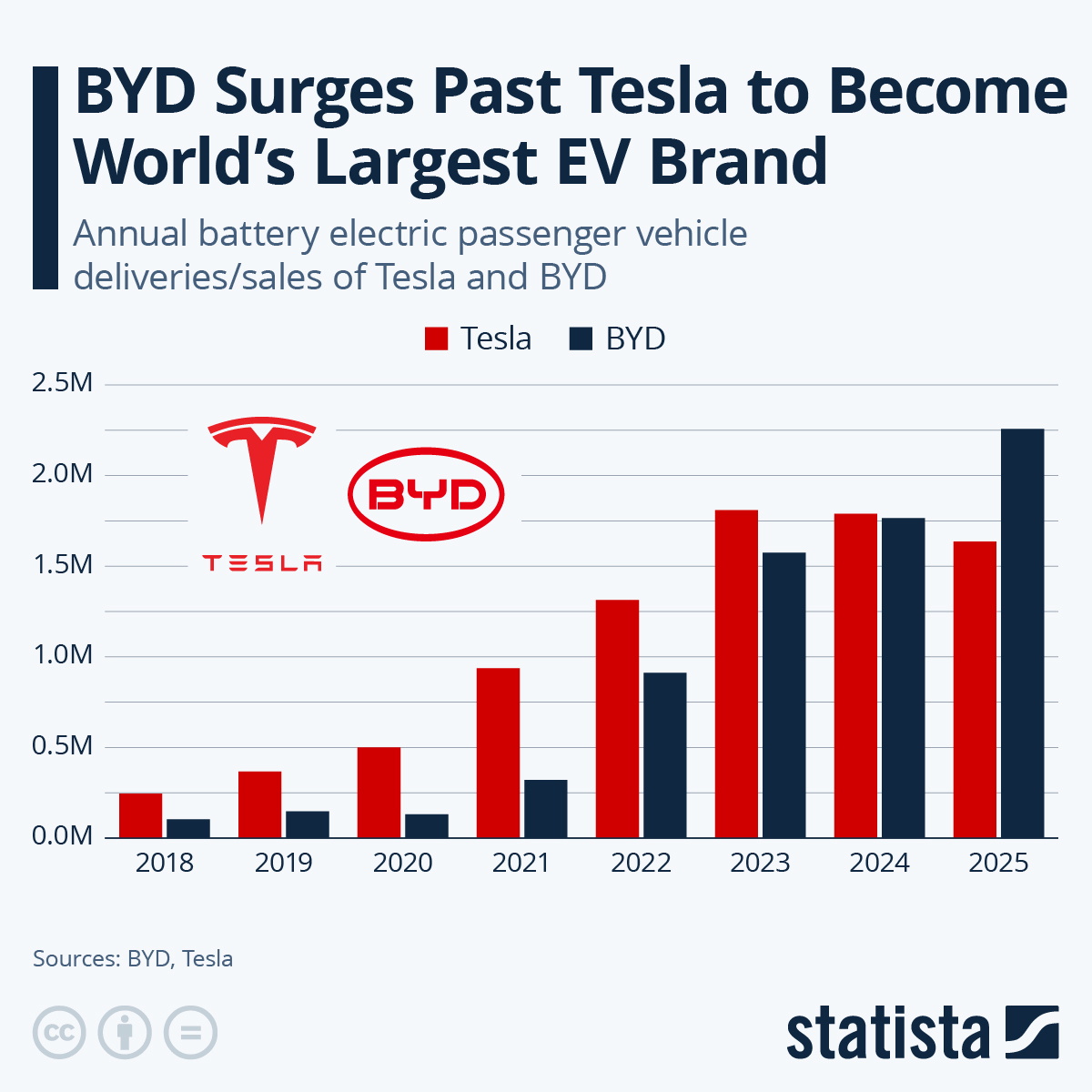 | According to Statista, BYD established clear dominance over Tesla in 2025 |
| Tesla's performance declined significantly, with deliveries falling 8.6% and production dropping 6.7% in 2025. Three main factors contributed to this decline: reduced government incentives, an aging vehicle lineup, and aggressive competition from Chinese manufacturers capable of producing vehicles at costs 30–40% lower. This cost advantage gives Chinese automakers a powerful competitive edge. |
|
| | Why Consumers Are Hesitating | Cost remains the primary barrier to EV adoption. Globally, 60% of consumers say EVs are too expensive, a perception unlikely to change until prices fall substantially. In the U.S., approximately 45% of demand is for vehicles priced below $45,000, yet only 14% of EV models currently meet this threshold. | Charging infrastructure is another major concern. A 2025 study revealed a significant disconnect between reported charger availability and real-world reliability. While operators claim stations are operational, drivers frequently encounter malfunctions, highlighting a gap between infrastructure claims and user experience. | Resale value is also an issue. EVs depreciate two to three times faster than gasoline vehicles, with new models losing 30–50% of their value within the first year. This rapid depreciation further increases the total cost of ownership. |
|
| | Grid Capacity Challenges | High concentrations of EV charging can strain local power grids. When many vehicles charge simultaneously, infrastructure issues can arise, including overloaded transformers, voltage instability, and frequency disruptions. | Researchers at the National Renewable Energy Laboratory (NREL) have identified a promising solution. Their case study found that installing battery energy storage systems at charging sites can reduce infrastructure costs by up to 65% and shorten project timelines by two to five years. This approach eliminates the need for costly new substations. |
|
| | What's Coming: 2026–2030 | Global EV sales are projected to continue growing, reaching approximately 39 million units by 2030, up from 17.6 million in 2024. China is expected to maintain its dominance, accounting for more than half of all global EV sales through the end of the decade. | A major milestone is anticipated in 2026, when oil demand for road transportation is forecast to peak. After years of rising EV adoption, petroleum consumption for vehicles is expected to begin a sustained decline—marking a fundamental shift in global energy usage patterns. |
|
| | The Bottom Line | The "wall" hit in 2025 represents a structural correction, highlighting the gap between policy ambition and consumer readiness. The withdrawal of subsidies exposed persistent cost disadvantages, while infrastructure limitations continue to deter mass adoption. Still, the industry remains resilient, with manufacturers becoming more financially disciplined and continuing to advance EV technology. | The path forward requires balance. Automakers are likely to scale production to align with current demand while continuing long-term investments in electrification. The growing emphasis on hybrids and extended-range electric vehicles (EREVs) is widely seen as a tactical bridge—not a retreat—from the broader transition to electric mobility. |
|
| | | | | Important disclosures: This newsletter is provided for informational purposes only and does not constitute investment advice. All investments involve risk, including possible loss of principal. Please consult with your financial advisor before making investment decisions. |
| |
| | |
|
|







No comments:
Post a Comment