The grid needs a massive rebuild.
- The world must add the equivalent of 330 Hoover Dams of power capacity. Every single year. Until 2040.
Transmission and distribution networks need $7.5 trillion in investment over that stretch. Underground cables drive most of the growth. Copper dominates there because it conducts better and resists corrosion.
Subsea cables connecting renewables across borders add another layer. Australia's AAPowerLink project alone needs an estimated 70,000 tonnes of copper.
EVs multiply the problem.
A battery electric car uses 2.9x more copper than a gas vehicle.
The metal runs through the wiring, battery packs, and motors. You can't build an EV without copper. Period.
- China became the first market where EVs outsold gas cars in 2025.
Chinese electrics are now grabbing share across Asia, Europe, and Latin America. Global EV copper demand will hit 6.3 million tonnes annually by 2040. Up from 2.6 million today.
And let’s not forget two billion air conditioners. That's how many get installed between now and 2040.
Each unit needs copper for heat exchangers and coils.
Lee Kuan Yew the former Prime Minister of Singapore, called air conditioning "the single most important invention of the twentieth century."
The developing world is about to find out why.
Defense spending adds fuel.
NATO members pledged to hit 5% of GDP on military budgets. Modern weapons, drones, and communications systems run on copper-intensive electronics. This demand is inelastic. National security doesn't negotiate on price.
Mines Can't Keep Pace
Grasberg's fatal incident shut their Block Cave zone until mid-2026. Chile crawled forward and Peru dealt with protests.
These aren't one-off problems. They're symptoms of something deeper.
- Ore grades keep falling. The easy deposits were mined decades ago. What's left sits deeper, in harder places, with less metal per tonne of rock.
- Costs climb every year. S&P Global's data shows it clearly.
- New mines take forever and the average project needs 17 years from discovery to first production. Permits. Reviews. Consultations. Legal fights.
Even if companies threw massive capital at the problem today, real supply wouldn't arrive until the early 2030s.
The project pipeline can't respond fast enough.
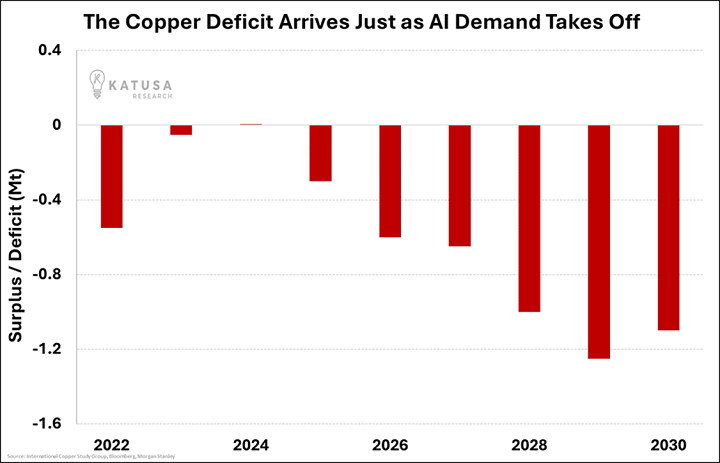
The deficit is widening fast.
UBS forecasts a 230,000 tonne shortfall in 2025. That rises to over 400,000 tonnes in 2026. Nearly four times larger than old estimates.
The chart below shows the gap widening.








No comments:
Post a Comment