Five years from now, some of the industries you take for granted today will not look anything like they do now. |
And no, it's not because of AI or automation, but because of something that happened this year. |
A moment that barely made a sound outside a single laboratory. |
Google's quantum processor (Willow) solved a problem every classical supercomputer on Earth is fundamentally incapable of solving at this speed in which it did it. It beat them by 13,000x. |
It was the first verifiable demonstration that quantum computing has entered practical use. |
A real scientific problem—molecular structure—computed with accuracy and speed that classical machines cannot replicate. |
Why does that matter to you? |
Because breakthroughs like this don't just stay in research papers. They spill into the world. They change costs, industries, supply chains, medicines, national security, and eventually, the trajectory of your investments. They redefine what's possible and what's obsolete. |
Quantum didn't "arrive" someday in the future. It arrived at Google earlier this year, in October. And now the world around you is moving into a new computational era whether anyone notices or not. |
The Line Quantum Crossed |
Quantum computing has been hyped for a decade, but until now, almost all of that hype lived in theory. The machines were unstable, noisy, and useful primarily for academic experiments. |
Then something changed. |
Engineers stabilized enough qubits long enough to run a complete algorithm that tackled real chemical behavior. This is a real calculation with practical value. |
Classical systems hit a hard boundary with these kinds of problems because the complexity explodes beyond what binary architecture can process. Quantum doesn't need to scale to that level of complexity because it already starts there. |
That was the breakthrough. Not the 13,000x number itself, but the fact that the machine completed a problem classical architectures cannot enter. A line was crossed, and the implications of that line are enormous. |
Quantum is no longer a scientific curiosity. It's a tool. |
Where Quantum Hits Your Life First |
Now comes the real question: what does this shift mean for your daily life and the world you rely on? |
Here's just a handful: |
Developing new drugs takes years because classical computers have to approximate chemical behavior. Quantum can model molecules with a level of precision that transforms discovery from guesswork into engineering. |
Energy depends on materials science—better batteries, better superconductors, better solar efficiency. Quantum simulation can accelerate that development dramatically. |
Logistics and supply chains run into optimization problems that grow exponentially with scale. Classical systems choke on that. Quantum doesn't. Routing, scheduling, and resource allocation all become solvable instead of merely "manageable." |
And then there's security. Our entire digital world runs on encryption built around the limits of classical computing. Quantum ignores those limits. It will force a complete rewrite of global cybersecurity. |
The breakthrough matters because it touches every pillar of modern life: healthcare, energy, infrastructure, communication, defense. All of them depend on computation, and quantum just expanded the boundaries of what computation can do. |
You're Already Living in the New Computational Era |
Technology rarely transforms the world overnight. It does it gradually, then all at once. Quantum is now in the "gradually" phase, and by the time it hits "all at once," it will already be too late to prepare. |
Quantum is a different category entirely from the classical computers we're used to. Quantum solves problems that classical systems were never built for. |
That's why governments are treating this as a geopolitical race. |
Eleven companies have been advanced into a DARPA benchmarking program designed to identify which architectures can scale. |
China is deploying more than $140 billion toward hard-tech leadership. Cloud providers are moving quantum into enterprise environments. |
Drug pipelines, energy grids, logistics networks, and encryption models will all be rebuilt around capabilities that didn't exist until this year. |
Quantum is becoming the baseline of a new technological era, and most people won't recognize the shift until it has already remade the landscape. |
You will. |
How To Spot the Companies That Survive a Technological Regime Change |
When a new computational class emerges, the value doesn't sit with the companies shouting the most dramatic announcements. And if AI has shown us, there will be plenty of those announcements! |
Quantum touches dozens of industries: materials, energy, healthcare, defense, optimization, manufacturing, and cybersecurity. Every one of them will reorganize around quantum capabilities. |
The winners will be determined by who can manufacture qubits at scale and who can turn quantum into hardware, infrastructure, and deployable systems. |
Here's a short list of companies to be on the lookout for: |
Trapped-ion platforms with high-fidelity qubits. Superconducting architectures industrialized by cloud providers. Silicon-spin and photonic designs that align with existing fabrication methods. Companies developing cryogenic controllers, quantum-safe encryption, quantum networking, and industrial integration. |
If you want broad exposure, quantum and high-performance computing ETFs exist today. Automation and advanced manufacturing indices capture many of the downstream beneficiaries. Publicly traded firms in optics, lithography, cryogenics, and precision engineering are also positioning themselves early. |
This is about understanding where the center of gravity is moving, and my team and I will be researching the areas we believe have the most upside potential. There's never been a better time to join Premium below. |
The Only Thing You Need to Remember About Quantum |
Strip away the complexity, and the entire story comes down to one truth: |
A new computational class entered the world this year, and the world has not priced it in. |
Industries will reorganize. Security assumptions will break. Entire cost structures will shift. But for now, the world is still behaving as if nothing has changed. |
That's the opportunity. |
You don't need every detail of quantum physics. |
You only need to understand that the rules underneath the global economy are being rewritten, and you're seeing the rewrite at the very beginning. |
Once you recognize that, you don't unsee it. |
How To Get Positioned |
| 🚀 Get Moonshot Alerts Instantly | Markets move in minutes. Your inbox can't keep up. | Join the Moonshot VIP Text Service and get real-time alerts, portfolio updates, and first-move intelligence directly to your phone. | Be first to know. Anywhere. | 👉 [Join the Text List →] | |
|
|
The question now is simple: how do you position yourself inside this shift instead of outside it? |
You don't need a perfect strategy. |
Focus on the companies solving manufacturability, which are the ones turning quantum from fragile prototypes into industrial systems. |
Track the architectures gaining real momentum. |
Watch the firms building quantum-safe encryption, quantum networking, and the support hardware required for scale. (SIDE NOTE: This is a big one. Pay close attention to quantum-safe encryption.) |
As I mentioned above, if you want a broad starting point, quantum and high-performance computing ETFs offer diversified exposure. Automation and advanced-manufacturing indices capture many of the second-order winners. And the companies working on cryogenics, lithography, precision optics, and fabrication tools will be essential long before the first fault-tolerant machine arrives. |
Here's your one action: |
Choose one way to get oriented. Build a watchlist, study a platform, explore a basket, or follow a subsection of the ecosystem. One deliberate step. |
Because when a new computational class arrives, the people who act early don't need to predict the future. |
They get to meet it on their terms. |
And as I mentioned above, my team and I will be diving deep into this space in 2026. When you decide to join Moonshot Minute Premium, you'll be the first to receive the research and the stock picks we find. |
Double D |
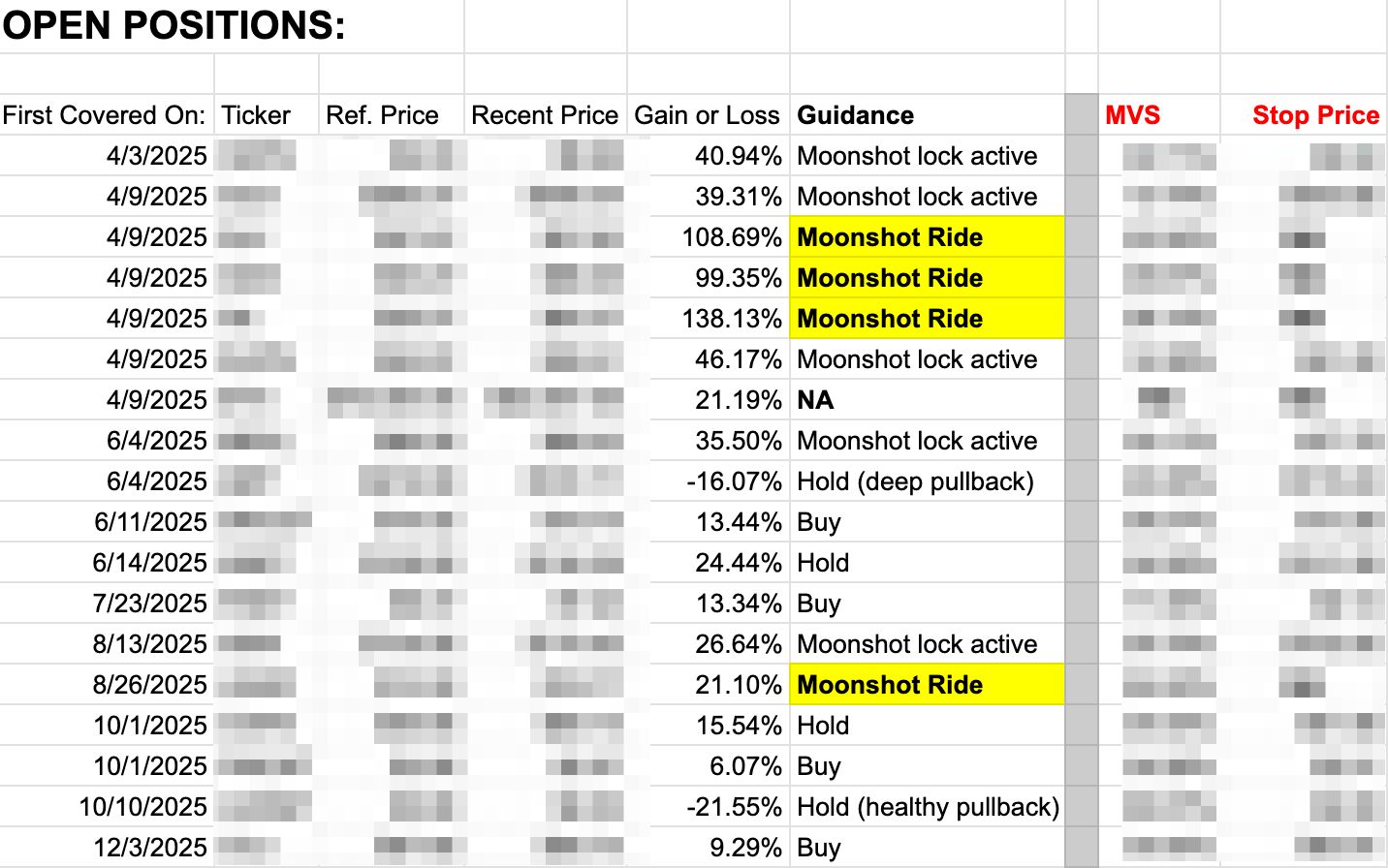
P.S. Here's our current open portfolio with the tickers blurred out since that's only for Premium. As you can see, of the 18 open positions, all but 2 are up, and many are still in buy range: (keep scrolling down for the Premium Section) |
|
🔓 Premium Content Begins Here 🔒 |
|
In today's Premium Section, you'll find a TWO brand new recommendations that hit our Moonshot Ride. What that means is they both have hit at least a 100% gain. Congratulations to all the Premium Members who got in. | I hope you've been paying attention because many of our picks are currently beating the S&P by up to 4-to-1 this year. | Most financial newsletters charge $500, $1,000, even $5,000 per year. Why? Because they know they can. | I don't. | I built my wealth the old-fashioned way, not by selling subscriptions. | That's why I priced this at $25/month, or $250/year. | Not because it's low quality, but because I don't need to charge the typical prices other newsletters charge. | One good trade, idea, or concept could pay for your next decade of subscriptions. | The question isn't 'Why is this so cheap?' The question is, 'Why would I charge more?' | 👉 Upgrade to Premium Now | P.S. If this newsletter were $1,000 per year, you'd have to think about it. | You'd weigh your options. You'd analyze the risk. | But it's $25 a month. | That's the price of a bad lunch decision. | And remember, just one good idea could pay for your subscription for a decade. | 👉 Upgrade to Premium Now | |
|
|






No comments:
Post a Comment