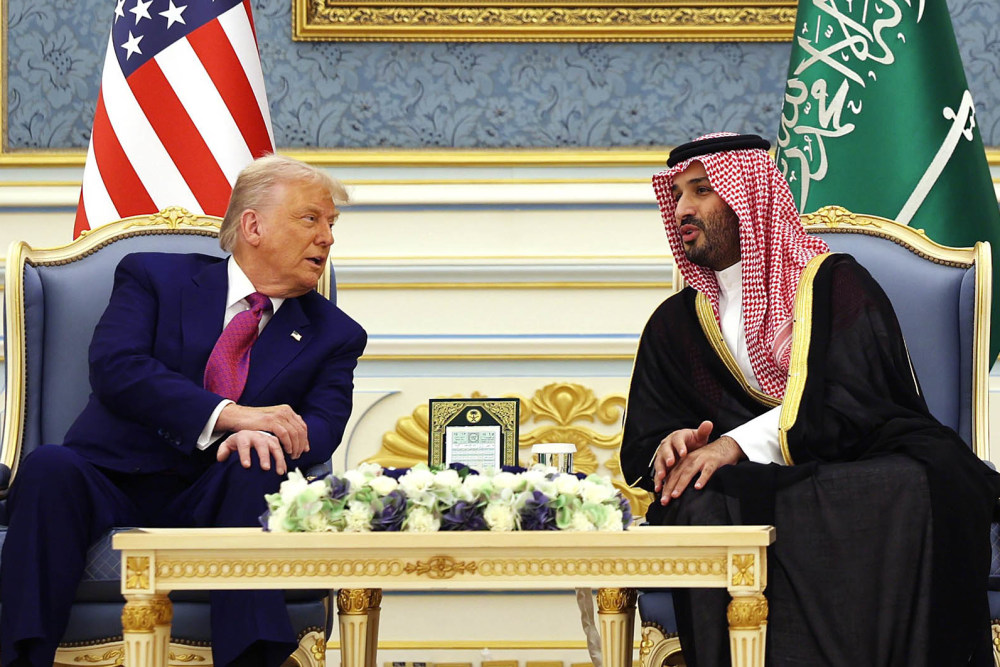
Crown Prince Mohammed bin Salman, Saudi Arabia's de facto leader, will be taking a huge step toward rejoining the international community when he meets President Donald Trump at the White House today.
Trump has defended the Saudi government despite the CIA concluding that the 40-year-old leader ordered the 2018 killing of journalist Jamal Khashoggi, who was a frequent critic of bin Salman. Khashoggi's murder made bin Salman an international pariah in the years that followed.
The prince said in 2019 that he took "full responsibility" for the killing since it happened on his watch, but denied ordering it. Saudi officials have said Khashoggi's killing was the work of a rogue Saudi security and intelligence officials.
Trump and bin Salman are expected to sign economic and defense agreements, a White House official told NBC News. Even before the Crown Prince had set foot in the U.S, Trump confirmed during an Oval Office event that he would be willing to sign off on the sale of F-35 stealth fighter jets to Saudi Arabia, a move that could potentially shift the balance of power in the Middle East.
The possibility of Saudi Arabia normalizing relations with Israel will be a key part of the talks, according to the White House official. The official said that Trump "hopes" the kingdom will soon join the Abraham Accords, the 2020 U.S.-brokered agreement that led to a number of regional countries establishing formal diplomatic ties with Israel, though analysts are skeptical about a breakthrough.
Trump has long touted his deal-making abilities and, according to a senior administration official, there are a number of deals expected to be announced, including a multi-billion-dollar Saudi investment in America's AI infrastructure, enhanced cooperation on civil nuclear energy and fulfillment of the Saudis' $600 billion investment pledge via dozens of targeted investments.
The deals come as critics have raised questions about Trump's affinity for mixing personal business and diplomacy. Trump's properties have for years hosted tournaments for the Saudi-backed LIV Golf.
"There's some massive ethical questions in here," said Andrew Leber, a nonresident fellow at the Carnegie Endowment for International Peace who has done extensive research on Saudi Arabia. "It's very obvious that all of the Gulf states have realized that the way you get to Trump is to find some way to enrich his family members, enrich his friends, promise to enrich them down the line."
Read the full story.







No comments:
Post a Comment