Hello, Thanks for signing up for MarketBeat Daily Ratings—we’re excited to have you on board. Every weekday, you’ll get a curated summary of new “Buy” and “Sell” ratings from Wall Street’s top-rated analysts, the latest stock news, and bonus investing content—all delivered straight to your inbox. You’re just two quick steps away from completing your sign-up: 1. Make sure our emails go to your inbox Gmail users:
Mobile: Tap the three dots (…) in the top right and select Move to Inbox or Move to Primary
Desktop: Click the folder icon at the top and select Move to Inbox or Primary Apple Mail users:
Tap our email address at the top (next to From: on mobile), then select Add to VIP Other providers:
Reply to this message and add newsletters@analystratings.net to your contacts 2. Confirm your subscription Click this link to confirm your subscription. This verifies your account and ensures you receive your newsletters without interruption instead of getting stuck in your spam filter. Confirm your subscription here. After you confirm, feel free to download our popular free report, "7 Stocks to Buy and Hold Forever" with this link. Thanks again for subscribing—we look forward to being part of your investing journey. 
Matthew Paulson
Founder and CEO, MarketBeat. P.S. If you didn’t mean to subscribe, no problem—you can unsubscribe here.
Just For You The BYD Opportunity: Tesla-Like Growth at a Fraction of the PriceWritten by Leo Miller. Published 9/26/2025. 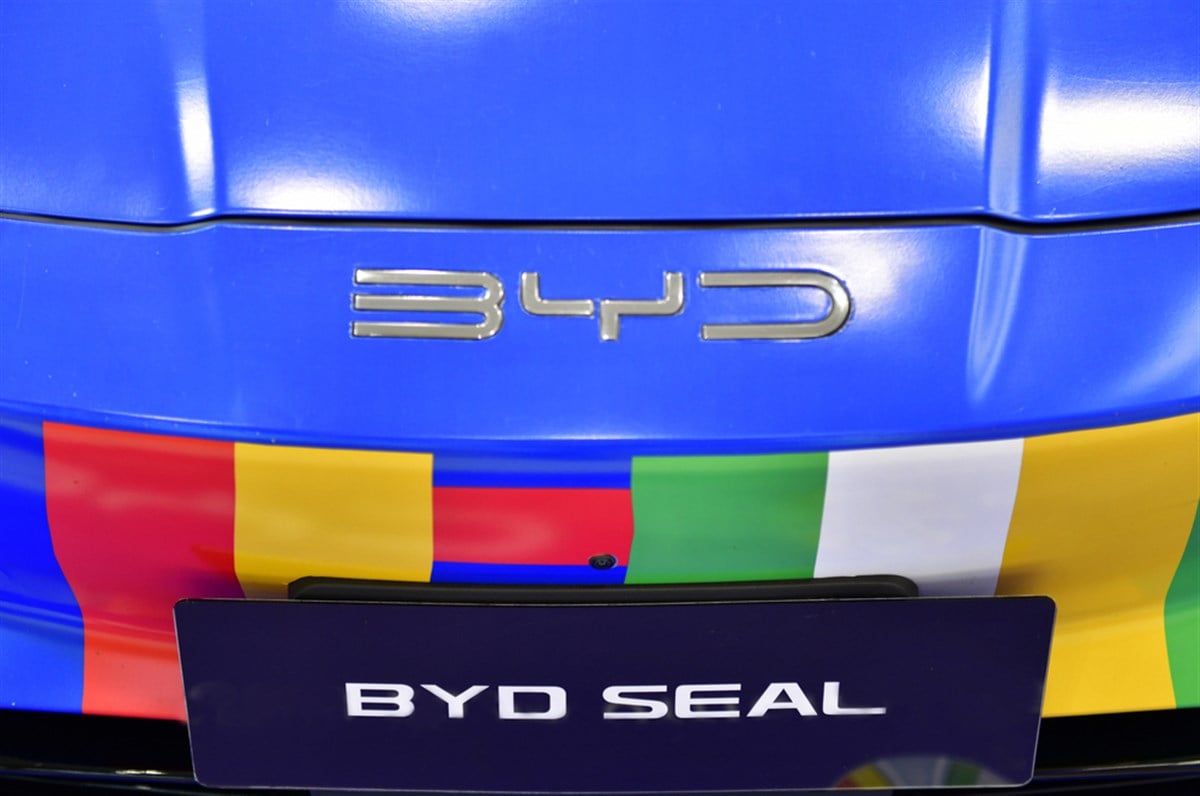
Key Points - BYD jockeys with Tesla for dominance in electric vehicles.
- However, BYD's market capitalization is only a fraction of Tesla's, despite similar fundamentals.
- This difference creates an interesting opportunity in BYD stock. However, Chinese government intervention is a palpable risk.
Within the electric vehicle (EV) space, two companies dominate: Elon Musk's Tesla (NASDAQ: TSLA) and Chinese automaker BYD (OTCMKTS: BYDDY). Tesla leads the U.S. EV market and ranks among the world's top ten most valuable stocks. Meanwhile, BYD has surged to become the world's third most valuable automaker and is one of just three EV companies—alongside Tesla and Li Auto (NASDAQ: LI)—to achieve profitability. Li Auto's $20 billion in last-twelve-months (LTM) revenue pales beside Tesla's $92 billion and BYD's $118 billion. This stark contrast sets Tesla and BYD in a league of their own. While headlines focus on Tesla's car sales, tech analyst Jeff Brown says the real story is Tesla's role in a $25 trillion AI revolution — one that Nvidia's CEO himself has called a "multi-trillion-dollar future industry" — and he's uncovered a little-known stock 168 times smaller than Nvidia that could be positioned to ride this breakthrough. Click here now to see the full report With that context in mind, the key question for investors is this: Is BYD a stock worth considering? Tesla vs. BYD: Similar Financials, Stark Valuation Gap One way to frame BYD's opportunity is to compare valuations relative to sales. Year-to-date, Tesla's market capitalization stands at roughly $1.4 trillion, while BYD's is about $130 billion—under one-tenth of Tesla's value. Yet BYD reported $118 billion in LTM sales, some $26 billion more than Tesla. Even isolating BYD's automotive division (excluding its mobile handset business), automotive revenue of around $96 billion still edges out Tesla's $92 billion. That revenue advantage, paired with a much smaller market cap, underscores a significant dislocation in valuation. Profitability metrics are similarly close. In H1 2025, BYD's automotive gross margin was about 20%, slightly above Tesla's 18% in the same period. BYD's EBITDA margin of roughly 15.5% compares closely to Tesla's adjusted 14.8%. On net income, BYD generated $1.4 billion in H1 2025 for a 4.2% margin, while Tesla posted about $1.6 billion for a 5.2% margin. Given these comparable fundamentals, Tesla's dramatically higher valuation is puzzling. A key factor that may temper BYD's appeal is the influence of the Chinese government on its domestic market. Chinese Government Influence Complicates BYD's Outlook China's generous EV subsidies have driven rapid expansion but also led to overcapacity and price wars. Efforts by regulators to rein in this competition helped push BYD's quarterly net profit down by 30%, even though H1 profit remains up 14% year-over-year. On the international front, BYD's revenue climbed 50% in H1 2025. In April, the company outpaced Tesla in European EV registrations for the first time, and it extended that lead further in July. Despite these gains, China still accounts for about 73% of BYD's automotive revenue. While the world's largest EV market offers scale, heavy government intervention adds uncertainty about future policy shifts. Buffett Sells BYD, But Valuation Remains Compelling Warren Buffett's Berkshire Hathaway recently fully divested its BYD stake. However, this was part of a gradual reduction that began in Q4 2022, following years of outsized gains rather than a sudden loss of confidence. On balance, BYD trades at a significant discount to Tesla despite similar sales and profit margins. Even a hypothetical doubling of BYD's share price would leave its market cap well below Tesla's. Coupled with robust international growth, this valuation gap presents an attractive risk-reward proposition for investors willing to navigate the complexities of the Chinese market.
| 





No comments:
Post a Comment