Tonight, my colleague Lisa Lerer — the inaugural writer of the On Politics newsletter when it started in 2018 — is back with an interview with departing Senator Laphonza Butler of California. We're also covering why her state is still finalizing its election results, nearly a month after Election Day. — Jess Bidgood
A Harris ally says Biden broke a promise
The latest
Laphonza Butler will have served as a senator from California for only about 15 months. But she has been a close ally of Vice President Kamala Harris for 15 years. This week, I spoke with Butler, whose long partnership with Harris — they first met when Butler was a Los Angeles-based union leader — gives her an intriguing perspective on why her party lost the presidential election and how it might rebuild. Harris hasn't said much publicly about why she lost. In Butler's view, some of the fault starts with President Biden, who she believes broke what was a clear campaign promise by running for re-election. But just blaming Biden isn't enough: Democrats, she says, must stop talking and start listening. Really listening. Butler was appointed by Gov. Gavin Newsom to fill the U.S. Senate seat left open by the death of Senator Dianne Feinstein in September 2023. Because she decided not to run for re-election, this week is her last in the body: On Monday, Representative Adam Schiff will be sworn in as the state's newest senator. This interview was edited for length and clarity. LL: Why do you think Harris lost? LB: The American people wanted a change. They wanted a candidate who they thought represented change. And I think that might simply be it. Should Biden not have run? President Biden said initially that he was going to be a transitional leader. I think that is the expectation that people had. So in that sense, I think that he probably would have been better to remain in that posture. We can't deny the success of his presidency. When history looks back, his presidency will be one of the most impactful in my lifetime, for sure. But I think once you sort of create an expectation with people, there is the need to hold to that. You were briefly president of EMILYs List, the organization that promotes Democratic female candidates. Do you still think a woman can win the presidency? I do. The vice president came within 1.5 percent — and that was with a 100-day campaign. If anything, this election proves that a Democratic woman can win. For a long time, many Democrats believed an Obama-era theory that, as the country became more diverse, their support among Black and brown voters would create a permanent majority for their party. Does this election put that idea to rest? No voter can be taken for granted. No matter what race they are. Every human being wants to know, how is government working for them? It's wonderful, the things that a Democratic Congress and a Democratic president were able to deliver in this Biden-Harris administration. But when people don't know and/or can't feel those impacts, and have been told for the last 10 years that they've got nothing else to lose, that idea sets in. Demographics is not destiny. We've got to continue to engage and do the work and offer something. Democrats are heading into a period of rebuilding. What should that look like? It's going to have to start with a whole lot of authentic listening outside of Washington, D.C. Not just going somewhere to give a speech, but really listening to people and the lives that they are trying to navigate, the issues that they're trying to manage and really trying to formulate a way of moving forward rooted in that. As opposed to focusing on the noise that can be the latest talking point. Is there something that surprised you about the workings of the Senate? Two things, really. One is the difference between the people that we see on TV and the kind of people that I get to build relationships with. I was surprised by the collegiality in that way. The other thing that surprised me was the pace. In one of my first meetings, Jeff Merkley took me to breakfast, and he said to me, "On average, it takes eight years to get legislation signed by the president." And I was blown away by that. Like, that explains a lot. You want to name any names of anyone who's much nicer than they seem on television? Josh Hawley. Lindsey Graham. Roger Wicker. Jim Moran. I would say Josh and Lindsey are probably the two from television that I have actually had a good time with. Do you have a sense of what you want to do next? I'm not sure. One of the reasons that I decided not to run for the Senate is the promise I made to my daughter to be present for her. She's 10. She's at a point where she needs me more, not less. No one prepares you for the tweens. They're a bit crazy. They are. They're crazy and cute and sweet and all over the place. My daughter's an only child, so I think often about the loneliness, the isolation. So I don't know yet what I want to do, but I want to make sure that whatever it is, it allows me to keep my promise to her.
It's still election night in CaliforniaWhether or not the election went as they'd hoped, most voters seem to agree on one thing. They're glad it's over. But there's a place where things are still dragging on: California. It's been nearly a month since Election Day on Nov. 5, but the last House race in the country, in a narrowly divided Central Valley congressional district, was called only yesterday. One state lawmaker, a Republican from the Inland Empire, was sworn into office this week even though her race had not actually been called. And county elections officials are only this week facing deadlines to complete their canvassing and certify the results in their jurisdictions. The slowness of California's vote-counting can be a perennial vexation for the rest of the country, particularly when the balance of power in the House is on the line. I called Natalie Adona, the clerk-recorder and registrar of voters in Nevada County, Calif., to ask why it all takes so darn long. California is a big state, obviously. It's a place where more than 80 percent of voters have cast their ballots by mail in recent years, with many dropping those ballots off on or just before Election Day. And it's a place where voters have a lot of time to fix problems on their mail ballots, which are usually related to their signatures. "Out of this list of three things," she said, "you can only pick two: fast, accurate or cheap." Counting ballots this year had been a little harrowing in Nevada County, a revolver-shaped county of about 100,000 people northeast of Sacramento. Adona said there was an "ink overspray" problem that created microscopic defects in some ballots' bar codes, slowing the counting operation. "The pressure and scrutiny is magnified in a presidential election," she said. "So once you get done it's like, 'Thank God, we can move on with our lives.'" Adona certified the election results in her county yesterday, after three final voters cured — or fixed — their ballots at the last minute. — Jess Bidgood Read past editions of the newsletter here. If you're enjoying what you're reading, please consider recommending it to others. They can sign up here. Have feedback? Ideas for coverage? We'd love to hear from you. Email us at onpolitics@nytimes.com.
|












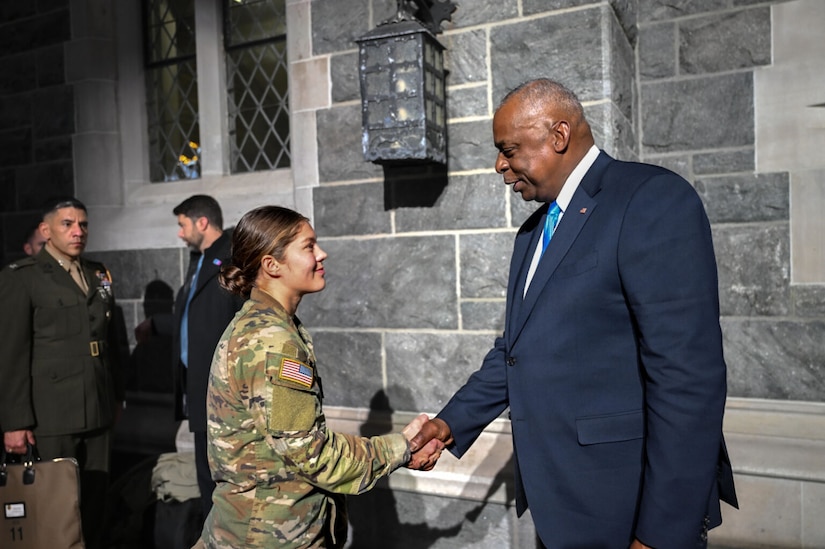
Secretary of Defense Lloyd J. Austin III today called on the next generation of Army officers to lead with courage and unwavering commitment to those women and men who have answered the call to serve.
In his address to U.S. Military Academy, West Point, New York, cadets on "Lessons in American Military Leadership," the secretary drew from his more than four decades of service in uniform underscoring that the people who fill the ranks of the nation's all-volunteer force will continue to remain as the core of the United States' warfighting prowess.
"Over the decades, our uniforms have changed. Our weapons have changed. Our tactics have changed. But one thing won't ever change. And that's the power and the capability of our people," Austin, a member of West Point's graduating class of 1975, said.
"You are the key to our strength and our warfighting power," he said. "And the security of the United States will always depend on two huge strategic assets: the talents and the commitment of the American people, and the values of our democracy."
He conveyed a series of lessons learned from his nearly six years of leading in combat as he drove home the imperative of leading the nation's warfighters with conviction.
"On the battlefield, troops will only go as far as they have to for poor leaders," Austin said. "But troops will go the distance for good leaders. And I have personally seen this over and over again.
"American soldiers will run through walls for leaders, and I mean that literally," he said. "They will do amazing things. They will show phenomenal courage. And it is more powerful than anything you'll see in any war movie."
That intrinsic bravery permeates throughout the ranks regardless of gender, Austin said. He noted, in particular, the courage he has witnessed among women serving under his command.
While serving as the assistant division commander for maneuver during the march on Baghdad in 2003, Austin said he decided to keep his command post close to the fight to see the situation and understand the battlefield conditions.
Shortly before crossing the line of departure, he gathered his team, including "several extraordinary women," serving in his command post to discuss what lay ahead.
"I told my team, 'Look, we need to win this fight, so I need to be at the front,' Austin recalled. "I know what will happen to me if I'm captured. I have no intention of being captured, and I will fight to the last bullet. But the risks are serious. I am enormously proud of all of you, and that won't ever change. So, if anyone here thinks that they can't deploy forward, I fully understand. And no one will ever think any less of you."
"The women and men of that incredible team looked at me, and finally one of the women popped up and said, 'Sir, what are you talking about,'" Austin said.
He said despite facing the same dangers as the men, and perhaps more, the women under his command "did not flinch."
"That is who the women of the United States military are," Austin said. "Everywhere I've gone on a battlefield, I've seen women fighting for America. They are incredibly capable, incredibly accomplished, and incredibly brave."
He also highlighted the bravery of another soldier who risked his life to save his save the members of his squad who had become pinned down by enemy fire in Iraq.
Austin, who was deployed to Iraq as a one-star general, spoke to the unit immediately after the firefight.
"Once we had evacuated the unit and they were out of harm's way, I approached that young soldier and I asked him, 'Hey, what made you do that? What made you run toward that automatic weapon?'" Austin said. "And I asked him, 'Weren't you afraid?'"
The soldier confirmed he was scared out of his mind, Austin said.
"And then he said, 'But I heard my squad leader's voice, and I knew that it was going to be OK,'" Austin said.
He said those "extraordinary patriots" that fill the ranks demand "extraordinary leadership." He called on the cadets to lead from the front and foster teamwork and confidence among the soldiers they lead.
"We are one team. One team," Austin said. And in today's complex national-security environment, we don't have one warrior to spare."
The secretary said the new generation of leaders are stepping up at a critical time for global security and for American ideals.
"We face serious security challenges today: coercion from the People's Republic of China; aggression from Putin's Russia; malice from North Korea, Iran, and transnational terrorist groups; and autocrats around the world who insist that democracy's day is done," Austin said.
He added that while the cadets will enter the Army under extraordinary circumstances, they are up to the task.
"Believe in yourselves," he said. "And trust in the training, the education, and the confidence that you've gained here as cadets."