P.S. 30% of revenue from AI in 2024. That percentage is about to explode. Get positioned now →
Advertising Disclosure: This email contains paid advertisements. This email is from our associates at Oxford Club.
Legal Entity Information: Investing Ideas Daily is owned and operated by Darwin Investor Network, a DBA of The Darwin Agency, Inc.
Disclaimer: Nothing in this email should be considered personalized financial advice. Always conduct your own due diligence when investing. We urge you to read our full disclaimer by clicking on the terms of use link below.
Unsubscribe: You are receiving this email as part of your complimentary subscription to the Investing Ideas Daily E-Letter. If you would like to unsubscribe, you can do so by clicking on the unsubscribe link below.
Department of War Forges Landmark Agreement to Triple PAC-3 Seeker Production, Bolstering the Arsenal of Freedom
April 1, 2026
The Department of War, in partnership with Boeing and Lockheed Martin, today announced a landmark framework agreement to triple the production capacity of seekers for the Patriot Advanced Capability-3 (PAC-3®) Missile Segment Enhancement (MSE). This agreement marks a pivotal step in executing President Trump and Secretary Hegseth's vision to build the Arsenal of Freedom, accelerate the delivery of critical capabilities to the warfighter, and create thousands of jobs across the defense industrial base.
This seven-year agreement with Boeing, a crucial supplier for the PAC-3 missile, directly supports the recently announced agreement with prime contractor Lockheed Martin to more than triple the output of the PAC-3 MSE all-up round. It is a direct application of the Department's new Acquisition Transformation Strategy, which prioritizes engaging directly with key suppliers at all levels of the industrial base.
This approach ensures the entire supply chain — not just the primes — have the stability and long-term demand signals necessary to invest in new facilities, tooling, and workforce development.
The seeker, produced by Boeing, provides active measurement data used for PAC-3 MSE missile guidance to ensure precision intercepts. By securing this long-term commitment for seeker production, the Department is mitigating chokepoints and ensuring the industrial base can scale to meet the operational demands of the warfighter.
"To build a true Arsenal of Freedom, we must strengthen every link in the chain," said Michael Duffey, Under Secretary of War for Acquisition and Sustainment. "This agreement with Boeing is a direct reflection that speed, volume, and a resilient supply chain are paramount. We are moving beyond the old model and forging direct partnerships with critical suppliers to ensure the entire defense industrial base is postured to expand production and deliver the decisive capabilities our warfighters need at speed and scale."
This initiative is a core component of the Department's broader effort to place the acquisition system on a "wartime footing," prioritizing speed and flexibility to outpace adversaries. By providing clear, stable, and long-term demand signals and fostering collaboration across the industrial base, the Department of War is ensuring that both the final products and the intricate supply networks that build them are robust, responsive, and ready.
This email was sent to stevenmagallanes520.nims@blogger.com using GovDelivery Communications Cloud on behalf of: U.S. Department of War 1400 Defense Pentagon Washington, DC 20301-1400
Today is your 2nd official day as a MarketBeat newsletter subscriber. Congratulations!
After using our website, tools, and newsletters for a few days, you will quickly realize we aren't like most financial websites. We aren't pushing specific stocks. We don't play the hype game, and we don't have some agenda we are trying to push on to individual investors.
Rather, our mission is to empower individual investors like you to make better trading decisions by providing best-in-class research tools, up-to-the-minute financial data and objective market research.
In this message, I wanted to highlight a few of the tools and resources that our subscribers love and have used for years so that you can make the best use of your free MarketBeat subscription.
My MarketBeat - This is our portfolio monitoring tool that allows you to see exactly what's happening with your stock portfolio right now. My MarketBeat will show you the latest news, price and performance, SEC filings, social sentiment, upcoming dates of interest, and much more for each of your stocks.
Daily Analyst Ratings - Wondering what Wall Street's top-rated research analysts are saying about your stocks? MarketBeat produces the most comprehensive list of analyst upgrades and downgrades available online and publishes it both on our websites and in our newsletter at no cost.
Stock Lists - Looking for stocks that in a specific sector or meet a specific theme? Whether you are looking for dividend-paying stocks or artificial intelligence companies, MarketBeat can help you find companies that meet your investing thesis. Just look in the "Stock Lists" menu on our website.
MarketBeat TV - Enjoy videos about the stock market? Subscribe to MarketBeat's YouTube channel where hosts Bridget Bennett, Chris Markoch, and Thomas Hughes discuss what's going on with stocks of interest right now.
MarketBeat All Access - This is our premium subscription offering that gives you everything MarketBeat has to offer. If you want to take your investing to the next level, MarketBeat All Access provides advanced research tools, proprietary reports, our premium daily newsletter, stock alerts, and much more.
Even amid market uncertainty, risk-tolerant investors may want to consider stocks trading under $20.
With broad market volatility persisting through the first quarter of 2026, finding growth outside of energy stocks can feel difficult. But history shows that buying quality companies at depressed prices often pays off. Right now, fear-driven selloffs in several sectors have created entry points investors may later applaud.
Each stock below has a consensus analyst rating of Moderate Buy or better and a consensus price target implying at least 30% upside over the next 12 months. All three are outside the energy sector, demonstrating that opportunities exist for investors willing to do their homework.
A Building Materials Play With Major Upside
QXO Inc. (NYSE: QXO) is the largest publicly traded distributor of roofing, waterproofing, and complementary building products in North America, and aims to become the tech-enabled leader in the roughly $800 billion building products distribution industry. That's a big vision, and analysts appear to believe in it.
QXO stock is down roughly 20% over the past month and about 1% year-to-date. The pullback followed a challenging earnings report that showed compressed margins and declining revenue, rattling investor confidence. Still, analysts remain bullish: the consensus price target of $32.27 sits about 70% above the stock's closing price on March 30.
The caveat: short interest is around 17%, which could create near-term pressure. QXO may reward patient investors who can ride that out.
Riding the AI Identity Security Wave
SailPoint (NASDAQ: SAIL) is a leader in unified identity security for enterprises, offering an AI-powered platform to address critical security challenges in modern IT environments. As AI agents and machine identities proliferate, that market is expanding rapidly.
SAIL stock is down roughly 7% over the last month and about 30% year-to-date, trading near $13—well below $20. The decline followed conservative forward guidance from management, despite annual recurring revenue surpassing $1 billion, up 28% year over year. Analysts expect a rebound: the consensus price target of $21.49 implies more than 60% upside.
What makes SailPoint particularly compelling is the institutional conviction behind it. Institutional investors have added about $1.45 billion in positions while selling roughly $239 million—a lopsided ratio that speaks to confidence. With short interest at only 3.4%, there's little headwind from bearish traders, making this one of the cleaner setups on the list.
A High-Risk, High-Reward Drone Defense Play
Ondas Holdings Inc. (NASDAQ: ONDS) provides autonomous systems and private wireless solutions to customers in rail, energy, public safety, critical infrastructure, and government markets. Its offerings include mission-critical networks, autonomous drones, counter-drone solutions, and AI capabilities—areas that can benefit from defense spending tailwinds.
Trading around $8 per share, ONDS is down roughly 15% over the last month and about 13% year-to-date. A fourth-quarter loss of $101 million dented investor sentiment, overshadowing some operational progress. Still, analysts maintain a Moderate Buy consensus with a $17.25 price target, implying more than 100% upside.
Institutional activity is notable: investors have added about $705.87 million while selling roughly $104.53 million. Total institutional ownership is near 37%, suggesting there is room for more institutional capital as the company matures.
The risk is real. Short interest near 34% is significant, so Ondas is best suited for investors with a high-risk tolerance and a long enough runway to let the story play out.
How to Balance Risk Across Speculative Stocks
None of these stocks is without risk, which is why they're trading at discounted levels. For investors willing to accept different degrees of risk, spreading exposure across all three can help balance the overall portfolio profile. SAIL's low short interest offsets some of the pressure from ONDS's crowded short trade, with QXO sitting between the two.
Remember that analyst consensus price targets are 12-month projections, not guarantees. They reflect informed expectations, not certainties. For risk-tolerant investors with a 12-month horizon, QXO, SAIL, and ONDS each combine analyst conviction with meaningful upside potential that's hard to ignore.
Thank you for subscribing to MarketBeat!
We empower investors to make better trading decisions by providing real-time financial information and best-in-class market research.
If you need help with your account, please feel free to email our South Dakota based support team at contact@marketbeat.com.
Face of Defense: A Guardian's Story, From Home to the Tactical Edge
April 1, 2026 | By John Ayre, Space Force Combat Forces Command
For Space Force Tech. Sgt. Alaowei W. Monibidor, the call to deploy came with little warning. In just two weeks, he would leave his home in Maryland for a six-month tour in a location he could not be told over the phone. Yet his answer was an immediate "yes." Mission Readiness Section Chief Fort Meade, Md. Detachment 2, 53rd Space Operations Squadron, Space Delta 8 This rapid departure and the high-stakes mission that followed underscore the agility and commitment of Space Force guardians and the families who support them.
As the mission readiness section chief for Detachment 2, 53rd Space Operations Squadron, Space Delta 8, Monibidor's job isn't on the front lines of satellite control.
"Instead, my primary focus is proactive: ensuring the squadron's personnel are flawlessly trained and ready to perform their mission 24/7," Monibidor explained.
His deployment, however, would take him to the tactical edge of space operations, supporting joint and coalition partners across Europe, Africa and the Middle East.
Family Resilience
The decision to volunteer for a short-notice deployment was made possible by a crucial conversation he and his wife had months earlier.
"I sought her support to accept a future deployment opportunity, and despite the anticipated challenges, she affirmed her understanding of the demands of my career path," Monibidor shared. "Her agreement was vital, as I believe deeply in confronting these professional realities as a united front."
That unity was tested by the pace of his departure.
"This deployment came with unexpected swiftness," Monibidor said. "This meant immediate cancellations and an abrupt shift for everyone. The final two weeks of preparation were mentally draining, but seeing my family's resilience made all the difference."
The untold story of military families, Monibidor emphasized, is one of unseen resilience. "The family runs its own parallel mission at home. Their strength is the silent, uncelebrated foundation of our own."
Critical Missions
His deployment saw him providing critical space electronic warfare command and control to four combatant commands, a role that shifted dramatically depending on the region. Supporting NATO and U.S. European Command involved collective defense within a formal alliance, a stark contrast to missions in the more volatile U.S. Central Command area of responsibility.
"It was a fundamental pivot from deterring a peer adversary to actively countering violent extremist organizations and state-sponsored aggression," Monibidor noted.
A highlight of his time supporting NATO-Eucom was his involvement in a special operations forces exercise, the highest level of strategic military simulation.
"My role was to provide the commanders and their staff with missile threat warning and options for space electronic warfare command and control against a near-peer adversary," Monibidor said.
This experience was vital in preparing for the real-world crises he would face in Centcom's area of operations. In the Middle East, his space electronic warfare command and control, or SEW C2, support was paramount.
"My support for SEW C2 revolved around maintaining friendly access to and superiority in the space domain, while denying or degrading the adversary's ability to use space for their operations," he explained.
This became critically important during Operation Midnight Hammer, a complex joint operation aimed at degrading Iran's nuclear enrichment capabilities.
"I coordinated directly with to synchronize the electronic warfare effects of 11 joint units, delivering unified effects for the commander of U.S. Central Command, directly enabling the strike force to penetrate Iran's contested airspace, precisely destroy its targets and return safely," Monibidor recounted. "Trust was built when leaders saw a consistent pattern. I learned to provide them with precisely what they needed to make difficult decisions."
A Strategic Expert
Guardians like Monibidor are a decisive advantage, said Space Force Master Sgt. Austin Adams, 53rd Space Operations Squadron training superintendent and Monibidor's frontline supervisor. "Space is a complex, technical domain, and he excels in the bridge between joint and coalition partners. His strategic thinking allows him to translate our sophisticated space capabilities into understandable, synchronized effects for our partners. Having an expert like him on the front lines is mission-essential for modern, integrated warfare."
Reflecting on his deployment, Monibidor is proud of both his professional and personal accomplishments. Professionally, he is proud of "using our capabilities to directly protect the U.S and its coalition partners from a real-world threat, proving our worth at the tactical edge."
But his greatest pride lies with his family. "Their stability at home is the bedrock that allows me to do my job, and that is my greatest accomplishment," he said.
This deployment served as a powerful reminder of the Space Force's integral role in modern warfare.
"This deployment proves that space isn't a separate or future battlefield; it's integral to every joint operation happening right now," Monibidor asserted.
Being a guardian at the tactical edge, Monibidor concluded, "means being the final link, translating our nation's strategic space assets into tangible combat effects for soldiers, pilots and sailors on the ground. At the edge, space superiority isn't a concept; it's the daily, hands-on mission of ensuring our joint and coalition partners can fight and win."
This email was sent to stevenmagallanes520.nims@blogger.com using GovDelivery Communications Cloud on behalf of: U.S. Department of War 1400 Defense Pentagon Washington, DC 20301-1400
Not long ago, I attended a private gathering of Wall Street elites.
Out of everyone in attendance — billionaires, hedge fund managers, titans of industry — I was one of two people selected to speak with Elon Musk personally.
Based on our conversation… I'm now making a bold prediction.
Elon Musk is going to announce the SpaceX IPO as early as April 20, 2026.
It will be the "millionaire-maker" event of the decade.
Bloomberg is already calling it "the biggest listing of ALL TIME." A $1.5 TRILLION valuation.
In preparation, I want to share with you an "access code" that lets anyone grab a pre-IPO stake in SpaceX.
This is your invitation to get in early on an opportunity to build generational wealth that can last a lifetime.
This ad is sent on behalf of The Oxford Club. 105 W Monument St, Baltimore, Maryland 21201.
Today's editorial pick for you
3 Small Biotech Stocks With the Potential for Big Oncology Payoffs
Posted On Mar 31, 2026 by Chris Markoch
Market uncertainty has a way of making speculative investments look especially risky. When broader indexes are choppy and macro headwinds dominate the headlines, parking money in clinical-stage biotech companies, stocks with no guaranteed revenue and multiyear timelines before a meaningful payoff, can feel borderline reckless.
Table of Contents
But long-term investors who have done this homework before know that volatility cuts both ways. Biotech stocks can crater on a single trial miss, yes. But they can also deliver extraordinary gains when science and timing align — and the best time to accumulate shares is often when nobody else wants to look.
This is precisely the moment to consider three small biotech stocks focused on oncology and related cell therapies: ImmunityBio (NASDAQ: IBRX), Crescent Biopharma (NASDAQ: CBIO), and Cabaletta Bio (NASDAQ: CABA). None of these are household names. All three trade at relatively low prices and carry real clinical risk. But each has a credible story backed by analyst support, and all three are operating in oncology, a therapeutic area where unmet medical need is so vast that it can support dozens of competing approaches simultaneously. There is no such thing as too many treatments in this market.
Owning these stocks is not a trade. It is a thesis, one that requires patience, a tolerance for volatility, and the discipline not to panic when the charts look ugly. For investors with a three-to-five-year horizon and a stomach for speculative risk, this dip may be worth acting on.
A Commercial-Stage Bladder Cancer Immunotherapy With Global Ambitions
ImmunityBio may be the most compelling of the three from a near-term commercial standpoint. The company has already crossed from development-stage to revenue-generating, with its lead product, Anktiva — an interleukin-15 receptor superagonist designed to activate natural killer cells and cytotoxic T cells — now approved in the U.S. for BCG-unresponsive non-muscle-invasive bladder cancer (NMIBC).
The commercial ramp has been striking. IBRX reported Anktiva’s net product revenue of approximately $113 million in 2025, representing around 700% year-over-year growth, with Q4 2025 revenue of $38.3 million. That kind of growth trajectory in a newly launched oncology drug attracts serious attention.
The regulatory footprint is expanding rapidly beyond U.S. borders. ANKTIVA holds full approvals for BCG-unresponsive NMIBC in the U.S., UK, and Saudi Arabia, with conditional EU authorization granted in early 2026, and is covered by more than 240 million U.S. lives. On the international front, ImmunityBio’s partner, Accord Healthcare, is set to deploy commercial teams across 31 European countries, with Germany as a priority early launch market.
The pipeline extends well beyond the bladder. IBRX is running trials across NSCLC, pancreatic cancer — where it holds RMAT designation — glioblastoma, NHL, and HPV-related tumors. The RMAT designation for pancreatic cancer is particularly notable; the FDA reserves it for regenerative therapies showing early evidence of meaningful patient benefit. Glioblastoma data readouts are among the catalysts analysts are watching most closely.
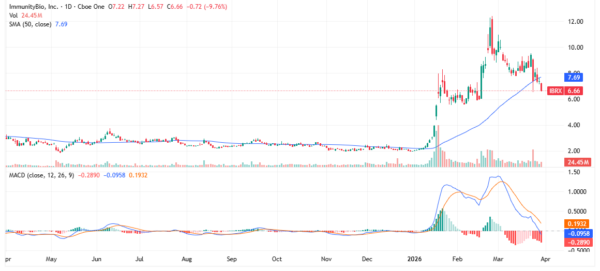
The chart tells a cautionary tale. After a spectacular run from roughly $2 to above $12 between late 2025 and early 2026, IBRX has pulled back significantly, closing around $6.66 on March 30 — below its 50-day moving average of $7.69, with a bearish MACD reading. For momentum traders, this is a red flag. For long-term patient investors, it may be an entry point worth considering, as the stock digests its gains while the underlying business continues to grow.
A Next-Generation Oncology Upstart Built for Speed
Crescent Biopharma is a younger and earlier-stage story, but one built with deliberate urgency. The company’s lead asset, CR-001, is a tetravalent PD-1 x VEGF bispecific antibody — a class of drug designed to simultaneously block two of the most validated targets in modern oncology. CR-001 was intentionally designed to replicate the cooperative pharmacology of ivonescimab, which demonstrated superior efficacy compared to market-leading pembrolizumab in a large Phase 3 trial in non-small cell lung cancer.
Crescent has moved quickly since its June 2025 merger with GlycoMimetics and a subsequent $185 million private placement. The ASCEND Phase 1/2 global clinical trial is now underway, evaluating CR-001 in advanced solid tumors, with three additional clinical trials across the portfolio expected to initiate in 2026, and the financing providing cash runway into 2028. ASCEND may enroll up to 290 patients across the U.S., Europe, and Asia Pacific, with proof-of-concept data targeted for Q1 2027.
Alongside CR-001, Crescent is advancing CR-002, a topoisomerase inhibitor antibody-drug conjugate targeting PD-L1, and CR-003, an ADC targeting integrin beta-6, which is overexpressed in many solid tumors but is minimally expressed in most normal tissues — a design intended to reduce systemic toxicity. The combination strategy — using CR-001 as an immuno-oncology backbone paired with ADCs — mirrors the direction the entire field is moving.
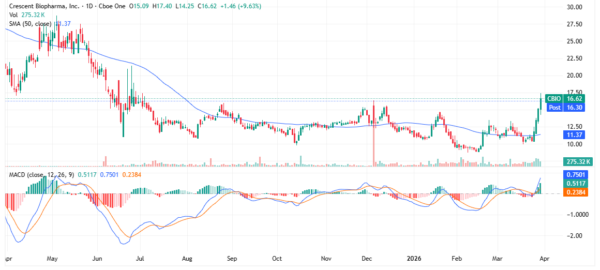
CBIO’s chart shows a dramatic surge on heavy volume in late March 2026, with the stock jumping from around $10 to close at $16.62 — well above its 50-day moving average of $11.37. The MACD is bullishly crossed and climbing. This kind of momentum can be fleeting for clinical-stage companies, and investors should be prepared for pullbacks as early trial data is awaited. But the combination of funded runway, credible science, and an experienced team makes CBIO worth watching for longer-term positioning.
CAR-T Technology Aimed at Diseases With No Good Options
Cabaletta Bio occupies a fascinating intersection between oncology and autoimmune disease. The company’s lead therapy, rese-cel (resecabtagene autoleucel), is a CAR-T cell therapy — a technology pioneered in cancer — now being applied to a set of devastating autoimmune conditions, including systemic lupus erythematosus, myositis, systemic sclerosis, and generalized myasthenia gravis. The idea is elegant: use the same machinery that wipes out cancer B cells to reset a malfunctioning immune system.
Morgan Stanley and Jefferies have each reiterated Buy ratings on the stock, forecasting upside potential of more than 350% from recent levels, with Jefferies highlighting the company’s use of automated manufacturing technology that could allow production for thousands of patients annually with limited capital investment.
The clinical story is gaining momentum. Cabaletta initiated an FDA-aligned registrational cohort for dermatomyositis and antisynthetase syndrome in December 2025, affecting approximately 70,000 U.S. patients, with a 16-week primary endpoint measuring improvement while off immunomodulators and on no or low-dose steroids. The company also gained clearance to use Cellares’ fully automated Cell Shuttle platform to manufacture rese-cel — described as a first for an autologous CAR-T program — with clinical manufacturing data expected in the first half of 2026.
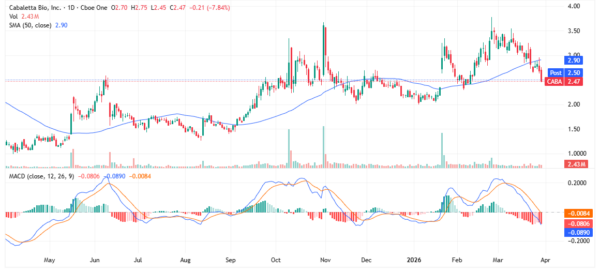
CABA’s chart shows the stock trading near $2.47, below its 50-day moving average of $2.90, with bearish MACD momentum after a period of strength in early 2026. The cash runway extends into the second half of 2026, meaning a fundraise may be on the horizon — a common risk for clinical-stage biotechs. Still, a BLA submission is being planned for 2027, and the technology has regulatory backing, including FDA Fast Track and RMAT designations.
Why These Biotech Stocks Aren’t for Everyone
Owning speculative biotech stocks requires a clear-eyed understanding of the risks. All three companies carry significant clinical uncertainty — a single failed trial can erase years of gains overnight. IBRX, despite its commercial traction, faces competition from Johnson & Johnson’s Inlexzo in bladder cancer and continues to burn cash at scale. CBIO is entirely pre-revenue, with proof-of-concept data not expected until 2027, and proof-of-concept is not the same as approval. CABA faces a capital crunch — its runway only extends into late 2026 — and while automated manufacturing is promising, the economics of autologous CAR-T therapies at scale remain unproven.
The broader macro environment is also unfavorable for speculative names, with interest rates keeping investors risk-averse. Any of these companies could also become acquisition targets, which sounds appealing until a deal closes at a disappointing premium.
Accumulate Slowly, Watch the Science
The case for these three biotech stocks is not about the next three months. It is about what the oncology and cell therapy landscape looks like in 2028 and 2030. ImmunityBio is building real revenue around a differentiated immunotherapy platform. Crescent Biopharma is executing a best-in-class strategy in one of the hottest areas of cancer drug development. Cabaletta Bio is applying breakthrough cell therapy science to diseases that desperately need better answers.
None of these investments is comfortable. But for investors with time on their side and a portfolio that can absorb some volatility, the current prices may look like gifts in hindsight — or lessons. Either way, the science is worth following.
This is a PAID ADVERTISEMENT provided to the subscribers of StockEarnings Free Newsletter. Although we have sent you this email, StockEarnings does not specifically endorse this product nor is it responsible for the content of this advertisement. Furthermore, we make no guarantee or warranty about what is advertised above.
Your privacy is very important to us, if you wish to be excluded from future notices, do not reply to this message. Instead, please click Unsubscribe.
StockEarnings, Inc 33 SE 4th St, Suite 100, Boca Raton, FL 33432 USA W: 877.6.STOCKS StockEarnings.com