Monday, January 5, 2026

Accurate Market Technician Issues Boldest Call Yet…

Dear Reader,

JC Parets has been called “The King of Technicals” by Fox Business…

The CMT Association called him “one of the most widely read market commentators of this generation.”

And Business Insider says JC is “Among the top financial people you have to follow…”

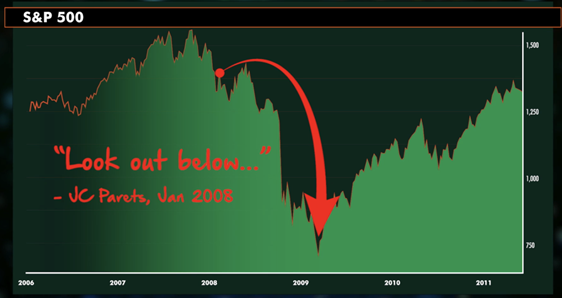
He’s predicted market moves with near-perfect precision — including the 2008 crash…

When he warned his clients just days before the market plummeted…
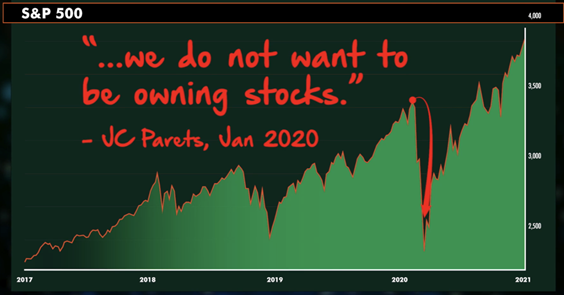
He also told his clients to get OUT of stocks in early 2020, at the exact peak before they dropped 30% in a matter of days...
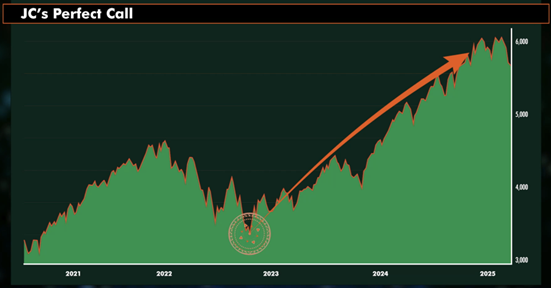
And he even called the exact bottom of the market on October 14th 2022, the precise moment before stocks rallied!
Now, he’s warning that a powerful market signal — one that’s preceded every crash for 50 years — will appear again on one specific date in the near future.

But before it does…

JC says we’re entering a short but explosive profit window — possibly the last of this decade.

Meaning RIGHT NOW could be your last chance to make money in stocks!

Click here to see his full prediction before this explosive profit window closes.

Regards,

Ryan McGrath
Co-Publisher, TrendLabs


Exclusive Article from MarketBeat Media

These 3 Consumer Stocks Just Authorized Big-Time Buyback Programs

Written by Leo Miller. Publication Date: 12/29/2025.

Grocery cart full of meal staples such as milk and bread, signifying the consumer staples sector.

Quick Look

  • Kroger, lululemon, and Etsy all expanded share repurchase authorizations large enough to meaningfully support per-share results.
  • Kroger holds one of the highest buyback yields in the S&P 500.
  • Etsy’s authorization is the biggest relative to company size, making execution on repurchases a key sentiment signal.

Three consumer stocks recently announced significant share-repurchase authorizations, and all three now have buyback capacity equal to 5% or more of their market capitalization.

That capacity can provide a tailwind to per-share metrics such as adjusted earnings per share (EPS) and signals management's confidence in each company's outlook. Here's a look at the repurchase news for Kroger (NYSE: KR), lululemon athletica (NASDAQ: LULU), and Etsy (NASDAQ: ETSY).

Kroger Boosts Capacity After Aggressive Buyback Spending in 2025

Executive Order 14330: Trump's Biggest Yet (Ad)

While President Trump's official salary is $400,000 per year... his tax returns reveal he's been collecting up to $250,000 PER MONTH from one hidden source. Until recently, most Americans couldn't touch the type of investment that makes up this investment. But thanks to Executive Order 14330, that just changed. If you love investing in disruptive new companies...

Discover how to invest in the fund Trump uses to collect this income >>tc pixel

On Dec. 23, the roughly $40 billion consumer staples company Kroger added $2 billion to its buyback authorization. That brings Kroger's total buyback capacity to about $2.9 billion — roughly 7.2% of its market capitalization.

Relative to its size, Kroger has been an aggressive repurchaser. The firm has spent more than $6 billion on buybacks over the last 12 months (LTM).

After issuing roughly $200 million of shares over the same period, the stock's LTM buyback yield is near 14.4% — among the top 10 LTM buyback yields in the S&P 500.

Buybacks are clearly a key capital-return tool for Kroger, but not the only one: the company also pays an indicated dividend yield of about 2.2%, roughly double the S&P 500's 1.1% average.

LULU's Tough 2025 Leads to New CEO, New Buybacks

lululemon has had a difficult 2025, with shares down about 45% year-to-date. Alongside its latest earnings release, the company made two major announcements on Dec. 11.

First, CEO Calvin McDonald will step down as the company searches for a permanent replacement to lead its next phase of growth.

Second, lululemon approved a $1 billion buyback program, bringing total buyback capacity to roughly $1.6 billion — about 6.5% of the stock's $24.5 billion market cap.

The authorization allows the company to continue repurchasing shares at a pace similar to recent periods; lululemon's LTM buyback spending is about $1.3 billion.

While a CEO transition and added buybacks could help restore investor confidence, markets will want more. With one quarter left in fiscal 2025, the company is forecasting annual sales growth of about 4% — down from roughly 10% last year and nearly 19% the year before. Ultimately, longer-term investor sentiment will hinge on product momentum, execution and the outcome of the CEO search.

After Post-Earnings Crash, ETSY Now Holds Massive Buyback Capacity

Etsy rallied nearly 43% in 2025 through Oct. 27, but its earnings report on Oct. 29 sent the shares down around 10%. Continued selling left Etsy up just 5.4% for the year.

Although Etsy beat estimates on sales and adjusted EPS, it described the outlook on consumer spending as "uncertain" and issued cautious guidance — a combination that pressured the stock.

The company also announced CEO Josh Silverman will step down, with Kruti Patel Goyal named as his successor, further weighing on investor sentiment.

On Dec. 18, Etsy announced a new $750 million share-repurchase authorization to help bolster confidence.

Combined with more than $200 million of remaining buyback capacity, the firm's total capacity now sits between about $950 million and $1 billion. At the midpoint, that amounts to roughly 17.7% of its $5.5 billion market capitalization. Etsy summed up its rationale plainly: "we see value in our shares."

Keep an Eye on ETSY's Repurchases

The takeaway across these three companies is simple: buyback capacity has increased enough to meaningfully affect share count and per-share metrics if managements follow through with repurchases.

Etsy's authorization is the most notable by percentage of market cap. Investors will be monitoring actual buyback activity over the coming quarters to judge whether management's commitment is substantive. Strong repurchase activity could help restore confidence after a volatile period for ETSY; weak activity could leave the market viewing the authorization as more signal than substance.


Thank you for subscribing to Insider Trades Daily, which covers the most recent insider buying and selling activity from Wall Street CEO's, CFO's, COO's and other insiders.
 
This email message is a paid advertisement sent on behalf of Trend Labs, a third-party advertiser of InsiderTrades.com and MarketBeat.
 
If you need help with your subscription, please contact our South Dakota based support team at contact@marketbeat.com.
 
If you no longer wish to receive email from InsiderTrades.com, you can unsubscribe.
 
Copyright 2006-2026 MarketBeat Media, LLC.
345 North Reid Place, Sixth Floor, Sioux Falls, S.D. 57103-7078. U.S.A..
 
Featured Link: 7 High-Yield Dividend Stocks You Need to See (Click to Opt-In)

Do NOT hang this on your front door

The new home design newsletter by Hometalk |
You can change your email settings or unsubscribe here.


Redesign - Your style, your story, your home.


redesignHaving trouble using Redesign? Let our support team know


You can change your email settings or unsubscribe here.

©2026 RedesignDaily.com, a Hometalk Inc. website, 30800 Telegraph Rd, Suite 1921 Bingham Farms, MI 48025  |  Privacy Policy
Ad Ad Ad Ad Ad Ad Ad Ad Ad Ad Ad Ad

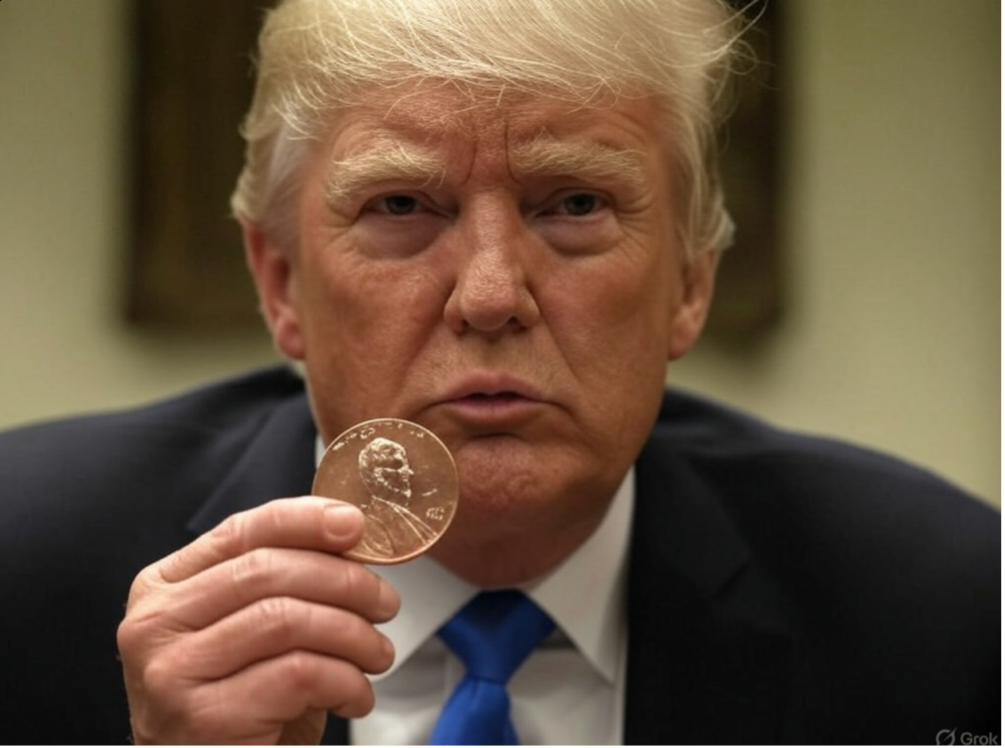
Terrifying reason Trump killed the U.S. penny?

Below is an important message from one of our highly valued sponsors. Please read it carefully as they have some special information to share with you.


Terrifying reason Trump killed the U.S. penny?
 
Dear Reader,
 
It’s perhaps the most common coin in existence.
 
I’m talking about the U.S. penny.
 
Recently, President Trump decided to kill the coin, for good reason. It now costs 4 cents to make a single penny. Which means the government is losing 3 cents on every one it mints.
 
 
But the truth behind Trump’s decision may be stranger than you think.
 
You see, the U.S. is facing a looming shortage that could cripple the economy with runaway inflation... and send one tiny clutch of investments soaring in the weeks ahead.
 
Former White House Advisor, Jim Rickards, just came forward to share this startling story.
 
Along with the reason why millionaires and billionaires are moving a vast sum of money into a little-understood corner of the stock market.
 
For his uncensored take on what’s really happening and what it could mean for your money, click here.
 
Regards,

Matt Insley
Publisher, Paradigm Press


This Month's Exclusive Article

2 Stocks to Avoid as Crypto Momentum Wanes

Submitted by Dan Schmidt. Article Published: 12/21/2025.

Bitcoin coin beside a falling red price chart, illustrating a crypto market slowdown and weakening investor sentiment in 2025.

Quick Look

  • Bitcoin and other major cryptocurrencies continue to lag other asset classes and indices as 2025 comes to a close.
  • Despite a friendly administration and investor risk-on behavior, cryptocurrency markets have been stymied by a lack of clear regulation from U.S. lawmakers.
  • Crypto-linked stocks like SharpLink Gaming and TeraWulf face valuation and debt risks as digital asset momentum fades.

The northeast United States wasn't the only region gripped by bitter cold this month—a new winter has also hit the cryptocurrency market. Weak sentiment and choppy trading threaten Bitcoin with its worst yearly performance since 2022. What has caused the cryptocurrency stall in 2025, and can investors hope for a brighter 2026?

Below, we'll explore why digital assets have floundered in 2025 and highlight two crypto-related companies you may want to avoid until Bitcoin reverses course.

Crypto Has Lagged Most Asset Classes in 2025

Trump just signed it (Ad)

A recent policy development is drawing attention from income-focused investors.

According to one analyst, changes behind the scenes may be opening the door to new cash-flow opportunities designed to generate regular monthly income — without requiring investors to pick individual stocks or predict market direction. In a new briefing, he explains how the structure works and what investors should understand before considering it.

Learn how these income opportunities are structuredtc pixel

Cryptocurrencies entered the year with plenty of momentum, but bullish sentiment faded as Bitcoin's price wobbled. After the 2024 U.S. presidential election, Bitcoin surged from roughly $70,000 to over $120,000 amid expectations of a friendlier regulatory environment and greater investor risk-taking. Investors did step up risk-taking—many dips were bought this year—but the anticipated regulatory clarity hasn't materialized in the way Bitcoin bulls hoped.

The Trump administration eased some rules on cryptocurrency trading, but the broader regulatory picture remains uncertain. The U.S. House of Representatives passed the Clarity Act last summer to establish clearer rules for digital assets. However, the bill is unlikely to pass the Senate as currently written, and revisions are being discussed across the aisle. The Senate hopes to vote in 2026, but no firm date is scheduled.

U.S. regulators are not the only concern for the crypto market. While the current administration is more open to digital assets than some predecessors, other jurisdictions have tightened rules. The European Union increased oversight of crypto exchanges and stablecoins, and some Asian regulators have taken stricter stances.

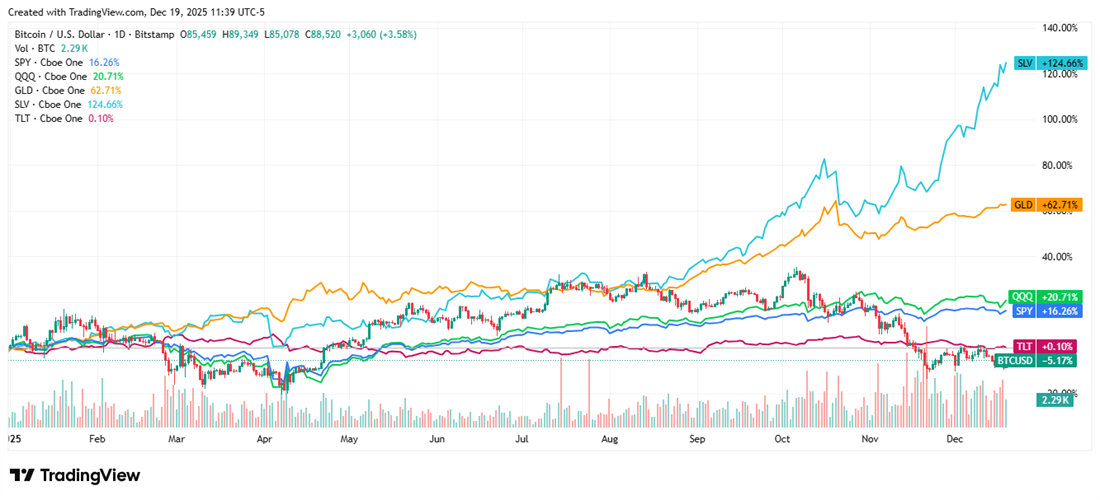
Stock chart displaying BTC falling, even as GLD, SLV, QQQ, and other assets surge.

China continues to ban cryptocurrency mining and trading outright. Cryptocurrency had been acting like a proxy for the broader tech sector, moving in lockstep with risk-on assets such as AI stocks. The chart above shows that correlation has broken down: Bitcoin is now underperforming not just stocks but also many commodities and bonds.

2 Stocks to Avoid as Crypto Markets Stall

With the launch of Bitcoin and Ethereum ETFs, investors have easier access to major cryptocurrencies through traditional channels. As a result, companies once prized for their crypto exposure—miners and treasury-heavy firms, for example—are losing investor interest.

Two stocks look especially vulnerable in the current environment. Both have substantial crypto exposure, and recent developments suggest rising financial and technical risks.

SharpLink Gaming: Overvaluation and Liquidity Concerns

SharpLink Gaming Inc. (NASDAQ: SBET) made headlines earlier this year when the small gaming and advertising company shifted fully into crypto.

After hiring Ethereum co-founder Joseph Lubin into the C-suite, SBET converted itself into an Ethereum treasury, purchasing more than $3 billion in ETH and staking nearly all of it to generate yield.

That staking income has produced record revenue, but the company's fortunes are now tightly linked to Ethereum's price.

If regulators determine that ETH is a security next year, SharpLink could be forced to register as an investment company, triggering substantial compliance costs and forcing a material change to its business model.

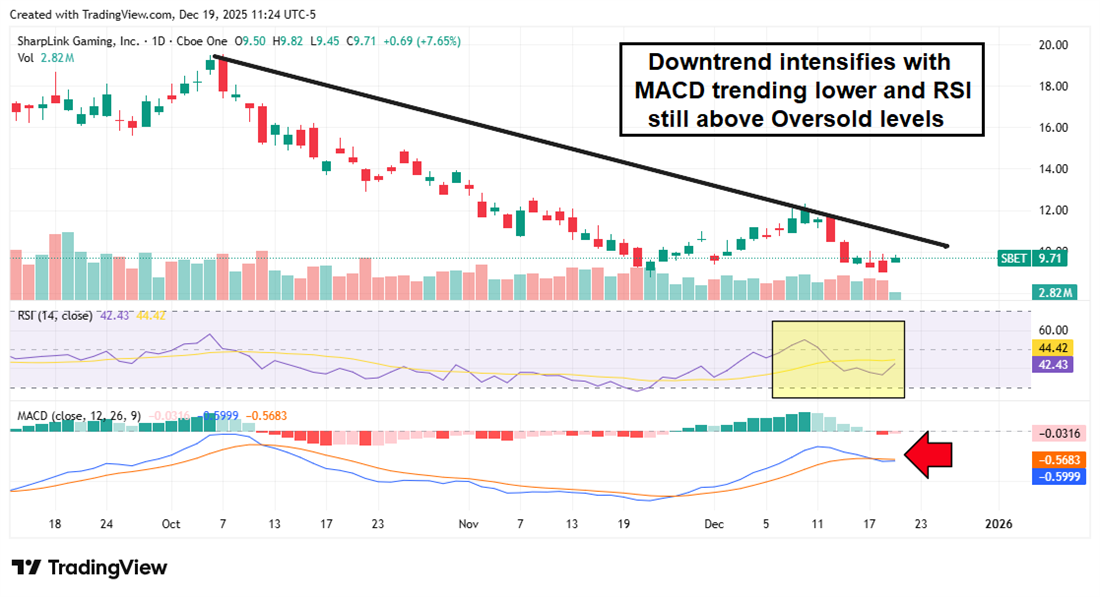
SBET stock chart displaying an intensifying downtrend.

The stock also faces valuation and technical headwinds. Despite record revenue, the company still lost $0.63 per share in Q3 2025, and the share price remains richly valued even after recent declines. The Moving Average Convergence Divergence (MACD) recently formed a bearish crossover, suggesting another wave of downward momentum could be imminent.

TeraWulf: Debt Risk Becoming Burdensome

TeraWulf Inc. (NASDAQ: WULF) aims to be a carbon-neutral cryptocurrency miner. One of its facilities, Project Nautilus, runs on hydroelectric power in New York.

TeraWulf also provides high-performance computing (HPC) solutions to data centers. That mix of revenue streams helped WULF shares rally roughly 120% year-to-date.

But much of the company's rapid expansion was debt-fueled, and those financing arrangements are starting to show strain.

TeraWulf reported about $5 billion in debt financing agreements in 2025, with total debt now exceeding $1.5 billion. Analysts warn this debt load could become unmanageable as costs rise and liabilities approach the value of the company's assets.

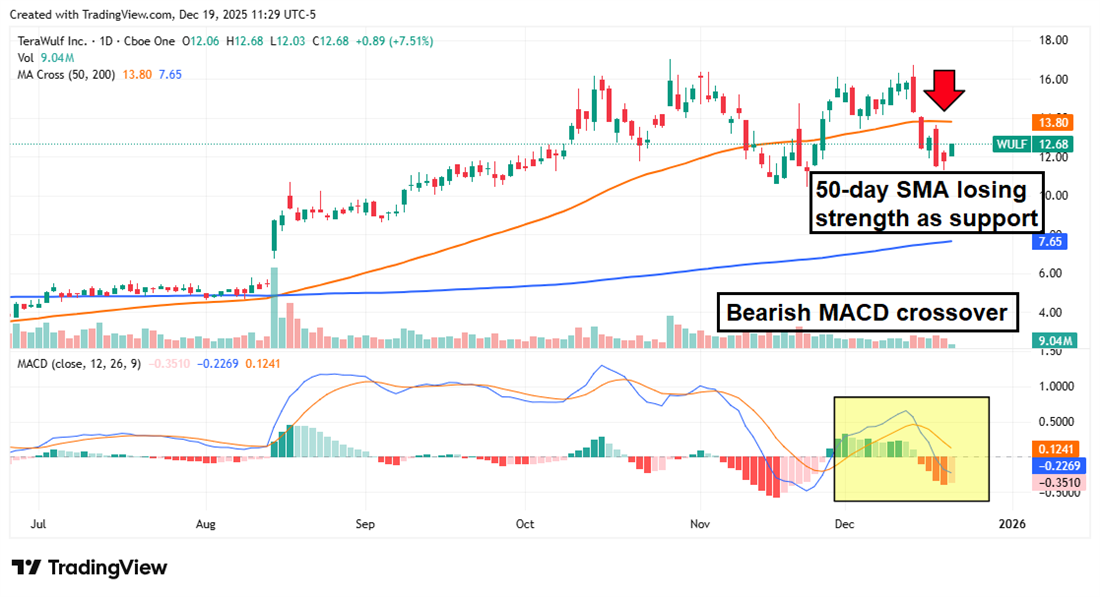
WULF stock chart displaying loss of support at the 50-day SMA, with the stock trending downward.

The fundamental weakness has spilled over into the market action: a key support level at the 50-day simple moving average (SMA) has been breached, and that breakdown was confirmed by a bearish MACD crossover. While TeraWulf is less reliant on Bitcoin for revenue than it once was, a further decline in BTC could exacerbate the company's debt challenges and place significant pressure on its balance sheet.


Thank you for subscribing to Insider Trades Daily, which covers the most recent insider buying and selling activity from Wall Street CEO's, CFO's, COO's and other insiders.
 
This email message is a paid sponsorship sent on behalf of Paradigm Press, a third-party advertiser of InsiderTrades.com and MarketBeat.
 
If you need help with your subscription, don't hesitate to contact our South Dakota based support team at contact@marketbeat.com.
 
If you no longer wish to receive email from InsiderTrades.com, you can unsubscribe.
 
© 2006-2026 MarketBeat Media, LLC. All rights reserved.
345 N Reid Place, Sixth Floor, Sioux Falls, SD 57103. United States of America..
 
Featured Link: 7 High-Yield Dividend Stocks You Need to See (Click to Opt-In)

Page List

Blog Archive

Search This Blog

GSA Auctions Industrial Machinery Update

You are subscribed to Industrial Machinery for GSA Auctions. This information has recently ...