Hello, Thanks for signing up for MarketBeat Daily Ratings—we’re excited to have you on board. Every weekday, you’ll get a curated summary of new “Buy” and “Sell” ratings from Wall Street’s top-rated analysts, the latest stock news, and bonus investing content—all delivered straight to your inbox. You’re just two quick steps away from completing your sign-up: 1. Make sure our emails go to your inboxGmail users:
Mobile: Tap the three dots (…) in the top right and select Move to Inbox or Move to Primary
Desktop: Click the folder icon at the top and select Move to Inbox or Primary Apple Mail users:
Tap our email address at the top (next to From: on mobile), then select Add to VIP Other providers:
Reply to this message and add newsletters@analystratings.net to your contacts 2. Confirm your subscriptionClick this link to confirm your subscription. This verifies your account and ensures you receive your newsletters without interruption instead of getting stuck in your spam filter. Confirm your subscription here. After you confirm, feel free to download our popular free report, "7 Stocks to Buy and Hold Forever" with this link. Thanks again for subscribing—we look forward to being part of your investing journey. 
Matthew Paulson
Founder and CEO, MarketBeat. P.S. If you didn’t mean to subscribe, no problem—you can unsubscribe here.
Further Reading from MarketBeat
A Diamond Quality Entry in DIA ETF, or Is It Time to Get Out?Author: Thomas Hughes. Article Posted: 4/17/2026. 
Key Points
- The Dow Jones-tracking ETF DIA is in rebound mode and on track to hit fresh highs before mid-year.
- Earnings, dividend growth, and share buybacks drive market appetite and are expected to increase this year.
- Institutions pose a risk, as they distributed shares in Q1, but may revert to buying, given the values and outlook.
- Special Report: The Biggest IPO Ever: Claim Your Stake Today
The Dow Jones Industrial Average ETF (NYSEARCA: DIA) bottomed in early April and is now rebounding, reclaiming ground faster than many investors expected. The key question is whether this market has the momentum to push to new highs, or whether the smarter move is to take profits and step aside before the advance fades.
Liberation Day wiped over $2 trillion from markets in a single day. Then a 90-day tariff pause added $4 trillion back to the S&P 500. Trump's AI initiatives sent Palantir up over 140%. Trader Larry Benedict says all of that was just the warm-up.
Benedict is calling what comes next 'Project 2026' - a move he believes could send billions, potentially trillions, into overlooked corners of the market. He's identified one ticker sitting at the center of it all, and he's revealing the name today at no cost. Larry is calling it "Project 2026."
Considering technicals, earnings, institutional activity, and analyst sentiment, the likeliest scenario is that new highs will be set—potentially before mid-year—followed by a sustainable rally. Dow Jones Rebounds: Vee-Bottom in Place for DIA ETFThe charts show a strong signal. The ETF's price action staged a pronounced vee-bottom in April, aligning with the prevailing uptrend. Momentum indicators are bullish: stochastic has already produced a buy signal and MACD is poised to follow. Volume is another important detail — it spiked during the late-2025 rally and again during the 2026 pullback — which indicates market support at critical levels and positions the index and ETF to hold current levels or advance further. 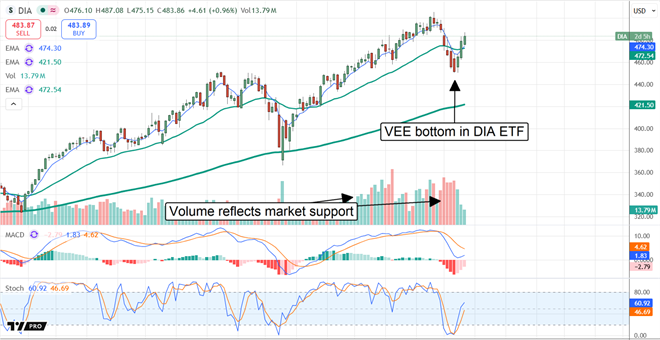
The main technical risk is that the ETF has not yet recorded a new high; resistance at prior peaks could cap gains. Still, other factors argue against a durable top. One item to watch is institutional behavior. While institutions were net sellers in Q1, that trend may have ended as valuations and expected capital returns improved. The likeliest outcome is institutions resuming accumulation in Q2, potentially accelerated by the Q1 earnings season. The index is expected to post earnings growth of 14% or more this year, and it is likely to outperform in Q1 while issuing favorable guidance. Analysts are optimistic entering the reporting season. The 25 ETF-specific ratings tracked by MarketBeat peg the DIA at a Moderate Buy, with meaningful upside potential over the next 12 months. That upside is underpinned by capital returns — dividends and share buybacks — both of which are expected to grow by year-end. As of mid-April, the DIA dividend yields roughly 1.4%, and dividends have grown at a mid-single-digit pace over the past few years. Forecasts for 2026 call for dividend growth to accelerate to over 6%, a trend likely to be confirmed by upcoming reports. Capital Return Underpins the DIA ETF Price OutlookEstimates for share buybacks vary, but most agree the buyback boom seen in 2025 will persist into 2026. The drivers are healthy margins and strong cash flow, led by sectors such as Financials and Technology. Highlights from 2025 buyback activity include a record trillion-dollar pace, the top 20 companies accounting for more than half of repurchases, and many firms cutting share counts by 4% or more. Lower share counts boost earnings per share and increase the value of each remaining share. The Technology sector, exemplified by names like NVIDIA (NASDAQ: NVDA), is expected to lead earnings growth — projected to rise by 40% or more, nearly double the next-highest sector, Materials. A caveat: Technology represents only about 17% of the Dow, so its outsized growth will have a smaller impact on the index than it would on ETFs such as the S&P 500 ETF (NYSEARCA: SPY) or the NASDAQ ETF (NASDAQ: QQQ). The flip side: Financials—the Dow's largest sector—is also expected to post robust results, as seen in reports from Goldman Sachs (NYSE: GS), JPMorgan Chase (NYSE: JPM), and other leading banks. Those stocks are trading near record highs and appear coiled for further gains, with analyst revisions pointing to fresh highs. The biggest macro risks for the Dow 30 and related ETFs are geopolitical conflicts and persistently high inflation, both of which can destroy demand. Slowing activity could still tip the U.S. or global economy into recession, but those risks seem to be receding. Labor-market data show activity softer than the post-COVID peaks yet remain consistent with a healthy economy. The most likely scenario is continued U.S. expansion, supported in part by deregulation and government spending. A key catalyst for Dow stocks is the AI boom. Its impact extends beyond Tech into Materials and other sectors via data-center demand and supply-chain reshoring. The narrative will move from pure infrastructure build-out toward the tangible business benefits as AI penetration deepens: significant cost savings, greater efficiencies, and revenue and earnings upside for companies that successfully deploy the technology. |






Tiada ulasan:
Catat Ulasan