|
Editor’s Note: Imagine typing an 18-digit code into your brokerage account and walking away one week later with a $6,316 payday. Sounds like a fantasy, but that’s one of the ways Larry Benedict made over $274 million in profits at his top 1% hedge fund. And now he’s sending the codes to ordinary people. They’ve seen an 84%-win rate so far, and the next code could go out any day now. For details and access, click here or read on… Dear Reader, “Punch this 18-digit code into an ordinary brokerage account,” Larry told me. At first, I was unsure… But Larry Benedict managed one of the top 100 hedge funds in the world, so I paid attention. “If my calculations are correct,” he continued, “this code could put over $6,000 in your account in seven days.” According to Larry, one simple trade could have returned over $6,316 in cold hard cash. And it took just seven days. It was that fast. So what exactly are these codes… and why are they potentially so profitable? He’s just released a new free video explainer. Just click here to see the whole thing (including all of the evidence). Regards, Lauren Wingfield Today’s editorial pick for you Boeing’s Q1 Report Confirm It Is Flying Again, But The Cash Register Hasn’tPosted On Apr 22, 2026 by Grayson Cavern 
There is a version of Boeing Co. (NYSE: BA) in this quarter that looks like a recovery story, and another that looks unfinished. Let’s start with what has clearly improved as revealed in Boeing’s Q1 2026 earnings release. Revenue rose to $22.2 billion, up 14% year over year, supported by higher aircraft deliveries and strength in defense and services. While earnings per share improved to -$0.11 from -$0.16. Table of ContentsAlthough anyone can easily see that Boeing is outperforming, this hasn’t translated into cash just yet. This is a friction in its book, and understanding it could change how you interpret the business beyond headlines. Pay Attention When The Deliveries Begin To RiseThe clearest signal of that stabilization is in production and deliveries, not earnings. You see, Boeing delivered exactly 143 aircraft in the quarter, up roughly 10% year over year, with 114 units from the 737 program alone, alongside contributions from the 787, 777, and 767 lines. This matters because delivery volume is the first real indicator that a manufacturing recovery is taking hold. Orders and backlog can sit on paper indefinitely, but deliveries require execution across supply chains, labor, and regulatory compliance. In that sense, Boeing has already crossed a meaningful threshold. Production is also stabilizing. The 737 program is now running at approximately 42 aircraft per month, with plans to move toward 47 per month later in the year, while the 787 program remains steady at around eight per month. These are not peak levels, but they are controlled and trending in the right direction. For a company that spent years struggling to produce consistently, that shift is not only incremental, but it is also, in fact, foundational. Backlog Looks Impressive – But It Isn’t SpecialIt would be easy to anchor the story on backlog, which now stands at approximately $695 billion, including more than 6,100 commercial aircraft. But backlog has never been Boeing’s problem. The company has operated with a massive order book for years, even while destroying value through execution failures and cash burn. I get it, backlog tells you demand exists. Where it fails is when it does not tell you whether that demand can be converted into profitable output. That distinction is critical because it leads directly to the part of the story that remains unresolved. The Financial Engine Is Still Lagging The Operational OneDespite higher deliveries and revenue growth, Boeing generated negative free cash flow of $1.5 billion in the quarter, even though operating cash flow improved significantly to -$179 million from -$1.6 billion a year ago. Operating margin also came in at approximately 2.0%, down from 2.4%. Total debt declined to approximately $47.2 billion from $54.1 billion. Sure enough, these are signs of financial progress and recovery. But this recovery breaks down because while the company is producing more aircraft, generating more revenue, and narrowing its losses, it is still not translating that activity into cash generation. Even within the segments, the imbalance is clear. Commercial Airplanes generated $9.2 billion in revenue but remained loss-making, with an operating loss of $563 million, while Global Services delivered $971 million in operating income on $5.4 billion of revenue, highlighting where the company is actually earning money today. In other words, Boeing can deliver planes again and improve its balance sheet, but it still cannot convert those deliveries into cash. A Facade For A Bullish SetupThe temptation is to view the cash flow deficit as a reason for caution, and in isolation, it is. But taken in context, it is better understood as a lagging indicator. Operational recovery always precedes financial recovery in manufacturing businesses of this scale. Deliveries improve first, revenue follows, margins expand next, and cash flow comes last. Boeing has already moved through the first two stages and is beginning to work through the third. That sequencing matters because once production stabilizes and margins begin to normalize, the conversion from revenue to cash does not improve gradually – it skyrockets. Fixed costs are absorbed, working capital normalizes, and incremental deliveries carry significantly higher contribution margins. What looks like a cash problem today is, in many ways, the final step in a process that is already well underway. The Market Is Waiting For The Last PieceThe market is already starting to price that transition, but it’s still holding back. After bottoming near $189, the stock has reclaimed the $208–$224 range, pushed through short-term resistance, and is now pressing toward $231, with the price reclaiming the 8-, 21-, and 50-day moving averages in sequence. That kind of structure reflects steady accumulation rather than speculative spikes. Volume has also expanded on up-moves, while pullbacks have come on lighter participation, a classic sign that institutions are building positions rather than distributing them. Momentum confirms it. RSI has moved to about 62, not overbought, but firmly in bullish territory, signaling controlled strength rather than exhaustion. 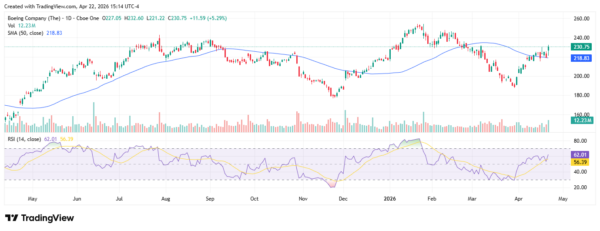
The chart is passing the same message along. That is, the market believes the operational recovery is real. What it is still waiting for and what it has not fully priced is the conversion of that recovery into consistent free cash flow. Bullish On The Aerospace CompanyAt this point, the investment case for Boeing is no longer about operational recovery, which is already visible in higher deliveries, stabilizing production, and revenue growth. The only question now is timing: how quickly that progress converts into margins and free cash flow. This is where I lean bullish because what the market is waiting for is not uncertainty but a mechanical outcome. If production holds and volumes scale, fixed costs get absorbed, and cash generation follows. That progression is not optional in a manufacturing recovery; it is inevitable. This is a PAID ADVERTISEMENT provided to the subscribers of StockEarnings Free Newsletter. Although we have sent you this email, StockEarnings does not specifically endorse this product nor is it responsible for the content of this advertisement. Furthermore, we make no guarantee or warranty about what is advertised above. Your privacy is very important to us, if you wish to be excluded from future notices, do not reply to this message. Instead, please click Unsubscribe. StockEarnings, Inc
|





Tiada ulasan:
Catat Ulasan